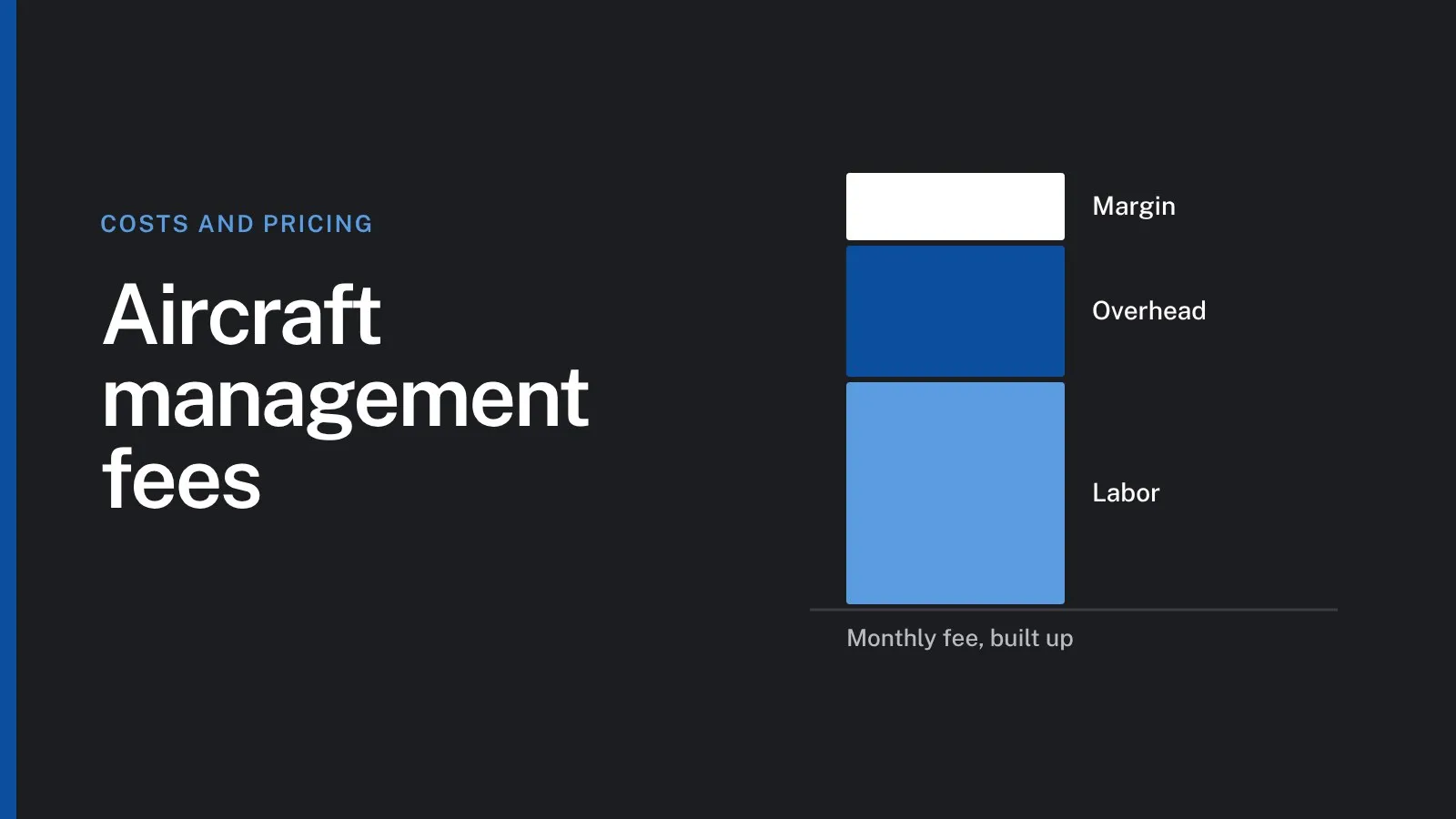
Aircraft management fees are built from up to four parts: a flat monthly fee for the manager’s own work, the aircraft’s costs passed through to the owner at cost or with a markup, markups on specific lines such as fuel and maintenance, and a share of charter revenue when the aircraft flies on the manager’s Part 135 certificate. What you should charge is the cost of the hours your people spend on that aircraft, plus the overhead those hours carry, plus your margin. The worked example below builds a monthly fee that way, then tests it against a markup structure and a charter share.
Every dollar figure in this article is illustrative and round on purpose so the arithmetic is easy to follow. None is market data, a going rate for any aircraft type, or a recommendation. We found no fee survey in a primary source we could read and link, so this article gives no market range. Build the fee from your own payroll and books.
How aircraft management fees are structured
A management agreement can pay the manager in four ways, and one agreement can combine two or three of them.
| Fee part | How it is set | What it pays for | Watch for |
|---|---|---|---|
| Flat monthly fee | A fixed amount per aircraft per month | The manager’s staff time, overhead and margin | Hours on the aircraft growing past what the fee assumed |
| Pass-through at cost | Third-party invoices and crew payroll billed to the owner at the amount paid | Nothing for the manager, it only moves the owner’s costs | Float: the manager pays vendors before the owner pays the manager |
| Markup on costs | A percentage added to some or all pass-through lines, or a per-gallon amount on fuel | The manager’s purchasing and oversight work, or simply margin | Income that follows the owner’s spending instead of the manager’s work |
| Charter revenue share | A percentage of charter revenue kept by the manager, the rest credited to the owner | Charter sales, quoting, and the cost of holding the Part 135 certificate | Owner availability, positioning cost, and who pays for wear |
Flat monthly management fee
A flat fee is one amount per aircraft per month, the same in a month with 50 flight hours and a month with 5. It pays for the people the owner does not see on any vendor invoice: the scheduler, the director of maintenance’s planning time, the accountant who reconciles the fuel cards, the chief pilot who hires and checks the crew.
The owner can budget a flat fee, and the manager can staff against it. Its weakness is that the workload is assumed when the fee is set. An owner who changes trips three times before each departure, or an older aircraft with frequent unscheduled maintenance, costs more hours than a flat fee quoted from a rate sheet expects.
Pass-through of costs, with or without markup
Pass-through costs are the aircraft’s own bills: crew salaries and benefits, fuel, maintenance, hangar, insurance, training, subscriptions, and each trip’s landing, handling and crew travel. In a pure pass-through, the owner pays what the vendor charged and sees the vendor’s invoice. The owner statement is where those invoices and any markup are shown to the owner.
A markup adds a percentage to those bills. Some agreements mark up everything, some mark up only named lines, and some mark up nothing. Whichever you choose, write it in the agreement line by line, because “cost” is a word an owner and a manager can read differently. If you buy fuel on a contract price and bill the owner the posted retail price, say so in the agreement.
Fuel and maintenance markups
Fuel and maintenance are the two lines a markup is most easily argued for, because they are large and the manager does real work on both: negotiating fuel prices, choosing the uplift airport, planning inspections, reviewing work orders and quotes.
A markup on these lines has a side effect the flat fee does not. The manager’s income rises when the owner spends more, and falls in a month when the aircraft sits. A percentage on maintenance pays the manager most in the month of a heavy inspection, which is not necessarily the month the manager worked hardest. The worked example below shows both effects with numbers.
Charter revenue share
When the owner allows charter, the aircraft flies those trips under the manager’s Part 135 certificate, and the certificate holder is “responsible for operational control” (14 CFR 135.77). The charter customer pays the manager, the manager keeps an agreed share, and the rest is credited to the owner against the month’s costs.
The share pays for work that sits outside ordinary management: selling and quoting trips, the crew training and checking that Part 135 requires, and the certificate itself. An owner’s net from charter is the owner’s share of revenue less the variable cost of the hours flown, so quote the owner both numbers. For how the revenue itself is divided, see charter revenue split between the aircraft owner and the operator. Our guide to pricing a charter trip covers the revenue side, and what an aircraft management agreement should include covers who holds operational control on which flights.
What the management fee has to cover
A fee set too low has often missed a category of work. List the work first, then price it.
| Work | Who does it | Inside the fee in this example | Billed separately in this example |
|---|---|---|---|
| Scheduling and trip support | Scheduler | Building trips, booking handlers, hotels and catering, changes | The handlers’, hotels’ and caterers’ invoices |
| Crew management | Chief pilot, office | Hiring, records, training bookings, standards | Salaries, benefits, training courses, contract pilots |
| Maintenance management | Director of maintenance | Tracking due items, planning, reviewing quotes and work orders | Shop labor, parts, engine programs |
| Accounting and reporting | Accountant | Paying vendors, coding expenses, the owner’s monthly invoice and backup | Outside audit or tax work |
| Insurance and documents | Office | Placing and renewing the policy, registration, databases | Premiums, subscription charges |
| Owner contact | Account manager | Calls, budget reviews, questions | Nothing |
The table shows one way to split the work, not a rule. What matters is that every row is either in your fee or named as a separate charge. One-time work belongs on the list too: taking on a new aircraft, a records review, or adding the aircraft to a Part 135 certificate can each be priced as a setup fee instead of being absorbed into the first year.
The fee also has to carry cash. If you pay the fuel and maintenance vendors and invoice the owner at month end, you are lending the owner a month of operating cost. An operating deposit held against the account, set in the agreement, removes that from your pricing.
How to calculate your own aircraft management fee
A fee built from cost has four steps: count the hours, price the hours, add overhead, add margin.
Step 1: count the labor hours per aircraft
Write down each role that touches the aircraft and its hours in an average month, from timesheets or a two-month sample. A low guess here puts the whole fee under cost.
Step 2: price each hour at its loaded cost
The loaded cost of an hour is the person’s wage plus payroll taxes and benefits, divided by the hours they actually work on managed aircraft.
Step 3: add overhead
Overhead is everything the company pays that no owner is billed for: the office, software, the company’s own insurance, the managers’ time that is not on any one aircraft, sales, and for a certificate holder the cost of the Part 135 manuals, training program and audits. Divide the year’s overhead by the year’s direct hours across all managed aircraft to get an overhead rate per direct hour.
Step 4: add margin and round
Cost divided by one minus the margin gives the fee. A 15 percent margin means dividing cost by 0.85.
Worked example: one managed turbojet
All figures are illustrative. A management company looks after six aircraft. For one of them, a turbojet flown about 300 hours a year, it counts these hours in an average month:
| Role | Hours per month | Loaded cost per hour | Arithmetic | Monthly cost |
|---|---|---|---|---|
| Scheduler | 20 | $55 | 20 × $55 | $1,100 |
| Director of maintenance | 18 | $85 | 18 × $85 | $1,530 |
| Accountant | 12 | $60 | 12 × $60 | $720 |
| Chief pilot (crew management) | 10 | $95 | 10 × $95 | $950 |
| Account manager | 6 | $100 | 6 × $100 | $600 |
| Direct labor | 66 | $4,900 |
The company’s overhead is $360,000 a year. Its staff log 4,800 direct hours a year across the six aircraft, so the overhead rate is $360,000 ÷ 4,800 = $75 per direct hour.
| Line | Arithmetic | Per month |
|---|---|---|
| Direct labor | from the table | $4,900 |
| Overhead | 66 hr × $75 | $4,950 |
| Cost to manage the aircraft | 4,900 + 4,950 | $9,850 |
| Fee at a 15% margin | $9,850 ÷ 0.85 = $11,588 | rounded to $11,600 |
| Margin | 11,600 − 9,850 | $1,750 |
The flat fee is $11,600 a month, or $139,200 a year. The margin of $1,750 is 15.1 percent of the fee.
The fee is only as good as the 66 hours. If the scheduler really spends 39 hours a month on this owner’s changes instead of 20, the cost rises by 19 × $55 = $1,045 of labor and 19 × $75 = $1,425 of overhead, a total of $2,470. Cost becomes $12,320, and the $11,600 fee now loses $720 a month. Measure the hours again after the first quarter, and give the agreement a way to reopen the fee.
The same aircraft priced with markups
Suppose the company instead quotes a lower base fee of $8,000 a month plus 10 percent on fuel and maintenance. The aircraft’s pass-through costs in an average month are:
| Pass-through line | Per month |
|---|---|
| Crew salaries and benefits | $38,000 |
| Fuel | $24,000 |
| Maintenance | $18,000 |
| Hangar | $7,000 |
| Insurance | $6,000 |
| Trip expenses | $5,000 |
| Training and subscriptions | $4,000 |
| Total | $102,000 |
The manager’s income now depends on the month:
| Month | Fuel | Maintenance | Markup (10% of both) | Base fee | Manager’s income | Against $9,850 cost |
|---|---|---|---|---|---|---|
| Average | $24,000 | $18,000 | $4,200 | $8,000 | $12,200 | $2,350 over |
| Slow | $8,000 | $6,000 | $1,400 | $8,000 | $9,400 | $450 short |
| Heavy inspection | $24,000 | $120,000 | $14,400 | $8,000 | $22,400 | $12,550 over |
In the slow month the office still schedules, tracks and reports, and the fee does not cover it. In the inspection month the owner pays $12,000 of markup on one work order. If you use markups, a cap per work order or a lower percentage on large maintenance events keeps the inspection month defensible.
Adding a charter revenue share
The owner allows 150 hours of charter a year. At an illustrative charter rate of $5,000 per flight hour, revenue is 150 × $5,000 = $750,000. The agreement splits it 85 percent to the owner and 15 percent to the manager.
| Line | Arithmetic | Per year |
|---|---|---|
| Charter revenue | 150 hr × $5,000 | $750,000 |
| Manager’s share | 15% × $750,000 | $112,500 |
| Owner’s share | 85% × $750,000 | $637,500 |
| Owner’s variable cost of those hours | 150 hr × $2,400 | $360,000 |
| Owner’s net from charter | 637,500 − 360,000 | $277,500 |
The 15 percent and the $2,400 variable rate are placeholders. The manager’s $112,500 has to pay for charter sales and the Part 135 work that the 66 management hours did not include, so cost that work the same way before agreeing to a split. The owner’s variable rate comes from the aircraft’s own fuel burn, reserves and engine programs. Our guide to what a trip really costs builds that rate.
Federal excise tax and how the fee is billed
A management fee used to raise a federal excise tax question: whether the owner’s payments to the manager were amounts paid for taxable air transportation. The Internal Revenue Code now answers it for owner flights. “No tax shall be imposed by this section or section 4271 on any amounts paid by an aircraft owner for aircraft management services related to” the “maintenance and support of the aircraft owner’s aircraft” or “flights on the aircraft owner’s aircraft” (26 U.S.C. 4261(e)(5)).
The Treasury regulation that implements it, 26 CFR 49.4261-10, bears directly on how you structure and document the fee:
- Billing method. “The method an aircraft management services provider bills, invoices, or otherwise charges an aircraft owner for aircraft management services, whether by specific itemization of costs, flat monthly or hourly fee, or otherwise, does not affect the application of section 4261(e)(5).” A flat fee and an itemized pass-through are treated alike.
- Part 91 or Part 135. Whether the owner’s flight operates under Part 91 or Part 135 “does not affect the application” of the exemption.
- Charter customers. “An amount paid by someone other than the aircraft owner for a for-hire flight on the aircraft owner’s aircraft is subject to the tax imposed by section 4261” unless another exemption applies. The charter revenue you share with the owner comes from taxable charter flights.
- Substitute aircraft. If the owner’s aircraft is unavailable and you fly the owner on another aircraft, the flight “is treated as a charter flight” provided to the owner. Show that charge as its own line on the invoice. The regulation’s own examples use a separate line item, and where the amount is not separable the tax base becomes the flight’s fair market value.
- Records. The owner and the manager “must maintain adequate records” showing that the amounts paid relate to the owner’s aircraft. The regulation lists the agreement, evidence of ownership, evidence that the payments came from the owner, and “the aircraft management services provider’s fee schedule.”
- Who pays. The exemption covers amounts paid by the aircraft owner. Amounts paid by a related party are not treated as paid by the owner “solely by virtue of the relationship.”
NBAA’s summary of the final rules notes that owner flights supported by a management company “are subject to the non-commercial fuel tax and exempt from the percentage tax” (NBAA, IRS final regulations on aircraft management services).
This is background, not tax advice. State sales and use tax on management fees and markups is a separate question that varies by state. Take both to a tax adviser who knows aircraft before you print a fee schedule.
Writing the fee into the management agreement
A fee the owner can check gets paid without argument. The fee schedule attached to the agreement should state:
- The flat fee, what work it includes, and the work that is billed separately.
- Each pass-through category and whether it is billed at cost or with a markup, with the percentage.
- How fuel is priced to the owner: the invoice price, a contract price, or a stated amount per gallon over cost.
- The labor rate and parts pricing when the manager’s own shop works on the aircraft.
- Setup fees, and any charge for adding the aircraft to the Part 135 certificate.
- The charter split, what revenue it applies to, and who pays for positioning legs and crew expenses on charter trips.
- The operating deposit, the invoice date and the payment terms.
- When the fee is reviewed: a yearly date, an index, or a change in the aircraft’s use.
Send the backup with every invoice: each vendor’s bill, each crew expense with its receipt, and the trip it belongs to.
Frequently asked questions
How much do aircraft management companies charge?
Each company sets its own fee from the parts described above: a flat monthly amount per aircraft, the aircraft’s costs passed through, markups, and a charter share. This article gives no market range because we found none in a primary source we could verify. Ask each manager for its fee schedule and compare what work is inside the flat fee.
Is it better to charge a flat fee or a markup on costs?
A flat fee follows the manager’s work, which is roughly the same each month. A markup follows the owner’s spending, so it underpays in a slow month and overpays in the month of a heavy inspection. In the illustrative example above, the same aircraft produced $9,400 in a slow month and $22,400 in an inspection month under a markup structure.
Do aircraft management fees include pilot salaries?
It depends on the agreement. In the structure described here, crew salaries and benefits are a cost of the aircraft passed through to the owner, and the management fee pays for hiring, supervising and scheduling the crew. The fee schedule should say which it is.
Is federal excise tax due on an aircraft management fee?
Amounts an aircraft owner pays for aircraft management services related to the owner’s own aircraft are exempt from the tax on air transportation under 26 U.S.C. 4261(e)(5). Amounts paid by charter customers are not covered by that exemption, and a flight for the owner on a substitute aircraft is treated as a charter. Confirm your own facts with a tax adviser.
How is charter revenue split between the owner and the manager?
The split is whatever the agreement says. The manager keeps a percentage for selling and operating the trips under its Part 135 certificate, and the owner is credited the rest. Compare the owner’s share with the variable cost of the hours flown, because that difference is what charter actually returns to the owner.
How often should a management fee be reviewed?
Review it whenever the hours behind it change: a new owner pattern, a second crew, an aircraft entering or leaving charter. A fixed yearly review date in the agreement gives both sides a set time to reopen it.
Managed aircraft costs in Avion Desk
Avion Desk keeps your vendors and their fuel prices and records the fuel uplift on each leg. Expenses are entered with their receipts and categories, and an expense counts only after it’s approved. Each trip shows what it cost, rolled up, and you can issue printable invoices, credit notes for corrections, and record payments against them. See the accounting features. To try it, start a free trial and enter one managed aircraft’s trips and expenses for last month, or request a demo.