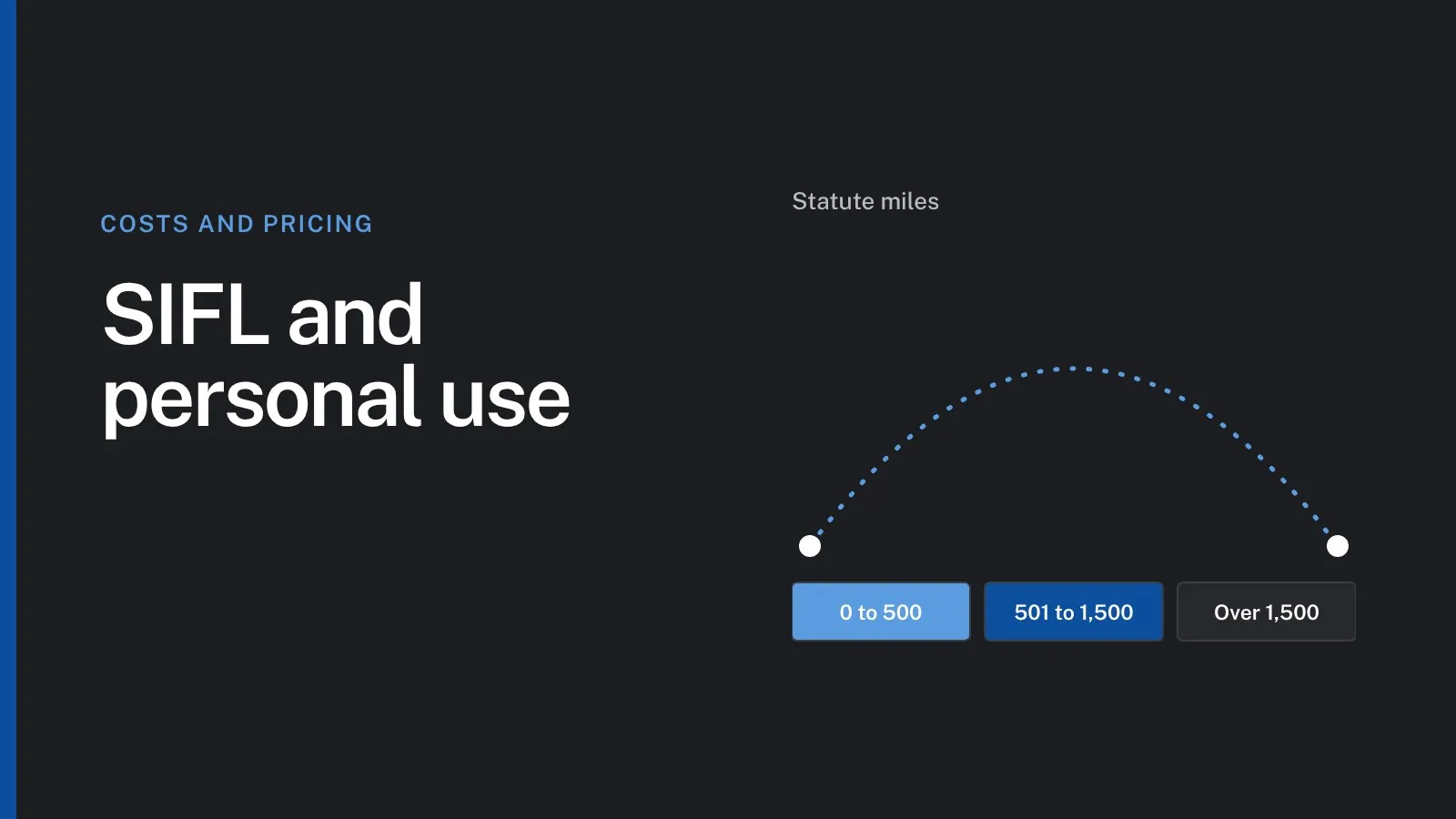
A SIFL calculation values one passenger’s personal flight on an employer’s aircraft so the amount can be added to an employee’s taxable income. For each flight, multiply the statute miles in each mileage band by that band’s Standard Industry Fare Level rate, multiply the total by the aircraft multiple for the aircraft’s maximum certified takeoff weight and the employee’s status (control or non-control), then add the terminal charge. The formula is in 26 CFR 1.61-21(g), the rates change every six months, and the result is worked out for each passenger on each flight.
The worked example below uses illustrative rates, round on purpose so the arithmetic is easy to follow. They are not the rates for any period. This article explains the regulation in plain language and is not tax advice. The employer’s tax adviser decides who is a control employee, which flights are personal and how the income is reported.
Personal flights on a company aircraft as a taxable fringe benefit
The income tax regulations list “a flight on an employer-provided aircraft” among their examples of fringe benefits that count as compensation (26 CFR 1.61-21(a)(1)). IRS Publication 15-B says: “Personal use of a company aircraft by an employee or their guests is a taxable fringe benefit” (Publication 15-B, 2026).
The employee carries the income, including the income for a guest. In Publication 15-B’s words, “the employee, not the guest, will be subject to a non-cash fringe benefit inclusion, typically as part of their W-2 wages for an employee.”
Publication 15-B names two ways to value the flight. Fair charter value, the general rule in 1.61-21(b)(6), is what it would cost “to charter the same or a comparable piloted aircraft for that period for the same or a comparable flight.” SIFL is the special rule in paragraph (g). A personal flight “may not be valued by reference to the cost of commercial airfare,” so the choice is one of those two. NBAA calls SIFL the “more common method” (NBAA, valuing non-business flights).
Paragraph (g) covers “all employer-provided aircraft, including helicopters,” and “international as well as domestic flights.”
The SIFL formula in 26 CFR 1.61-21(g)
Under paragraph (g)(5), the value of a flight is found “by multiplying the SIFL cents-per-mile rates applicable for the period during which the flight was taken by the appropriate aircraft multiple” and “then adding the applicable terminal charge.” For one passenger on one flight:
Value = (aircraft multiple × mileage charge) + terminal charge
The three mileage rates (miles 0 to 500, 501 to 1,500 and over 1,500) and the terminal charge come from the Department of Transportation. The multiple comes from the table in (g)(7) and is fixed. The multiple applies to the mileage charge only, and the terminal charge is added afterward at full value. The bands are cumulative, so a 2,000-mile flight uses 500 miles at the first rate, 1,000 at the second and 500 at the third.
The regulation’s own example uses the rates for the first half of 1989: $0.1449, $0.1105 and $0.1062 per mile and a terminal charge of $26.48. A non-control employee flies 2,000 miles on an aircraft with a maximum certified takeoff weight of 26,000 pounds, and the regulation gives the value as $100.36. The mileage charge is 72.45 + 110.50 + 53.10 = $236.05, the 31.3 percent multiple brings it to $73.88, and the terminal charge brings it to $100.36. A spreadsheet that reproduces that figure from those inputs has the structure right.
Where the current SIFL rates are published
Under (g)(5), the rates and the terminal charge “are calculated by the Department of Transportation and are revised semi-annually,” for January through June and July through December. NBAA republishes each period’s figures, with earlier periods, on its SIFL rates page.
NBAA’s notice for July 1 to December 31, 2026 lists $0.3225 per mile for 0 to 500 miles, $0.2459 for 501 to 1,500 miles, $0.2364 over 1,500 miles and a terminal charge of $58.95 (NBAA, SIFL rates for the second half of 2026). We read those figures on NBAA’s page and did not check them against the Department of Transportation’s own release, so confirm them before you use them.
A trip that leaves on June 29 and returns on July 2 has flights in two rate periods.
Aircraft multiples by maximum certified takeoff weight
The multiples in 1.61-21(g)(7) “are based on the maximum certified takeoff weight of the aircraft.”
| Maximum certified takeoff weight | Control employee | Non-control employee |
|---|---|---|
| 6,000 lbs. or less | 62.5% | 15.6% |
| 6,001 to 10,000 lbs. | 125% | 23.4% |
| 10,001 to 25,000 lbs. | 300% | 31.3% |
| 25,001 lbs. or more | 400% | 31.3% |
The weight belongs on the aircraft’s record once and doesn’t change by trip. Paragraph (g)(13) takes the SIFL rule away for a control employee’s flight when the employer claimed a weight class that later proves wrong, so check the documents of an aircraft near a boundary.
Control employees
For a non-government employer, paragraph (g)(8) defines a control employee as any employee who is:
- a board-appointed or shareholder-appointed, confirmed or elected officer, limited to the lesser of one percent of all employees or ten employees
- among the top one percent most highly paid employees, to a maximum of 50
- an owner of “a five-percent or greater equity, capital, or profits interest in the employer”
- a director of the employer
An employee who is a family member of a control employee is also a control employee. Officers and highly paid employees under a compensation floor are left out (the regulation states $50,000 and adjusts it over time). Former employees are covered in (g)(11) and government employers in (g)(9).
A flight department doesn’t make this determination. Human resources and the tax adviser produce the list each year, and the department needs a copy so each passenger record carries the right status.
Spouses, children and guests
Under (g)(7)(ii), a flight provided to someone whose flight is taxable to a control employee “shall be valued as if such flight had been provided to that control employee.” In the regulation’s example, a chief executive, a spouse and two children fly on a 12,000-pound aircraft and the income is four times the single-passenger value at 300 percent.
Two other rules decide whose flights count:
- Children under two. The value of a flight “by an individual who is less than two years old is deemed to be zero” ((g)(1)).
- Business guests. A person who isn’t an employee and isn’t “the personal guest of any employee” isn’t taxable to any employee when the employer provided the flight for its own business reasons ((g)(4)(v)).
How flights and miles are counted
Paragraph (g)(3) defines a flight as “the distance (in statute miles, i.e., 5,280 feet per statute mile) between the place at which the individual boards the aircraft and the place at which the individual deplanes.”
Statute miles. Flight departments work in nautical miles. One nautical mile is about 1.1508 statute miles, so a 1,000 nm leg is about 1,151 statute miles. Convert before applying the bands, because the 500 and 1,500 thresholds are statute miles.
Point to point, per passenger. The measure is the distance between where that passenger boarded and where that passenger got off, and “the value of a flight must be determined on a passenger-by-passenger basis.” Routing, vectors and block time don’t enter the formula.
Each flight on its own. “A round-trip is comprised of at least two flights,” each valued separately with its own terminal charge. Miles from earlier flights don’t carry over into the bands.
Intermediate stops
A landing “necessitated by weather conditions, by an emergency, for purposes of refueling or obtaining other services relating to the aircraft or for any other purpose unrelated to the personal purposes of the employee whose flight is being valued” is an intermediate stop under (g)(3)(iii), and its extra mileage is ignored. A fuel stop doesn’t split a passenger’s flight in two. Neither does a stop made to let a different passenger off.
Trips that mix business and personal flights
Paragraph (g)(4) first asks what the trip was primarily for.
- Primarily business. The employee includes “the excess of the value of all the flights that comprise the trip over the value of the flights that would have been taken had there been no personal flights but only business flights.”
- Primarily personal. The employee includes “the value of the personal flights that would have been taken had there been no business flights but only personal flights.”
Which one applies is the tax adviser’s call. The department’s part is to record the purpose of each flight for each passenger at the time.
Worked SIFL calculation for one trip
Every rate in this example is illustrative. Use the published rates for the period of your flight.
| Illustrative input | Value |
|---|---|
| Rate, miles 0 to 500 | $0.30 per statute mile |
| Rate, miles 501 to 1,500 | $0.23 per statute mile |
| Rate, miles over 1,500 | $0.22 per statute mile |
| Terminal charge | $55.00 |
| Aircraft maximum certified takeoff weight | 38,000 lbs. (the 25,001 lbs. or more row) |
A control employee and a spouse fly from the home base to a vacation home 1,200 statute miles away and return a week later. A non-control employee, who is nobody’s guest, rides along both ways on a personal trip of their own. Nobody aboard is traveling on business.
Mileage charge for one 1,200-mile flight
| Band | Arithmetic | Amount |
|---|---|---|
| Miles 0 to 500 | 500 × $0.30 | $150.00 |
| Miles 501 to 1,200 | 700 × $0.23 | $161.00 |
| Mileage charge | 150.00 + 161.00 | $311.00 |
Value per passenger, per flight
| Passenger | Multiple | Arithmetic | Value of one flight |
|---|---|---|---|
| Control employee | 400% | (4.00 × $311.00) + $55.00 | $1,299.00 |
| Spouse, valued as the control employee | 400% | (4.00 × $311.00) + $55.00 | $1,299.00 |
| Non-control employee | 31.3% | (0.313 × $311.00) + $55.00 = $97.34 + $55.00 | $152.34 |
For the round trip, the control employee’s income is 2 passengers × 2 flights × $1,299.00 = $5,196.00. The non-control employee’s is 2 flights × $152.34 = $304.68. The first figure is about seventeen times the second because of the multiple and the spouse’s seat.
A business trip with a personal side leg
The same control employee, alone, flies 800 statute miles to a meeting, then 300 miles to visit family, then 900 miles home. The trip is primarily for business. With the illustrative rates:
| Flight | Mileage charge | Value at 400% plus terminal charge |
|---|---|---|
| Home to meeting, 800 miles | 150.00 + (300 × 0.23) = $219.00 | (4.00 × 219.00) + 55.00 = $931.00 |
| Meeting to family, 300 miles | 300 × 0.30 = $90.00 | (4.00 × 90.00) + 55.00 = $415.00 |
| Family to home, 900 miles | 150.00 + (400 × 0.23) = $242.00 | (4.00 × 242.00) + 55.00 = $1,023.00 |
| All three flights | $2,369.00 | |
| Business-only trip, home to meeting and back | 2 × $931.00 | $1,862.00 |
| Excess included in income | 2,369.00 − 1,862.00 | $507.00 |
The seating capacity rule
Paragraph (g)(12) can bring a personal passenger’s value to zero. In general terms, where “50 percent or more of the regular passenger seating capacity of an aircraft (as used by the employer) is occupied by individuals whose flights are primarily for the employer’s business,” the value of a flight on that aircraft by an employee who isn’t flying primarily for business “is deemed to be zero.”
Each condition depends on a record:
- The test is met twice. It “must be met both at the time the individual whose flight is being valued boards the aircraft and at the time the individual deplanes.”
- Capacity is the most seats the aircraft has had. Regular passenger seating capacity is “the maximum number of seats that have at any time on or prior to the date of the flight been on the aircraft (while owned or leased by the employer).” Taking seats out for one trip doesn’t lower it.
- Flight crew seats are left out. A seat occupied by a crewmember who is aboard to serve as crew isn’t counted, and that crewmember isn’t counted as a business passenger.
- Not every guest gets the zero. In the regulation’s example, a control employee, a spouse and a dependent child are valued at zero, while the control employee’s cousin on the same flight is valued with the formula at the non-control multiple.
Who qualifies is your tax adviser’s to apply. Paragraph (g)(13) removes the SIFL rule for a control employee’s flight where the seating capacity rule was used in error, so a miscount is costly.
What the flight department records for each passenger on each leg
Accounting can’t run the formula from a schedule that shows only where the aircraft went. It needs a line for each passenger on each leg.
| Record | Why accounting needs it |
|---|---|
| Passenger’s name | The value is set passenger by passenger |
| The employee the passenger is attributed to (self, spouse, child, guest of whom) | The employee carries the income for guests |
| Business or personal, for that passenger on that leg | Only personal flights are valued, and mixed trips need each flight’s purpose |
| Airports where the passenger boarded and deplaned | A flight runs from boarding to deplaning, across intermediate stops |
| Statute miles between those two airports | The bands are in statute miles |
| Date of each flight | Sets the six-month rate period |
| Reason for each intermediate stop | Decides whether the stop splits the flight |
| Age, for a child under two | Their flight is valued at zero |
| Count of business passengers at boarding and deplaning | The seating capacity rule |
| Any amount the employee paid toward the flight | The general rule subtracts “the amount, if any, paid for the benefit” ((b)(1)) |
Three items sit on standing records instead of the leg: the aircraft’s maximum certified takeoff weight, its regular passenger seating capacity with the date of any permanent change, and the year’s list of control employees.
Record the purpose when the trip is flown. A passenger’s reason for a flight six months ago is hard to reconstruct, and (g)(13) withdraws the SIFL rule for a flight that was excluded as business and later found not to be. A trip sheet or manifest with a purpose column for each passenger is enough if it is filled in on every leg.
Be careful before anyone writes a check for a personal flight. NBAA notes that “with limited exceptions, the FAA generally prohibits aircraft operators from seeking reimbursements for the costs associated with flights conducted under 14 CFR Part 91” (NBAA, non-business use of employer-provided aircraft). Our article on flight department chargebacks covers what Part 91 allows a company to charge.
Limits of the SIFL value
The SIFL value is the employee’s income for the flight, and other calculations run beside it.
- The cost of the flight. Nothing in the formula comes from fuel, crew or maintenance, so a SIFL value says nothing about what the trip cost to fly. For the cost side, see what a trip really costs.
- The company’s deduction. For entertainment flights by specified individuals, 26 CFR 1.274-10 limits the employer’s deduction, and it counts empty legs, treating a deadhead as having “the same number and character of passengers” as the occupied leg it serves. Record whether a personal flight was for entertainment so the tax adviser can apply it.
- Consistency. Under (g)(14), an employer that uses the SIFL rule for any flight in a calendar year “must” use it for “all flights provided to all employees in the calendar year,” with an exception for entertainment flights by specified individuals. Publication 15-B adds that “SIFL may only be used on an originally filed return.”
Frequently asked questions
What is the SIFL rate for 2026?
There are two sets, one for January through June and one for July through December. NBAA’s notice for July 1 to December 31, 2026 lists $0.3225, $0.2459 and $0.2364 per statute mile for the three bands and a terminal charge of $58.95, and its SIFL rates page links each period. The Department of Transportation calculates the figures, so check them against its release.
Does SIFL use nautical miles or statute miles?
Statute miles. The regulation defines a flight as the distance “in statute miles, i.e., 5,280 feet per statute mile” between where the passenger boards and where the passenger deplanes. Convert from nautical miles at about 1.1508 statute miles each before applying the bands.
Are empty positioning legs included in a SIFL calculation?
No passenger is aboard an empty leg, and the formula values a passenger’s flight from boarding to deplaning, so an empty leg has no SIFL value. The employer’s deduction is a separate matter. For entertainment flights, 26 CFR 1.274-10 treats a deadhead leg as carrying the same passengers as the occupied leg it serves.
Can an employee pay the company to avoid the SIFL income?
The tax regulation reduces the income by “the amount, if any, paid for the benefit.” The FAA’s rules limit what a Part 91 operator may accept for a flight, though, so a payment that solves the tax question can create an operating one. Ask aviation counsel and your tax adviser before setting up reimbursement.
Passenger and leg records in Avion Desk
Avion Desk doesn’t calculate SIFL. It keeps the records the calculation starts from. You build each trip leg by leg and each leg has its own manifest, so there is a list of who was aboard between each pair of airports. Each leg is logged as flown, with corrections and voids kept instead of overwritten, and the trip recap shows every leg as scheduled and as flown with its distance and passengers.
See passengers and trips. To try it, start a free trial and enter one recent trip with its passengers on each leg, or request a demo.