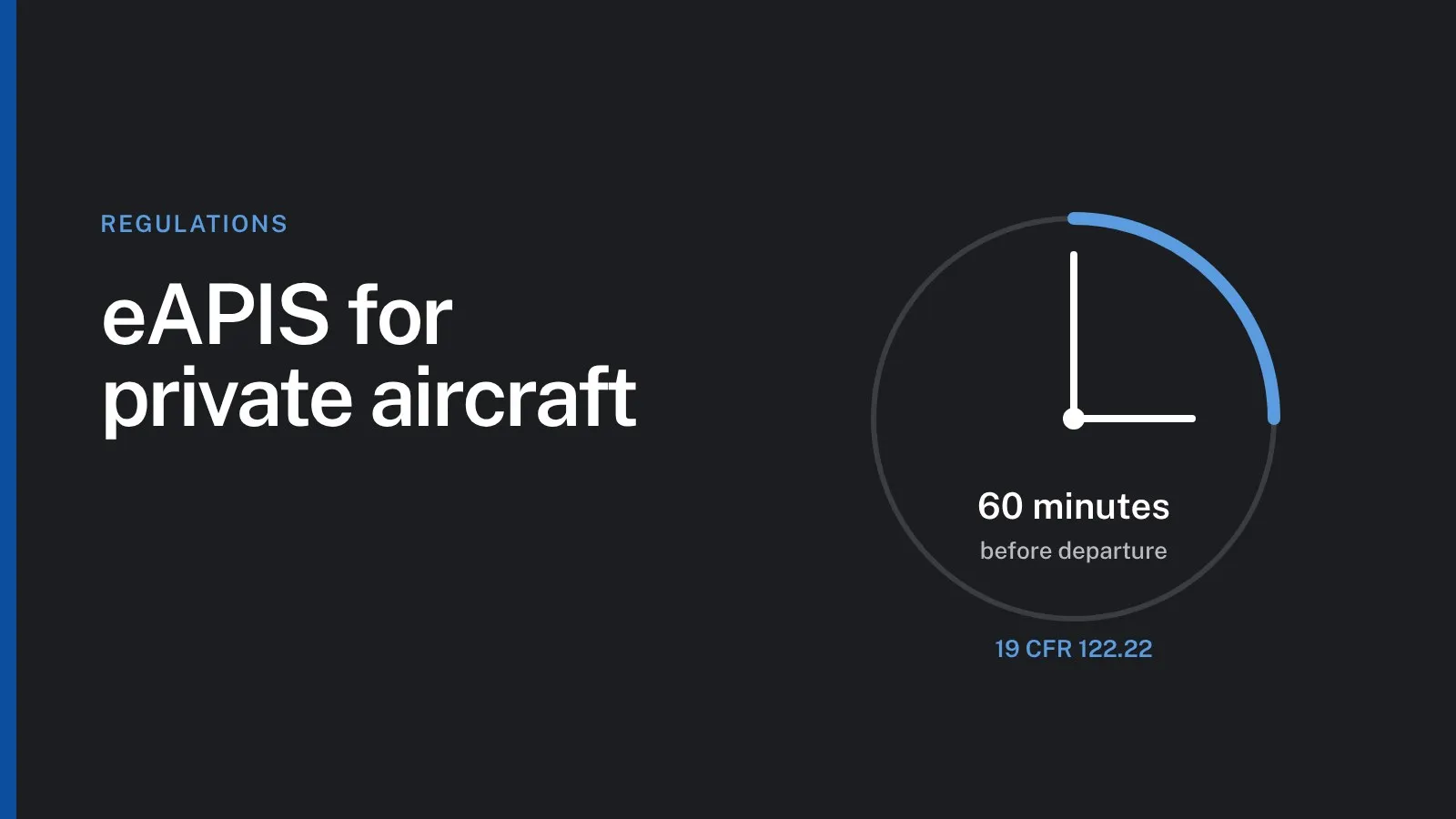
The eAPIS requirements for private aircraft are set by U.S. Customs and Border Protection in 19 CFR 122.22. For every flight that arrives in the United States from a foreign place or departs the United States for one, the pilot must see that a manifest covering each person aboard, crew included, and a notice of arrival or departure for the aircraft are sent to CBP electronically, in one transmission, no later than 60 minutes before departure. The aircraft may not leave until CBP has answered with approval, and a change to the manifest after that makes the earlier approval invalid.
This article covers a private aircraft as CBP defines it, which takes in a Part 91 flight department’s own flights. A flight that carries passengers for payment, including a Part 135 charter, is a commercial aircraft to CBP and files under different sections, summarized further down. It is a plain-language reading of the regulation and not legal advice.
Who must file eAPIS for a private aircraft
Section 122.22 puts the duty on the pilot, defined as “the individual(s) responsible for operation of an aircraft while in flight.” For arrivals, 122.22(b)(1) reads:
“The private aircraft pilot is responsible for ensuring the notice of arrival and manifest information regarding each individual onboard the aircraft are transmitted to CBP. The pilot is responsible for the submission, accuracy, correctness, timeliness, and completeness of the submitted information, but may authorize another party to submit the information on their behalf.”
Paragraph (c)(1) says the same for departures. A scheduler, a dispatcher or an outside trip-support provider may send the manifest, and the pilot still answers for what it says and when it arrived.
What CBP counts as a private aircraft
CBP’s definitions are in 19 CFR 122.1, and they don’t refer to the FAA’s operating parts. A private aircraft is “any aircraft engaged in a personal or business flight to or from the U.S.” that is not:
- “Carrying passengers and/or cargo for commercial purposes”
- “Leaving the U.S. carrying neither passengers nor cargo in order to lade passengers and/or cargo in a foreign area for commercial purposes”
- “Returning to the U.S. carrying neither passengers nor cargo in ballast after leaving with passengers and/or cargo for commercial purposes”
A commercial aircraft is “any aircraft transporting passengers and/or cargo for some payment or other consideration, including money or services rendered” (122.1(d)).
The test is applied to the flight, so the same airplane can be private on a Part 91 company trip and commercial on a Part 135 charter. Items 2 and 3 also take the empty positioning legs of a commercial trip out of the private definition. If a Part 91 flight involves a payment, such as a time sharing agreement, ask CBP or customs counsel which category it falls in before the first trip.
The 60-minute rule and when the clock starts
The manifest and the notice go to CBP together, and the deadline is counted back from takeoff:
- Arriving. “Any time prior to departure of the aircraft, but no later than 60 minutes prior to departure of the aircraft from the foreign port or place” (122.22(b)(2)(i)).
- Departing. “Any time prior to departing the United States, but no later than 60 minutes prior to departing the United States” (122.22(c)(2)).
“Departure” is defined as “the point at which the aircraft is airborne and the aircraft is en route directly to its destination.” The 60 minutes run to wheels-up, and engine start or taxi doesn’t count as departure.
“Any time prior” means the rule sets no earliest time, so a manifest can be sent days ahead. Every later change then has to be filed too.
One exception is written into the rule. A flight “not originally destined to the United States, but diverted to a U.S. port due to an emergency” must transmit “no later than 30 minutes prior to arrival” (122.22(b)(2)(ii)).
Permission to depart and permission to land
Outbound, “the pilot of a private aircraft must receive a message from DHS approving departure from the United States and follow any instructions contained therein” (122.22(c)(5)). Section 122.26 adds that a private aircraft “must not depart the United States to travel to a foreign location until CBP confirms receipt of the appropriate manifest and departure information” and “grants electronic clearance via electronic mail or telephone.”
Inbound, the pilot “must receive a message from DHS approving landing within the United States” before leaving the foreign airport (122.22(b)(6)). The landing rights rule says the same thing from the airport’s side: “the pilot of a private aircraft must receive a message from CBP that landing rights have been granted for that aircraft at a particular airport” (19 CFR 122.14(a)(2)).
Landing rights and the airport named in the manifest
The airport in the transmission is binding. Under 19 CFR 122.32(b), “aircraft must land at the airport designated in their APIS transmission unless instructed otherwise by CBP” or unless the FAA requires a change for safety.
Permission to land at a landing rights airport can be refused or withdrawn. One reason listed in 122.14(a)(4) is that “appropriate and/or sufficient Federal Government personnel are not available.” Changes in ETA and arrival location must “be coordinated with CBP at the new arrival location to ensure that resources are available to inspect the arriving aircraft” (122.22(b)(7)). The regulation does not set each port’s hours, so ask the port of arrival.
Arriving from the south
An aircraft covered by 19 CFR 122.23, which includes private aircraft, that enters the continental United States from Mexico or from the other southern areas the section describes “must land for CBP processing at the nearest designated airport to the border or coastline crossing point” on the list in 19 CFR 122.24, unless it holds an exemption. The overflight exemption in 19 CFR 122.25 is requested from the port director at least 30 days before the first arrival for a one-year exemption, or 15 days for a single flight. An exempt aircraft “shall continue to follow advance notice and general landing rights requirements,” so it still files under 122.22.
eAPIS data elements for each traveler
The manifest lists every person aboard. The rule’s own note on the address line says the information “is required for all travelers including crew onboard the aircraft.” The twelve elements are the same for arrivals (122.22(b)(3)) and departures ((c)(3)), with one difference in wording on the document number.
| Element | Rule’s wording or condition |
|---|---|
| Full name | Last, first, “and, if available, middle” |
| Date of birth | |
| Gender | The rule’s text gives two codes, F for female and M for male |
| Citizenship | |
| Country of residence | |
| Status on board the aircraft | |
| Travel document type | A “DHS-Approved travel document type,” with a passport and an alien registration card given as examples |
| Travel document number | On arrival, “if a DHS-approved travel document is required.” The departure list has no such condition |
| Travel document country of issuance | “If a DHS-approved travel document is required” |
| Travel document expiration date | “Where applicable” |
| Alien registration number | “Where applicable” |
| Address while in the United States | Number and street, city, state and zip code |
The pilot’s check against the document
The pilot who collects the information is “responsible for comparing the travel document presented by each individual to be transported onboard the aircraft with the travel document information he or she is transmitting to CBP,” to see that “the information is correct, the document appears to be valid for travel purposes, and the individual is the person to whom the travel document was issued” (122.22(b)(8) and (c)(7)).
A manifest built from the passport details in the office’s files is therefore a draft until someone has checked it against the passport the passenger actually brought.
Notice of arrival and notice of departure data
The second half of the transmission describes the aircraft, the flight and the people responsible for it. Paragraph (b)(4) lists twenty items for the notice of arrival, and (c)(4) lists twenty for the notice of departure. Grouped:
| Group | Items in 122.22(b)(4) and (c)(4) |
|---|---|
| Aircraft | Tail number, type of aircraft, color(s), call sign “if available,” CBP-issued decal number “if available” |
| Flight | Place of last departure (ICAO code when available), date, estimated time of arrival or departure, “estimated time and location of crossing U.S. border/coastline,” the intended airport of first landing |
| Itinerary | Arrival: “foreign airports landed at within past 24 hours prior to landing in United States.” Departure: “intended foreign airport destinations for 24 hours following departure” |
| Owner or lessee | Name (person or business entity), address, telephone, fax and email |
| Operator | Name (person or business entity), address, telephone, fax and email |
| Pilot | Name, license number, country that issued the license, address, telephone, fax and email |
| Emergency contact | A 24-hour point of contact “who is knowledgeable about this particular flight,” with name and phone number |
The notice asks for the owner or lessee and the operator as separate parties, so a management company needs both sets of details on file for each aircraft. The border-crossing estimate is a time and a place taken from the flight plan, so the scheduler needs it from whoever plans the flight.
Changes after the manifest is sent
The rule expects changes and says how each kind is handled (122.22(b)(7) for arrivals, (c)(6) for departures).
| Change | How the rule handles it |
|---|---|
| A traveler added, removed or corrected, or aircraft details changed | “An updated and amended manifest must be resubmitted to CBP” |
| Flight canceled, ETA or ETD changed, arrival or departure location changed | These are the only amendments that “may be submitted telephonically, by radio, or through existing processes and procedures” |
| Amended manifest sent less than 60 minutes before departure | The pilot “must receive approval from CBP for the amended manifest” before the aircraft may depart. Inbound, the aircraft may otherwise be “diverted from arriving in the United States, or denied permission to land.” Outbound, it “may be denied clearance to depart” |
| Any amended manifest | “Any approval to depart the foreign port or location previously granted by CBP as a result of the original manifest’s submission is invalid” |
| eAPIS can’t be reached | “On a limited case-by-case basis,” CBP may take the information by telephone, enter it manually, “and the pilot is required to wait for CBP screening and approval to depart” |
Worked example: a passenger added 40 minutes before departure
Every time and duration in this example is illustrative, and all times are given in one time zone to keep the arithmetic simple.
A Part 91 flight department flies two pilots and three company passengers to a foreign airport on Tuesday and home on Thursday.
| Leg | Planned takeoff | Latest transmission (takeoff minus 60 minutes) | Planned flight time | ETA |
|---|---|---|---|---|
| Outbound, Tuesday | 09:00 | 08:00 | 2 hr 40 min | 11:40 |
| Inbound, Thursday | 15:30 | 14:30 | 2 hr 40 min | 18:10 |
The scheduler sends both manifests on Monday afternoon, each listing five people, and the approval messages for both come back the same day.
On Thursday at 14:50 a fourth passenger asks to ride home. That is 40 minutes before the planned 15:30 takeoff, inside the 60-minute limit.
- The scheduler sends an amended inbound manifest with six people at 14:55, after the pilot has compared the new passenger’s passport with the details entered.
- Monday’s approval for the inbound leg is now invalid, because an amended manifest was submitted.
- Because the amendment came less than 60 minutes before departure, the pilot must have CBP’s approval of the amended manifest before taking off.
- Suppose the approval arrives at 15:35 and the aircraft takes off at 15:50. The new ETA is 15:50 plus 2 hr 40 min, which is 18:30, or 20 minutes later than filed.
- The ETA change is one of the amendments that may be passed by telephone, and it has to be coordinated with CBP at the arrival airport so that officers are there at 18:30.
Had the passenger asked at 14:10, 80 minutes before takeoff, the earlier approval would still be invalid, but the 60-minute provision would not apply.
Commercial operators: Part 135 flights and 19 CFR 122.49a
A flight that meets CBP’s definition of a commercial aircraft, which includes a Part 135 charter carrying passengers for payment, does not file under 122.22. Its obligations are in a separate group of sections, and they differ in who files, what is filed and when.
| Private aircraft | Commercial aircraft | |
|---|---|---|
| Rule | 19 CFR 122.22 | Passengers: 122.49a arriving, 122.75a departing. Crew: 122.49b arriving, 122.75b departing |
| Who is responsible | The pilot, who “may authorize another party to submit” | The “appropriate official,” which the rule uses interchangeably with “carrier” |
| What is sent | One transmission: everyone aboard plus the notice of arrival or departure | A passenger manifest and a separate crew manifest |
| Passenger timing | No later than 60 minutes before departure | Batch transmission: “no later than 30 minutes prior to the securing of the aircraft.” Interactive individual transmission: “no later than the securing of the aircraft” |
| Crew timing | Same transmission as the passengers | “No later than 60 minutes prior to departure of the aircraft” |
| Crew list on file with CBP | None in 122.22 | By sending the crew manifest, the carrier certifies that its crew members are on the master crew member list “previously submitted to CBP in accordance with § 122.49c” |
“Securing the aircraft” is defined in 122.49a as “the moment the aircraft’s doors are closed and secured for flight.” This table summarizes where the two sets of rules differ most and is not a guide to commercial filing. NBAA keeps an APIS page with material for both private and commercial operators, and our comparison of Part 91, Part 135 and Part 91K covers the FAA side of the difference.
Penalties in 19 CFR Part 122
Part 122 carries its own penalty sections. Under 19 CFR 122.161, “any person who violates any Customs requirements stated in this part” is “subject to civil penalty of $5,000.” For a pilot’s failures in advance notification of arrival, report of arrival, landing and presentation of documents, 19 CFR 122.166(c) sets “a civil penalty of $5,000 for the first violation, and $10,000 for each subsequent violation,” and adds that “any aircraft used in connection with any such violation is subject to seizure and forfeiture.” Those are the amounts printed in the regulation as of this article’s date.
Before the trip: what the office should have on file
Before an international trip is scheduled, the office needs:
- For every person aboard, crew included: the twelve traveler elements above, taken from the travel document.
- For each aircraft: tail number, type, colors, the CBP decal number if it has one, and the owner’s or lessee’s name and contact details.
- For the operator and each pilot: names, addresses, phone and email, and each pilot’s license number and issuing country.
- A 24-hour contact who knows the flight, and the name of whoever is authorized to transmit for the pilot.
- A rule for late changes: who amends the manifest, who tells the crew the earlier approval is void, and who calls the arrival port about a new ETA.
A trip sheet is a reasonable place to carry the filing status and the approval for each border-crossing leg, so the crew sees it with the rest of the trip. Our post on two-pilot scheduling for a Challenger 350 covers the crew side of international legs.
Frequently asked questions
How far in advance do you have to file eAPIS for a private flight?
No later than 60 minutes before the aircraft departs, counted to the moment it is airborne, both when leaving the United States and when leaving a foreign airport for the United States (19 CFR 122.22). The rule allows transmission “any time prior to departure,” so there is no earliest time. The aircraft also has to wait for CBP’s approval message before it departs.
Does the crew have to be on the eAPIS manifest?
Yes. The manifest covers “each individual onboard the aircraft,” and the rule states that the information “is required for all travelers including crew onboard the aircraft.” Each person’s status on board is one of the required data elements.
What happens if a passenger is added after eAPIS is filed?
An amended manifest must be resubmitted, and any approval CBP gave on the original manifest becomes invalid. If the amended manifest goes in less than 60 minutes before departure, the pilot must receive CBP’s approval of it before the aircraft may depart, or the aircraft may be denied permission to land or clearance to depart (122.22(b)(7) and (c)(6)).
Is eAPIS required for a Part 135 charter flight?
A charter flight carrying passengers for payment is a commercial aircraft under 19 CFR 122.1(d), so it does not file under the private aircraft rule. The carrier transmits passenger manifests under 19 CFR 122.49a and 122.75a and crew manifests under 122.49b and 122.75b, with different deadlines from the private rule.
Do you need eAPIS to fly to Puerto Rico or the U.S. Virgin Islands?
For 122.22, “United States” includes Puerto Rico and the Virgin Islands of the United States, so a flight from the mainland to either one is not a departure from the United States under that section. Coming back north, read 19 CFR 122.23, which has a notice-of-arrival rule that names both places.
Travel documents and eAPIS details in Avion Desk
Avion Desk keeps each passenger’s passports and other travel documents on the passenger’s record, with one passport marked as the default, the identity fields encrypted and every reveal logged. When you build a leg’s manifest, an international leg warns you about a passenger with no passport on file or one that has already expired. The warning doesn’t block the trip. On each border-crossing leg the eAPIS details are ready for you. Avion Desk does not file with CBP and sends nothing to it: you, or the party your pilot authorizes, file through CBP’s system and then record that it was filed. See the passenger features. To try it, start a free trial and build one international trip with its manifest, or request a demo.