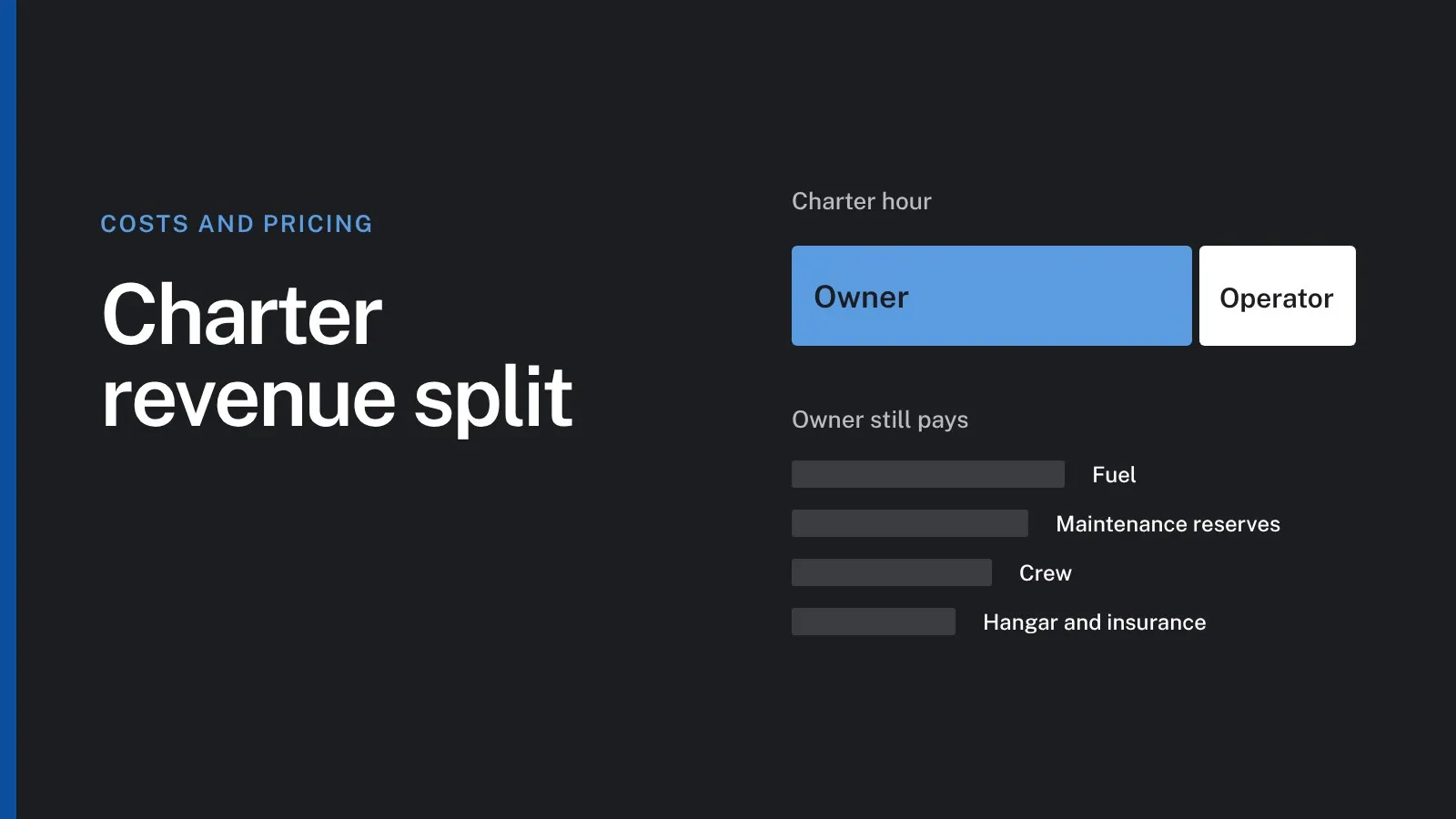
When a managed aircraft flies charter under a Part 135 certificate, the certificate holder sells the trip, collects from the customer and pays the aircraft owner for the use of the aircraft, either as a percentage of the charter revenue or as a fixed fee per hour. The charter revenue split between the aircraft owner and the operator is that percentage. The base it applies to has to be written down, and this article works with a split of the hourly flight charges, with trip fees and federal excise tax handled outside it. The owner still pays the aircraft’s operating and fixed costs, so the owner’s share is revenue against cost and nowhere near profit per hour. The agreement between the two parties sets every one of these terms. No regulation does.
Every dollar figure and percentage below is illustrative, and round on purpose so the arithmetic is easy to follow. None is a market rate, a typical split or a cost for any aircraft type. This article is general background and is not legal or tax advice.
How a managed aircraft earns charter revenue
An owner can’t sell charter on the aircraft directly. Under 14 CFR 119.5(g), “No person may operate as a direct air carrier or as a commercial operator without, or in violation of, an appropriate certificate and appropriate operations specifications.” The aircraft goes onto a certificate holder’s Part 135 operation, and the certificate holder sells and flies the trips.
NBAA’s Aircraft Operating and Leasing Guide describes the arrangement where the owner flies its own trips under Part 91 and the same aircraft is “also operated by a licensed air carrier under FAR Part 135 (commercial) for other passenger- and cargo-carrying flights.” Of the money, the guide says:
“Generally the air carrier pays the owner, or the dry lessee of the aircraft, either a fixed fee or a percentage of the charter revenue for this use, which helps to offset some of the fixed costs associated with owning the aircraft.”
The payment runs from the operator to the owner, because the charter customer’s contract is with the certificate holder. And the guide’s own description of the result is an offset to fixed costs.
Operational control stays with the certificate holder
On a charter leg the operator is in charge of the flight, whoever owns the aircraft. 14 CFR 1.1 defines operational control as “the exercise of authority over initiating, conducting or terminating a flight,” and for Part 135 operations 14 CFR 135.77 says “Each certificate holder is responsible for operational control.”
What the charter revenue split is a percentage of
A split quoted as a bare percentage tells an owner little until the agreement says what it is a percentage of. A charter invoice has several kinds of lines (our post on how to price a charter trip builds one from the rate card), and the agreement should place each of them inside or outside the split.
| Charter invoice line | Questions the agreement should answer |
|---|---|
| Flight time on passenger legs | The base in this article’s examples. Is it measured in block time or air time, and at the rate quoted or the rate collected? |
| Positioning legs billed to the customer | In the base at the same percentage, at a different one, or not at all? |
| Daily and trip minimums | Billed hours that weren’t flown. Split like flight time, or kept by one side? |
| Fuel surcharge | Goes to whoever pays for the fuel. If the owner buys the fuel, a surcharge the operator keeps is a cost the owner carries twice. |
| Crew overnight fees and per diem | A reimbursement to whoever pays the crew’s hotel and meals, or revenue inside the split? |
| Landing, handling, parking, de-ice | Passed through to whoever paid the vendor, or marked up. Who keeps a markup? |
| Catering and ground transport | Passed through, with the same question about markup. |
| Broker commission or discount | Taken before the split or out of the operator’s share? |
| Federal excise tax | Collected from the customer for the IRS. Never revenue to either side. |
The NBAA guide puts one more item on the list for these agreements: “Allocation of risk of non-payment by the Provider’s charter customers.” A split applied to revenue billed pays the owner whether or not the customer pays. A split applied to revenue collected leaves the bad debt partly with the owner.
A percentage against a fixed fee per hour
The guide names both forms of payment, “either a percentage of the charter revenue or a fixed fee per hour.” With a percentage, the owner’s income per hour rises and falls with the rate the operator sells at, discounts included. With a fixed fee per hour, the owner gets the same amount for every charter hour and the operator keeps or absorbs the difference.
Arithmetic for three illustrative splits
Take an illustrative charter rate of $5,000 per flight hour and an illustrative variable cost to the owner of $2,800 per flight hour (fuel, maintenance reserves and engine programs, as built in our guide to what a trip really costs). The three splits below are examples for the arithmetic, not what the market pays.
| Owner’s share | Owner’s revenue per charter hour | Operator’s share per hour | Owner’s variable cost per hour | Owner’s margin per charter hour |
|---|---|---|---|---|
| 80% | 80% × $5,000 = $4,000 | $1,000 | $2,800 | $4,000 − $2,800 = $1,200 |
| 85% | 85% × $5,000 = $4,250 | $750 | $2,800 | $4,250 − $2,800 = $1,450 |
| 90% | 90% × $5,000 = $4,500 | $500 | $2,800 | $4,500 − $2,800 = $1,700 |
Ten points of split move the operator’s share from $500 to $1,000 an hour, which doubles it. The owner’s margin moves from $1,700 to $1,200, a drop of about 29%.
The same table shows the floor on discounting. At an 85% share and a $2,800 variable cost, the owner’s margin reaches zero when the rate sold falls to $2,800 ÷ 0.85 = about $3,294 per hour. Below that rate each charter hour costs the owner money before any fixed cost is counted, while the operator still earns 15% of what it sold.
What the owner still pays
The owner’s share is revenue before the owner’s costs, which are these.
- Variable cost of every charter hour. Fuel, maintenance reserves, and engine and APU programs run on charter hours exactly as they do on the owner’s hours.
- Fixed costs. Crew salaries and benefits, hangar, insurance, recurrent training, subscriptions and the management fee come due whether the aircraft flies charter or not.
- The cost of going onto the certificate. The NBAA guide lists, as the customer’s responsibilities, “Making the aircraft available for certification and training flights” and “Paying the cost of any aircraft modifications that may be required to qualify the aircraft for certification under FAR Part 135.”
- Insurance. The guide notes that when the provider uses the aircraft under Part 135, “it is customary for the aircraft to be added to the Provider’s fleet insurance policy.”
Whether the operator pays these and bills them back or the owner pays directly, a monthly aircraft owner statement shows them next to the charter credit.
What the operator keeps and why
The operator’s share pays for what a Part 135 certificate holder has to do that an owner flying under Part 91 does not. The NBAA guide lists the provider’s responsibilities when the aircraft flies under Part 135:
- “Performing the conformity inspection and obtaining the necessary certifications and approvals to operate the aircraft under FAR Part 135.”
- “Supervising training, certification, checking and other matters for Part 135 operations for the flight and maintenance crew.”
- “Advertising and billing relating to charter flights and collecting and remitting FET relating to all Part 135 flights.”
Behind those lines sit the certificate itself, the manual 14 CFR 135.21 requires, the records 14 CFR 135.63 requires for each pilot and aircraft, the sales effort, quoting, collection, and the liability that comes with operational control. None of it is a line on the charter invoice, so it comes out of the operator’s share.
The guide also warns that the split can’t become rent for the certificate: “The FAA prohibits the Provider from franchising out its charter certificate, as this is viewed as an indicator of a loss of operational control.” Questions about a specific structure go to aviation counsel and the operator’s principal operations inspector.
Positioning legs
A charter trip that starts away from the aircraft’s base needs an empty leg to reach the passengers and often another to come home. Each of those hours costs the owner the full variable rate, and the agreement decides whether the owner is paid for them. There are three cases:
- Positioning billed to the customer at the full rate. The hours enter the base and the owner earns the normal margin on them.
- Positioning billed at a reduced rate. At 75% of a $5,000 rate, the owner’s 85% share is 0.85 × $3,750 = $3,187.50, and the margin over a $2,800 variable cost falls to $387.50 an hour.
- Positioning not billed. The owner gets nothing and pays $2,800 for each hour, unless the agreement says the operator covers unbilled positioning.
An owner comparing two offers should ask for last year’s ratio of billed hours to hours flown on a similar aircraft.
Federal excise tax on the charter
Federal excise tax is charged to the charter customer on top of the price, and it belongs to neither side of the split. 26 U.S.C. 4261(a) imposes “on the amount paid for taxable transportation of any person a tax equal to 7.5 percent of the amount so paid,” and 4261(b) adds a tax on “each domestic segment,” meaning “any segment consisting of 1 takeoff and 1 landing.” The statute’s $3.00 is indexed for inflation, and for 2026 IRS Publication 510 gives the segment tax as $5.30. It applies per passenger.
Under 4261(d) the tax is “paid by the person making the payment subject to the tax,” which is the charter customer. Publication 510 adds that “ordinarily, the person receiving the payment collects the tax, files the returns, and pays the tax over to the government,” which is the operator. Publication 510 also says amounts paid for transportation include “layover or waiting time, and movement of aircraft in deadhead service,” so billed positioning and waiting charges are part of the amount the 7.5% is figured on.
The split should therefore be defined on revenue before tax, with the tax on its own line of the charter invoice. The agreement should also say who collects and remits. The NBAA guide puts it plainly: “Responsibilities for collection and remittance should be addressed.”
The owner’s flights and the management services exemption
Section 4261(e)(5) provides that no tax under 4261 applies to “amounts paid by an aircraft owner for aircraft management services related to” maintenance and support of the owner’s aircraft or “flights on the aircraft owner’s aircraft.” The Treasury regulation, 26 CFR 49.4261-10, covers the managed aircraft that also flies charter. Under paragraph (e), letting the management company use the aircraft for for-hire flights “does not affect the application of section 4261(e)(5),” but “an amount paid by someone other than the aircraft owner for a for-hire flight on the aircraft owner’s aircraft is subject to the tax imposed by section 4261” unless another exemption applies.
On one aircraft in one month, the owner’s payments for its own flights can be exempt while every charter customer’s payment is taxed. The regulation requires “adequate records” to support the exemption (49.4261-10(a)(3)), which means each leg has to be recorded as an owner flight or a for-hire flight and each payment tied to one or the other.
Fuel tax differs as well. NBAA notes that owner flights supported by a management company are subject to the non-commercial fuel tax, which Publication 510 sets higher than the commercial aviation rate. How any of this applies to a given owner, lease or trust is a question for a tax adviser.
Owner hours versus charter hours
Days the aircraft is out on charter are days the owner can’t fly it, and an aircraft held back for the owner sells fewer charter hours. The agreement should settle three things:
- Notice and release. How far ahead the owner books, and whether the operator may sell a date the owner hasn’t claimed without asking. The NBAA guide lists “Providing the Customer with notice and the option to consent to the Provider’s use of the Aircraft” among the terms for Part 135 use.
- Which rules each owner flight is flown under. The NBAA guide says the agreement “should clearly identify each type of flight contemplated and which party is in operational control: Customer Part 91 (Customer), Provider Part 135 (Provider) and Provider Part 91 (Provider).” Our comparison of Part 91, Part 135 and Part 91K covers what changes between them.
- What the owner pays per hour of its own flying. The owner’s hours carry no split. The owner pays their variable and trip costs in full.
Charter hours and their positioning add to the owner’s own hours on the airframe and engines, and inspections and engine program charges follow the total.
A worked break-even example
Every figure in this example is illustrative.
Assumptions
| Item | Figure |
|---|---|
| Charter rate per billed flight hour | $5,000 |
| Owner’s share of hourly flight revenue | 85% |
| Owner’s variable cost per hour flown | $2,800 |
| Owner’s fixed costs per year, management fee included | $900,000 |
| Trip fees (crew overnight, airports, catering) | Billed to the charter customer at cost, outside the split |
One charter trip
A customer flies two passenger legs of 2.0 hours each with four passengers. The aircraft positions 0.5 hour each way, billed at the full rate.
| Line | Arithmetic | Amount |
|---|---|---|
| Flight charges | 5.0 billed hr × $5,000 | $25,000 |
| Crew overnight and airport fees, at cost | one night away | $2,100 |
| Amount paid for transportation | 25,000 + 2,100 | $27,100 |
| Excise tax, percentage | 7.5% × $27,100 | $2,032.50 |
| Excise tax, segments | 2 passenger segments × 4 passengers × $5.30 | $42.40 |
| Customer pays | 27,100 + 2,032.50 + 42.40 | $29,174.90 |
For the illustration the fees are treated as part of the amount paid for transportation. Which lines of a real invoice are in the tax base is a question for the operator’s tax adviser.
| Where the money goes | Arithmetic | Amount |
|---|---|---|
| Owner’s share | 85% × $25,000 | $21,250 |
| Operator’s share | 15% × $25,000 | $3,750 |
| Vendors and crew expenses, reimbursed | at cost | $2,100 |
| IRS | 2,032.50 + 42.40 | $2,074.90 |
| Total | $29,174.90 |
The owner’s variable cost for the trip is 5.0 hours × $2,800 = $14,000, so the trip contributes $21,250 − $14,000 = $7,250 toward the owner’s fixed costs.
Hours needed to cover fixed costs
Each billed charter hour contributes $4,250 − $2,800 = $1,450. To cover the whole $900,000 of fixed cost from charter alone would take $900,000 ÷ $1,450 = about 621 billed hours a year, with no unbilled positioning at all. At an 80% share the figure is $900,000 ÷ $1,200 = 750 hours, and at 90% it is $900,000 ÷ $1,700 = about 529 hours.
A plan with 300 billed charter hours gives a different picture:
| Case | Arithmetic | Contribution to fixed costs |
|---|---|---|
| Every hour flown is billed | 300 hr × $1,450 | $435,000 |
| One unbilled positioning hour for every four billed | 300 hr × $1,450 − 75 hr × $2,800 | $435,000 − $210,000 = $225,000 |
With every hour billed, charter covers $435,000 ÷ $900,000 = about 48% of the owner’s fixed costs. With 75 unbilled positioning hours it covers 25%, and the aircraft has flown 375 hours for it. In neither case does charter pay for the aircraft. It reduces what ownership costs, which is the result the NBAA guide describes.
The example leaves out income tax, depreciation, the wear cost of the added hours and the owner’s own flying.
Frequently asked questions
Is the charter revenue split based on gross or net revenue?
It depends on the agreement. A split can be applied to hourly flight charges only, to everything billed before tax, or to what is left after broker commissions and pass-through fees. Federal excise tax is never part of it.
Who pays for fuel on a charter flight in a managed aircraft?
Whoever the management agreement says. Where the owner carries the aircraft’s operating costs and receives a share of the revenue in return, as in this article’s example, the owner pays for it. If the owner buys the fuel, any fuel surcharge billed to the charter customer should go to the owner or into the split.
Can an aircraft owner charter the aircraft without a Part 135 operator?
Not as the seller of the flights. 14 CFR 119.5(g) bars operating “as a direct air carrier or as a commercial operator” without the appropriate certificate and operations specifications. The aircraft goes to a Part 135 certificate holder, which is responsible for operational control of the charter flights under 14 CFR 135.77.
Does the aircraft owner pay federal excise tax on its own flights?
Amounts an owner pays a management company for management services related to flights on the owner’s own aircraft are exempt from the section 4261 tax under 26 U.S.C. 4261(e)(5), if the conditions in 26 CFR 49.4261-10 are met. Charter customers’ payments for flights on the same aircraft are taxed. Whether a particular owner, lessee or trust qualifies is a question for a tax adviser.
How many charter hours does an aircraft need to break even?
Divide the owner’s annual fixed costs by the margin per billed hour, which is the owner’s share of the hourly rate minus the variable cost per hour, and then allow for unbilled positioning. In the illustrative example above that came to about 621 billed hours a year at an 85% share, more than twice the 300 hours in the plan.
Charter trips and their costs in Avion Desk
Avion Desk keeps rate cards and builds printable quotes from them. It logs each leg as flown, keeps expenses with their receipts and categories, shows what each trip cost, and issues invoices with payments recorded against them. It does not calculate a revenue split or produce an owner statement. See the accounting features. To try it, start a free trial and enter one recent charter trip with its legs and expenses, or request a demo.