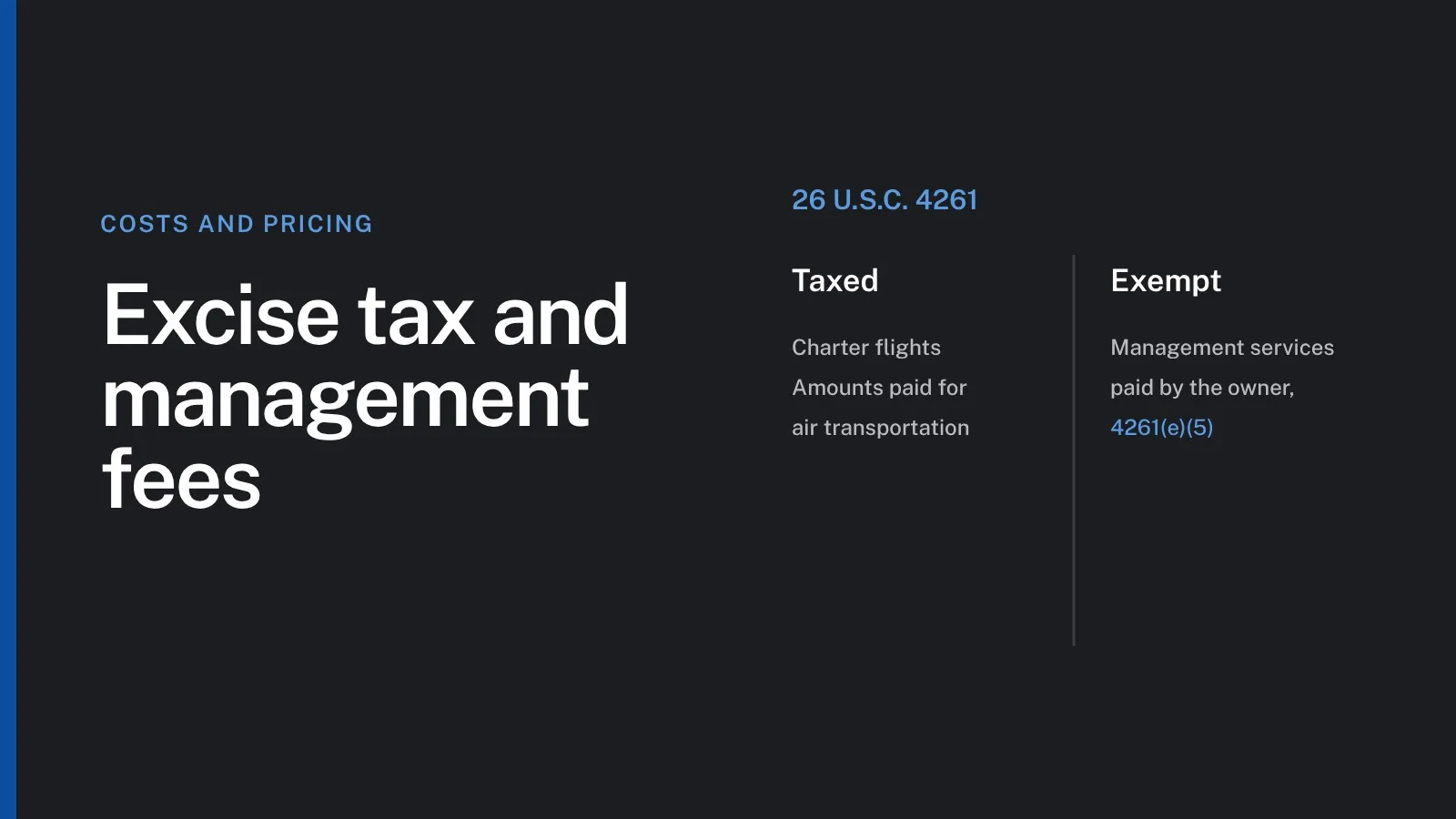
Federal excise tax on aircraft management fees is not due when the aircraft owner itself pays the management company for services on the owner’s own aircraft. Since December 2017, 26 U.S.C. 4261(e)(5) has exempted “any amounts paid by an aircraft owner for aircraft management services” from the 7.5% air transportation tax, and the IRS filled in the details in final regulations in 2021 (T.D. 9948). The tax still applies to charter flights sold to third parties on the owner’s aircraft, to flights the owner takes on a substitute aircraft, and to payments that come from anyone who isn’t the owner or a qualifying lessee.
This article explains the statute and the regulation for management companies, Part 135 operators that manage aircraft, and owners. It isn’t tax advice. Every dollar figure in the worked example is illustrative.
The air transportation excise tax in 26 U.S.C. 4261
The air transportation excise tax is a tax on “the amount paid for taxable transportation of any person” by air (26 U.S.C. 4261(a)). It is the tax a Part 135 charter customer sees on a quote, and our guide to pricing a charter trip shows it on one. The rates below come from the statute and from the IRS Instructions for Form 720 (revised June 2026), which carry the inflation-adjusted amounts for calendar year 2026.
| Tax | Rate | Source |
|---|---|---|
| Percentage tax on amounts paid for taxable transportation of persons | 7.5% | 4261(a) |
| Domestic segment tax, 2026 | $5.30 per segment | 4261(b), Form 720 instructions |
| International air travel facilities, 2026 | $23.40 per person | 4261(c), Form 720 instructions |
| Transportation of property by air | 6.25% | 26 U.S.C. 4271(a) |
On a chartered aircraft the segment tax is counted per passenger. The Form 720 instructions say it “is figured by multiplying the tax by the number of passengers transported on the aircraft.”
The tax is “paid by the person making the payment subject to the tax” (4261(d)), but the Form 720 instructions put the work on the other side: “The person receiving the payment for air transportation services must” collect the tax, submit it, and file Form 720 for the quarter.
Before 2017 no rule was written for managed aircraft, and the IRS decided these cases by asking which party had possession, command and control of the aircraft. The preamble to T.D. 9948 says that test “has caused confusion and uncertainty in the air transportation excise tax area for decades” and “is not relevant” where the exemption applies (T.D. 9948, Internal Revenue Bulletin 2021-6).
The aircraft management services exemption in 4261(e)(5)
Section 13822 of Public Law 115-97 added the exemption in December 2017. The operative sentence is short:
“No tax shall be imposed by this section or section 4271 on any amounts paid by an aircraft owner for aircraft management services related to (i) maintenance and support of the aircraft owner’s aircraft, or (ii) flights on the aircraft owner’s aircraft.”
The statute then says what “aircraft management services” includes (4261(e)(5)(B)):
- “assisting an aircraft owner with administrative and support services, such as scheduling, flight planning, and weather forecasting”
- “obtaining insurance”
- “maintenance, storage and fueling of aircraft”
- “hiring, training, and provision of pilots and crew”
- “establishing and complying with safety standards”
- “such other services as are necessary to support flights operated by an aircraft owner”
The regulation, 26 CFR 49.4261-10, widens the last item to “any service (including, but not limited to, purchasing fuel, purchasing aircraft parts, and arranging for the fueling of an aircraft owner’s aircraft)” provided to the owner “in order to provide air transportation to the aircraft owner on the aircraft owner’s aircraft at a level and quality of service required under the agreement.” The proposed version limited these services to what kept the aircraft airworthy, and the IRS removed that wording after a commenter pointed to upgrades, interior refurbishment and paint (T.D. 9948 preamble).
Three more points in the regulation settle a lot of real cases:
- The owner need not be aboard. The exemption applies to amounts the owner pays for flights on its aircraft “even if the aircraft owner is not on the flight” (49.4261-10(a)(1)).
- Part 91 or Part 135 makes no difference. “Whether a flight on an aircraft owner’s aircraft operates pursuant to the rules under FARs Part 91 or pursuant to the rules under FARs Part 135 does not affect the application of section 4261(e)(5)” (49.4261-10(d)).
- The billing method makes no difference. Itemized costs, a flat monthly fee and an hourly fee are treated alike (49.4261-10(f)).
The exemption is limited to aircraft “used in private aviation,” defined as civilian flights other than scheduled passenger service sold seat by seat to the general public. The definition expressly includes Part 135 flights (49.4261-10(b)(8)).
Who counts as the aircraft owner
The exemption turns on who makes the payment. Under 49.4261-10(b)(3), the aircraft owner is one of these:
- A person that “holds legal title to the aircraft.”
- A person that “holds substantial incidents of ownership in the aircraft for a period of more than 31 days.”
- A person that leases the managed aircraft under a lease that isn’t a disqualified lease.
- The beneficiary of an owner trust that holds legal title, who is treated as a lessee.
Disqualified leases
A disqualified lease is “a lease from a person providing aircraft management services with respect to such aircraft (or a related person (within the meaning of section 465(b)(3)(C)) to the person providing such services), if such lease is for a term of 31 days or less” (4261(e)(5)(C)(ii)). A management company can’t lease its own aircraft to a customer for a month or less and treat the customer as an owner.
Payments from a related party
This part of the final regulations surprises owners. Many aircraft are titled in a single-purpose LLC, and the bills are often paid by the individual, the operating company or a family office. The regulation says:
“amounts paid for aircraft management services by a party related to the aircraft owner are not amounts paid by the aircraft owner solely by virtue of the relationship between the aircraft owner and the related party.”
Commenters asked the IRS to treat an LLC’s single member, an affiliate or a family member as the owner, and the IRS declined. The preamble lists “members of an affiliated group, members of a limited liability company, disregarded entities, and family members” as related parties whose payments don’t qualify on the relationship alone, because excise tax law respects each entity as separate from its owner, even one that is disregarded for income tax.
The regulation leaves two routes open:
- A lease. If the owner leases the aircraft to the related party, “amounts paid by the lessee to an aircraft management services provider for aircraft management services related to the leased aircraft qualify,” provided the lease isn’t a disqualified lease.
- An agent paying for its principal. The exemption doesn’t apply to amounts paid “by another person on behalf of an aircraft owner (other than in a principal-agent scenario in which the aircraft owner is the principal).” The preamble says state agency law decides whether that relationship exists.
The same goes for corporate families. The regulation says amounts paid by one member of an affiliated group for flights on an aircraft owned by another member “are not amounts paid by the aircraft owner unless the member owning the aircraft leases the aircraft to the member of the affiliated group that pays for the aircraft management services.” The separate affiliated group exemption in 26 U.S.C. 4282 is covered in our article on flight department chargebacks.
Which route fits a given ownership structure is a question for the owner’s aviation tax counsel. The management company’s part is to know, for every managed aircraft, who holds title, who the lessee is if there is one, and whose account each payment came from.
What the exemption covers and what it does not
| Payment | Treatment under 4261(e)(5) | Where it says so |
|---|---|---|
| Monthly management fee paid by the owner for its own aircraft | Exempt | 4261(e)(5)(A) |
| Crew, hangar, maintenance, insurance and fuel billed to the owner for its own aircraft | Exempt | 4261(e)(5)(B), 49.4261-10(b)(1) |
| The same charges paid by a lessee under a lease that isn’t disqualified | Exempt | 49.4261-10(b)(3) |
| The same charges paid by a member, parent, affiliate or relative, with no lease and no agency | Not covered on the relationship alone | 49.4261-10(a)(1) |
| Amount a third party pays for a charter flight on the owner’s aircraft | Taxable unless another exemption applies | 49.4261-10(e) |
| Amount the owner pays for a flight on a substitute aircraft | Treated as a charter | 49.4261-10(c)(2) |
| Fees for an aircraft leased from the management company for 31 days or less | Not covered | 4261(e)(5)(C)(ii) |
“Not covered” doesn’t always mean tax is due. The payment goes back to the ordinary questions of whether it was paid for taxable transportation and whether another exemption applies.
Charter flights on a managed aircraft
A managed aircraft on a Part 135 certificate may fly for its owner some days and for charter customers on others, and 49.4261-10(e) handles both. Letting the management company charter the aircraft “does not affect the application of section 4261(e)(5)” to what the owner pays. But:
“an amount paid by someone other than the aircraft owner for a for-hire flight on the aircraft owner’s aircraft is subject to the tax imposed by section 4261 unless the flight is otherwise exempt from such tax by reason of an exemption other than the aircraft management services exemption.”
The charter customer’s payment carries the 7.5% tax and the segment tax, and the owner’s management fees for the same aircraft in the same month stay exempt. The regulation’s third example has exactly these facts.
Paragraph (e) excepts “payments made by the aircraft owner.” When the owner’s own trip is flown under Part 135 on the owner’s aircraft and the owner pays for it, the payment stays within the exemption.
Substitute aircraft and mixed invoices
When the owner’s aircraft is down for maintenance and the management company puts the owner on another aircraft, the exemption doesn’t follow. Under 49.4261-10(c)(2), a flight on a substitute aircraft “is treated as a charter flight provided by the aircraft management services provider to the aircraft owner,” whether or not the owner is aboard, “and the aircraft owner is treated as the charterer.”
When one payment covers both exempt and taxable items, the exemption applies “on a pro rata basis only to the portion which consists of” exempt amounts (4261(e)(5)(D)). The regulation says how to find the taxable part (49.4261-10(c)(1)):
- If the taxable amount is “separable and shown in exact amounts in the records pertaining to the charge,” the tax base is the amount paid for the flight.
- If it isn’t separable, “the tax base is the fair market value of the flights or services,” capped at the total amount paid. The management company’s published fee schedule may be used as evidence of fair market value.
In the regulation’s first two examples, an owner pays a $3,000 monthly fee and takes one flight on a substitute aircraft. Where the invoice shows $1,000 for that flight as its own line, $1,000 is the tax base. Where the flight is buried in the monthly fee, the base is the flight’s fair market value. So put every substitute-aircraft flight on its own invoice line with its own amount.
Worked example: one quarter on a managed aircraft
The figures below are illustrative and round on purpose. They aren’t market rates for management, crew, fuel or charter.
An LLC holds title to a turbojet and has a management agreement with a Part 135 operator. The LLC pays every invoice from its own bank account. In one quarter:
| Item | Paid by | Amount | Exempt under 4261(e)(5)? |
|---|---|---|---|
| Management fee, 3 months × $12,000 | The LLC | $36,000 | Yes |
| Crew salaries and benefits, billed at cost | The LLC | $90,000 | Yes |
| Hangar | The LLC | $18,000 | Yes |
| Maintenance and parts | The LLC | $40,000 | Yes |
| Fuel for the owner’s flights | The LLC | $56,000 | Yes |
| Owner’s payments for its own aircraft | $240,000 | Yes | |
| One flight on a substitute aircraft, shown as its own line | The LLC | $14,000 | No, treated as a charter |
| One charter on the LLC’s aircraft | A charter customer | $20,000 | No |
The substitute flight. It is domestic, two segments, with four passengers. Percentage tax is 7.5% × $14,000 = $1,050. Segment tax is 2 segments × 4 passengers × $5.30 = $42.40. The management company collects $1,092.40 from the LLC on top of the $14,000.
The charter. It is domestic, two segments, with six passengers. Percentage tax is 7.5% × $20,000 = $1,500. Segment tax is 2 × 6 × $5.30 = $63.60. The operator collects $1,563.60 from the charter customer.
The owner’s $240,000. No air transportation tax is collected on it.
Now change one fact. The LLC’s sole member pays the same $240,000 from a personal account, with no lease from the LLC and no agency arrangement. Those are not amounts paid by the aircraft owner “solely by virtue of the relationship,” so the exemption can’t be relied on. The preamble states the consequence: “if a payment is received from someone other than the aircraft owner … the aircraft management services exemption does not apply and the aircraft management services provider must collect any applicable air transportation tax on the amount paid.” If the whole amount were treated as paid for taxable transportation, the percentage tax alone would be 7.5% × $240,000 = $18,000 for the quarter.
When fuel tax applies instead
Aviation fuel carries its own federal excise tax, and the rate depends on whether the flight is commercial aviation. The Form 720 instructions give the kerosene rates for fuel removed directly into an aircraft: “$.219 per gallon” for noncommercial aviation and “$.044 per gallon” for commercial aviation (other than foreign trade), the second only for registered commercial aviation operators.
“Commercial aviation” is defined in 26 U.S.C. 4083(b) as “any use of an aircraft in a business of transporting persons or property for compensation or hire by air, unless properly allocable to any transportation exempt from the taxes imposed by sections 4261 and 4271 by reason of section 4281 or 4282 or by reason of subsection (h) or (i) of section 4261.” That list names the small-aircraft and affiliated-group exemptions. It doesn’t name 4261(e)(5).
The proposed regulations would have treated every flight covered by the management exemption as noncommercial, so the higher fuel rate would apply automatically. The IRS dropped that rule. The preamble says the final regulation “does not provide fuel excise tax guidance related to the exemption in section 4261(e)(5),” and that affected persons “should continue to follow current statutory, regulatory, and administrative guidance related to the rates of tax for aviation fuel.”
So the fuel rate on an owner’s flight follows the 4083(b) definition and the existing fuel tax guidance. If you hold a commercial aviation fuel registration and fly owner trips on managed aircraft, ask your tax adviser how each kind of flight should be fueled and reported, and keep gallons by leg.
Records the exemption requires
Under 49.4261-10(a)(3), the owner and the management company “must maintain adequate records to show that the amounts paid by the aircraft owner to the aircraft management services provider relate to aircraft management services specifically for the aircraft owner’s aircraft or for flights on the aircraft owner’s aircraft and to support any allocations.” The regulation names the management agreement, “evidence of aircraft ownership,” “evidence that amounts paid for aircraft management services came from the aircraft owner,” and the management company’s fee schedule.
In the office, that comes down to four habits:
- Keep the registration, any lease and the management agreement for each managed aircraft together, and invoice the party they name.
- Note whose account each payment came from.
- Record every flight with its aircraft, legs, passengers and payer, and put any flight on a substitute aircraft on its own invoice line.
- Keep a dated fee schedule, the evidence of fair market value if an amount ever has to be split.
Our guide to what a trip really costs covers recording fuel by leg and expenses by trip.
Frequently asked questions
Are aircraft management fees subject to federal excise tax?
Not when the aircraft owner, or a lessee under a lease that isn’t disqualified, pays them for its own aircraft. 26 U.S.C. 4261(e)(5) exempts those amounts from the taxes on transportation of persons and property by air. Payments from someone else, or for flights on another aircraft, fall outside the exemption.
Does the exemption apply if my managed aircraft is on a Part 135 certificate?
Yes. 26 CFR 49.4261-10(d) says the choice between Part 91 and Part 135 flight rules “does not affect the application of section 4261(e)(5).” What third parties pay for charter flights on the aircraft is still taxed.
My LLC owns the aircraft and I pay the management company personally. Is that exempt?
Not on the relationship alone. The regulation says amounts paid by a related party “are not amounts paid by the aircraft owner solely by virtue of the relationship,” and the preamble names LLC members and disregarded entities among the related parties. A lease from the LLC to the payer, or a principal-agent arrangement, can change that, which is a matter for your tax counsel.
When did the aircraft management services exemption take effect?
The Form 720 instructions say “Effective December 23, 2017, certain payments related to the management of private aircraft are exempt from the excise taxes imposed on taxable transportation by air.” The final regulation applies to amounts paid on and after January 19, 2021, the day it was published at 86 FR 4990.
Management billing records in Avion Desk
Avion Desk records the fuel uplift on each leg against your vendors and their prices, keeps expenses with their receipts and categories, and counts an expense only after it’s approved. Each trip shows what it cost, rolled up, and you can issue printable invoices and credit notes and record payments against them. What is taxable stays a decision for you and your tax adviser. See the accounting features. To try it, start a free trial and enter one managed aircraft’s trips and expenses for a month, or request a demo.