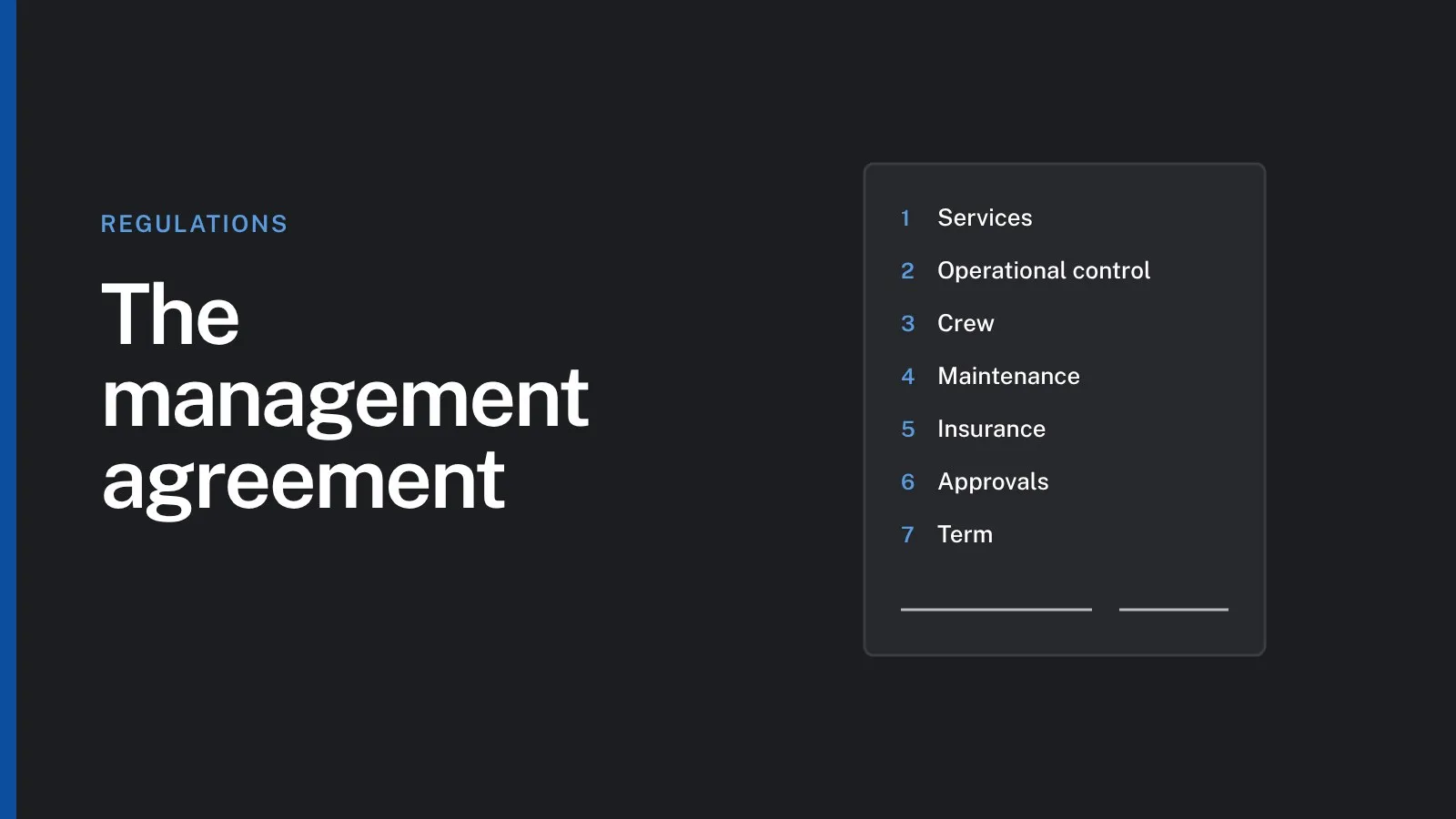
An aircraft management agreement should state the services the manager provides, who has operational control of each kind of flight, who employs the crew, who is responsible for maintenance and airworthiness, what insurance is carried and who is named on it, what the manager may spend without the owner’s approval, what the owner receives each month, and how either side ends the arrangement. On operational control, the clause the FAA looks at first: on owner flights under Part 91 it normally rests with the owner, and on charter flights it rests with the Part 135 certificate holder. The agreement has to say which is which, and the operation has to match what the agreement says.
This article explains the clauses and the rules behind them. It is not legal advice, and a management agreement is a contract that aviation counsel should draft or review for both sides.
What an aircraft management agreement covers
The agreement is between the aircraft’s owner (or lessee) and a management company. Its working clauses are services, operational control, crew, maintenance, insurance, approvals and spending, reporting, fees, and term and termination. The sections below take them in that order with the rule behind each.
Aircraft management services to list
List the services one by one. A clause that says the manager will “manage the aircraft” leaves both sides to guess what is included.
The Internal Revenue Code happens to contain a useful starting list. In exempting an owner’s payments for management from the federal tax on air transportation, it describes aircraft management services as including “administrative and support services, such as scheduling, flight planning, and weather forecasting,” “obtaining insurance,” “maintenance, storage and fueling of aircraft,” “hiring, training, and provision of pilots and crew,” and “establishing and complying with safety standards” (26 U.S.C. 4261(e)(5)(B)).
For each service, the agreement should say three things:
- Whether it is inside the management fee or billed separately.
- Who chooses the vendor. The owner may want a say in the maintenance shop, the training provider or the home base.
- Whose name the contract is in. A hangar lease or an engine program in the owner’s name survives a change of manager. One in the manager’s name does not.
For how the fee is built, see what to charge to manage an aircraft.
Operational control in a management agreement
The operational control clause decides who answers to the FAA for a flight. For how operational control works in each lease, see dry lease vs wet lease.
The definition in 14 CFR 1.1
“Operational control, with respect to a flight, means the exercise of authority over initiating, conducting or terminating a flight” (14 CFR 1.1). The definition turns on authority over the flight, not on who owns the aircraft or who sits in the left seat.
The FAA’s advisory circular on truth in leasing breaks operational control into three areas: aircrew (crewmembers are trained, qualified and within flight, duty and rest requirements, and a pilot in command is designated for each flight), aircraft (it is airworthy and in compliance), and flight management (the conditions under which a flight may be operated, such as weather minimums, loading and fuel) (AC 91-37B, paragraph 4.6). The circular calls operational control “a matter of legal responsibility.”
Owner flights under Part 91
When the owner flies on its own aircraft under Part 91, the usual arrangement is that the owner keeps operational control and the manager supplies services to the owner: pilots, maintenance oversight, scheduling. The pilot in command remains “directly responsible for, and is the final authority as to, the operation of that aircraft” (14 CFR 91.3(a)).
The agreement should say this in plain words: the owner has operational control of flights conducted for the owner under Part 91, the manager acts as the owner’s agent in providing services, and the owner understands that it carries the regulatory responsibility that goes with it. Under this structure the responsibility has not passed to the manager, and the agreement is the place to say so.
The other way to fly the owner is under the manager’s Part 135 certificate, with the manager in operational control of the owner’s own trips. The agreement should name the rule for owner flights, and the trip records should show which rule each leg was flown under. Our comparison of Part 91, Part 135 and Part 91K covers what changes between them.
Charter flights under the manager’s Part 135 certificate
When the aircraft carries charter customers, the flight is the certificate holder’s. “Each certificate holder is responsible for operational control and shall list, in the manual required by § 135.21, the name and title of each person authorized by it to exercise operational control” (14 CFR 135.77). The owner has no say over whether a charter flight departs, who crews it, or whether the aircraft is fit for it. The agreement should say so.
The manager needs the aircraft under a written agreement to use it on the certificate. A person has exclusive use of an aircraft under Part 135 if it “has the sole possession, control, and use of it for flight, as owner, or has a written agreement (including arrangements for performing required maintenance), in effect when the aircraft is operated, giving the person that possession, control, and use for at least 6 consecutive months” (14 CFR 135.25(c)). A certificate holder needs exclusive use of at least one aircraft, not of every aircraft it uses (135.25(b)). If yours is that aircraft, the six months limit how quickly the owner can pull it off the certificate, so ask.
This part of the arrangement can be a lease from the owner to the certificate holder, written into the management agreement or signed beside it. For a large civil aircraft (more than 12,500 pounds maximum certificated takeoff weight), 14 CFR 91.23 requires a written truth-in-leasing clause in a lease, but the requirement does not apply when “the party to whom the aircraft is furnished is a foreign air carrier or certificate holder under part 121, 125, 135, or 141.”
Part 91 owner flights and Part 135 charter flights compared
| Owner flight under Part 91 | Charter flight under Part 135 | |
|---|---|---|
| Operational control | The owner, in the usual structure | The certificate holder (135.77) |
| Crew | The manager’s pilots acting for the owner, or the owner’s own | Pilots trained and used by the certificate holder (135.343) |
| Airworthiness responsibility | “The owner or operator” (91.403(a)) | “Each certificate holder” (135.413(a)) |
| Who pays whom | The owner pays the manager for services | The customer pays the certificate holder, who credits the owner |
The FAA’s operational control questions
AC 91-37B was written for leases, not management agreements, but its questions fit any arrangement where one party owns the aircraft and another provides the crew. It lists seven that that “can clarify who will maintain operational control.” Each one maps to a clause.
| The FAA’s question (AC 91-37B, paragraph 6.3) | Where the agreement answers it |
|---|---|
| Who decides to assign crewmembers and aircraft, accept flight requests, and “initiate, conduct, and terminate flights” | Operational control, scheduling procedure |
| “For whom do the pilots work as direct employees or agents?” | Crew |
| “Who is maintaining the aircraft and where is it maintained?” | Maintenance |
| “Prior to departure, who ensures the flight, aircraft, and crew comply with regulations?” | Operational control, release procedure |
| “Who decides when/where maintenance is accomplished, and who directly pays for the maintenance?” | Maintenance, approvals, payment |
| “Who determines weather/fuel requirements, and who directly pays for the fuel?” | Operational control, payment |
| “Who directly pays for the airport fees, parking/hangar costs, food service, and/or rental cars?” | Payment |
The circular warns that the words alone do not settle it. Operational control may sit with a party other than the one the contract names, and “it may be necessary to look at the actual manner in which the operations are conducted” (paragraph 8.1). If asked, “the FAA will determine whether the lessor or lessee has operational control” from the document “and any other circumstances regarding the actual operation” (paragraph 8.2). Write the agreement to describe what you actually do.
Crew employment
The crew clause says who employs the pilots, who pays them and who directs them on each kind of flight. On charter flights the rules decide it. The FAA’s guidance for pilots, owners and operators says “the pilots must be employed (as a direct employee or agent) by the certificate holder with operational control of the flight” (FAA, Safe Air Charter). They must also have completed the certificate holder’s training: no certificate holder may use a crewmember under Part 135 “unless that crewmember has completed the appropriate initial or recurrent training phase of the training program … since the beginning of the 12th calendar month before that service” (14 CFR 135.343).
On Part 91 owner flights, the pilots may be the manager’s employees, assigned to the owner’s aircraft and acting for the owner on those flights. The agreement should cover:
- The number of pilots assigned, and whether they fly only this aircraft.
- Salaries, benefits and training, and whether they are passed through at cost.
- The owner’s right to approve or reject an assigned pilot, and the manager’s right to remove one for cause.
- Contract pilots: when they may be used, at whose cost, and the minimums they must meet under the insurance policy.
- Duty and rest for pilots who also fly charter legs (see Part 135 duty time limits).
- What happens to the crew at termination, including any limit on the owner hiring them directly.
Maintenance responsibility under 14 CFR 91.403
Part 91 puts airworthiness on the owner or operator: “The owner or operator of an aircraft is primarily responsible for maintaining that aircraft in an airworthy condition, including compliance with part 39 of this chapter” (14 CFR 91.403(a)). Part 39 is airworthiness directives. Hiring a manager to run maintenance does not move that sentence off the owner on Part 91 flights.
The duties that follow are also written to the owner or operator. Each “shall have that aircraft inspected as prescribed in subpart E” (14 CFR 91.405). For large and turbine-powered multiengine airplanes, the “registered owner or operator” must select and use an inspection program, and the program must include “the name and address of the person responsible for scheduling the inspections” (14 CFR 91.409(f)). For a managed aircraft the agreement should name that role, which may be the manager’s director of maintenance.
When the aircraft is on the Part 135 certificate, a second rule applies to the manager directly: “Each certificate holder is primarily responsible for the airworthiness of its aircraft … and shall have its aircraft maintained under this chapter” (14 CFR 135.413(a)).
The maintenance clause should state:
- Which inspection program the aircraft is on, and who may change it.
- Who tracks due items, airworthiness directives and life-limited parts, and in what system (see aircraft maintenance tracking).
- Who chooses the shop, and the dollar limit above which the owner approves a work order.
- Who holds the maintenance records. The owner or operator must keep them and “make all maintenance records required to be kept by this section available for inspection by the Administrator” (14 CFR 91.417). The agreement should say the records are the owner’s property.
- Who decides to ground the aircraft. The manager’s director of maintenance and the pilot in command need that authority without a call to the owner.
Insurance
The insurance clause says who buys the hull and liability policy, who is a named insured, and who is an additional insured. Points to settle:
- Named insureds. Both the owner and the manager should be covered by the policy, because both can be named in a claim.
- Approved uses. A policy written for the owner’s Part 91 flying does not necessarily cover charter. If the aircraft goes on the certificate, the policy has to say so.
- Limits and deductibles. State the liability limit and who pays the deductible after a loss.
For charter, the Department of Transportation sets a floor. U.S. air taxi operators registered under Part 298 must carry third-party liability of at least “$75,000 for any one person in any one occurrence, and a total of $300,000 per involved aircraft for each occurrence,” at least $100,000 for property damage, and passenger liability of “$75,000 times 75 percent of the number of passenger seats installed in the aircraft” (14 CFR 205.5(c)). Those are regulatory minimums, and the limits in the agreement are for the owner, the manager and their broker to decide.
Owner approvals and spending limits
The manager spends the owner’s money every day, so the agreement needs a rule for when the manager may commit it alone. Four parts make up the rule:
- An annual budget the owner approves, by category.
- A per-item limit for anything outside the budget. Below it the manager proceeds and reports. Above it the manager gets the owner’s written approval first.
- A safety exception. The manager may spend what is needed to make the aircraft airworthy or recover it when the owner cannot be reached, up to a stated amount.
- An operating deposit the manager draws on, refilled by the owner’s payment of each monthly invoice.
Worked example: one month under a spending limit
Every figure here is illustrative, not market data. An agreement sets a monthly budget of $102,000, a per-item limit of $5,000 for unbudgeted spending, notice to the owner when a month runs more than 10 percent over budget, and an operating deposit of one and a half months of budget.
| Item | Arithmetic | Amount |
|---|---|---|
| Operating deposit | 1.5 × $102,000 | $153,000 |
| Budgeted spending in the month | per the approved budget | $102,000 |
| Main tire replacement, unbudgeted | under the $5,000 limit, manager proceeds and reports | $3,200 |
| Windshield heat controller, unbudgeted | over the limit, owner approves in writing first | $14,500 |
| Month’s spending | 102,000 + 3,200 + 14,500 | $119,700 |
| Over budget | 119,700 − 102,000 | $17,700 |
| Over budget, percent | 17,700 ÷ 102,000 | 17.4% |
| Notice threshold | 10% × $102,000 | $10,200 |
| Deposit left before the owner pays | 153,000 − 119,700 | $33,300 |
The month runs $17,700 over, past the $10,200 threshold, so the manager owes the owner notice before the invoice arrives. The deposit covers the month with $33,300 to spare. A deposit of one month’s budget would have been $17,700 short.
Reporting and records
The reporting clause lists what the owner receives and when. A workable set is a monthly invoice with every vendor bill and receipt behind it, a flight summary by leg with hours and passengers, the maintenance status with items coming due, and a budget comparison. The owner should also have the right to inspect the aircraft’s books and records on notice. For what a monthly owner statement should hold, see aircraft owner statement.
Records carry tax weight too. To use the federal excise tax exemption for management services, the owner and the manager “must maintain adequate records,” and the regulation names “the agreement, if any, between the aircraft owner and the aircraft management services provider” among them (26 CFR 49.4261-10(a)(3)). Tax treatment is a question for the owner’s tax adviser.
Term and termination
The agreement should run for a stated term and renew unless one side gives notice. The termination clause covers:
- Notice without cause, in days, for either side.
- Termination for cause: nonpayment, loss of insurance, loss or suspension of the manager’s certificate, sale or total loss of the aircraft.
- The Part 135 side. If the aircraft is on the certificate, say how and when it comes off, and remember the six-month written agreement in 14 CFR 135.25(c) if it is the manager’s exclusive-use aircraft. Charter trips already sold need a rule.
- Return of the aircraft and its records. All logbooks, maintenance records, manuals, keys, databases and loose equipment go back to the owner at a named place. Maintenance records follow the aircraft: the status records in 91.417(a)(2) must be “retained and transferred with the aircraft” when it is sold (14 CFR 91.417(b)(2)), so an owner without them has a problem at resale.
- Final accounting. A date for the last invoice, return of the unused deposit, and who pays vendor bills that arrive afterward.
Frequently asked questions
Who has operational control under an aircraft management agreement?
It depends on the flight. On owner flights under Part 91 the owner normally keeps operational control and the manager provides services as the owner’s agent. On charter flights the Part 135 certificate holder “is responsible for operational control” (14 CFR 135.77). The agreement should name the party for each kind of flight.
Is the owner still responsible for maintenance when a management company handles it?
On Part 91 flights, yes. “The owner or operator of an aircraft is primarily responsible for maintaining that aircraft in an airworthy condition” (14 CFR 91.403(a)). The manager does the tracking and arranges the work, and on Part 135 flights the certificate holder is primarily responsible under 14 CFR 135.413(a).
Does an aircraft management agreement need a truth-in-leasing clause?
A management agreement under which the owner keeps the aircraft and operational control is a services contract, and 14 CFR 91.23 applies to leases and conditional sales of large civil aircraft. If the arrangement includes a lease of a large aircraft, 91.23 applies unless an exception does, such as a lease to a Part 135 certificate holder. Ask aviation counsel which you have.
Can the owner’s own pilots fly charter trips on the aircraft?
Only if they work for the certificate holder as employees or agents and have completed its Part 135 training and checking. The FAA says the pilots “must be employed (as a direct employee or agent) by the certificate holder with operational control of the flight” (FAA, Safe Air Charter).
Records for a managed aircraft in Avion Desk
Avion Desk logs each leg as flown, and corrections and voids are kept, not overwritten. Maintenance items are tracked due by date or by counter and signed off, with a status calculated for each aircraft. Expenses are entered with their receipts and categories and count only after they’re approved, each trip shows what it cost, and you can issue printable invoices, credit notes and record payments against them. See the aircraft features and the accounting features. To try it, start a free trial and set up one managed aircraft with its maintenance items and last month’s trips, or request a demo.