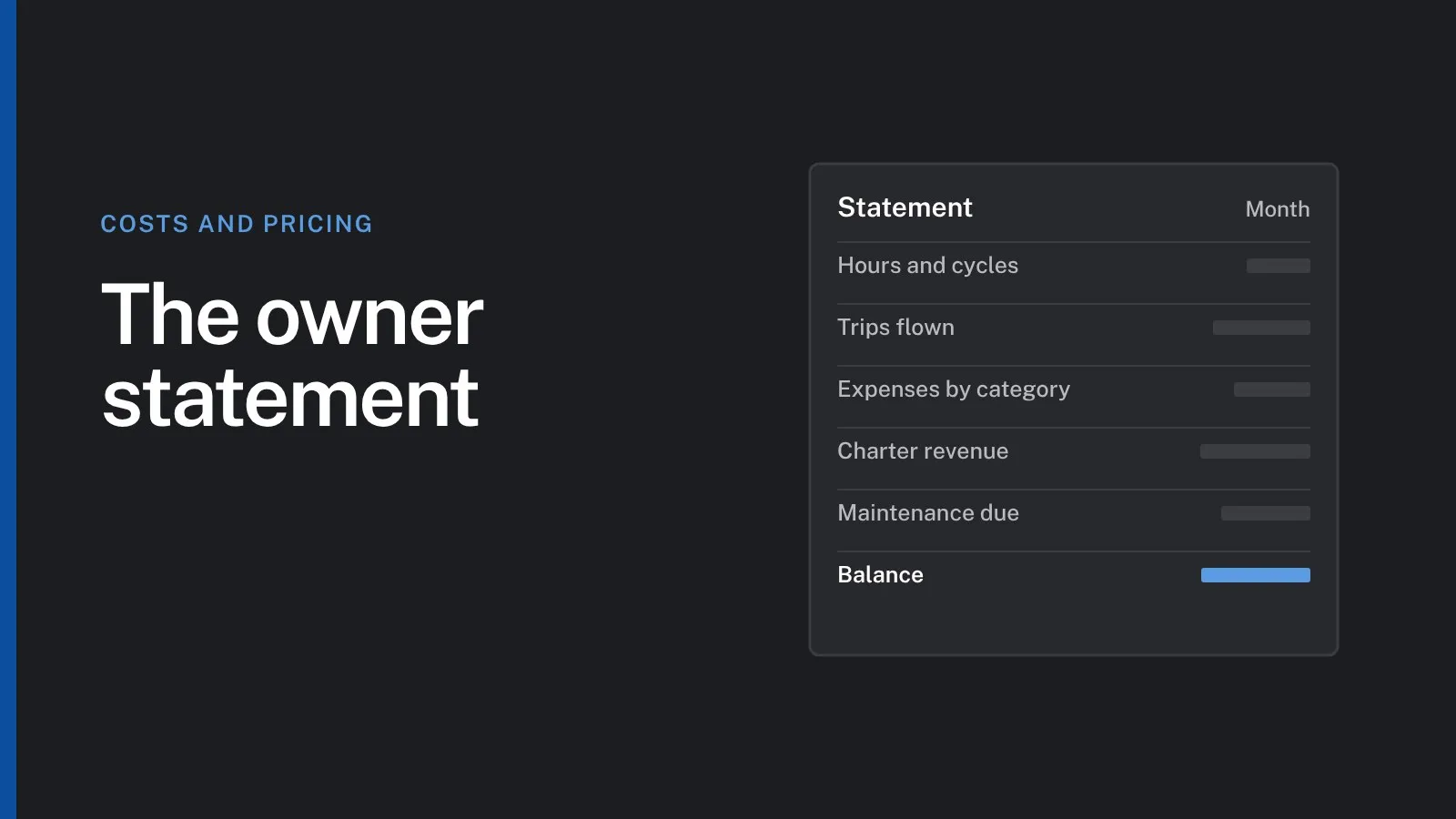
A monthly aircraft owner statement is the management company’s account to the owner of what the aircraft did and what it cost in the month. It should show hours and cycles flown with opening and closing totals, every trip by type, expenses by category with receipts behind them, charter revenue credited, fuel bought, maintenance done and coming due, and the owner’s balance with any funding request. Every number on it should trace to a record the owner can ask to see: a flight log entry, a receipt, a work order or a charter invoice.
All dollar figures below are illustrative, and round on purpose so the arithmetic is easy to follow. None is market data or a cost for any aircraft type. This article is general background and is not legal, tax or accounting advice.
Who sends an owner statement and what governs it
No FAA rule prescribes an owner statement. Its contents come from the management agreement, and NBAA’s Aircraft Operating and Leasing Guide lists reporting as a term to settle when the agreement is written: “With regard to aircraft recordkeeping, budgeting and reporting, indicate the types of reports the Customer will receive.” The same guide tells the parties to “Specify how the Provider is compensated for its services and how aircraft-related expenses are handled,” and notes that “The Customer can directly pay or reimburse the Provider for aircraft expenses.”
The statement applies to a managed aircraft flown under Part 91 for the owner, and equally to one that also flies charter under the management company’s Part 135 certificate. In the second case it has a revenue side, and the trip list has to separate the owner’s flights from the for-hire ones.
What the regulations do govern is the records under the statement. For an aircraft operated under Part 91, 14 CFR 91.417 requires “each registered owner or operator” to keep maintenance records, including “the total time in service of the airframe, each engine, each propeller, and each rotor” and “the current inspection status of the aircraft.” For aircraft a Part 135 certificate holder maintains under the maintenance program in 135.423 through 135.443 (required for aircraft type certificated for ten or more passenger seats, 14 CFR 135.411), 14 CFR 135.439 puts similar records on the certificate holder. The statement’s hours and maintenance sections should agree with those records.
What a monthly aircraft owner statement includes
The table lists the sections and the record each one comes from.
| Section | What it shows | Source record |
|---|---|---|
| Hours and cycles | Opening and closing airframe hours, landings, engine hours and cycles, APU | Flight log, aircraft counters |
| Trips by type | Each trip and leg, dated, with its type and who it was flown for | Trip records, flight log |
| Expenses by category | Fixed and variable charges, each with a vendor invoice or receipt | Approved expenses, vendor invoices |
| Charter revenue | Billed hours, rate, the owner’s share, any adjustments | Charter invoices, the agreement’s split |
| Fuel | Gallons, price and vendor by leg | Fuel tickets, fuel invoices |
| Maintenance | Work done with cost, items coming due, open defects and deferrals | Work orders, maintenance tracking |
| Balance and funding | Opening balance, charges, credits, closing balance, amount requested | The month’s ledger |
Hours and cycles flown
This section shows the month’s change in each counter the aircraft’s maintenance runs on: airframe hours, landings, engine hours and cycles for each engine, and APU hours if the APU is tracked. It should give the opening reading, the month’s flying and the closing reading, so this month’s opening can be checked against last month’s closing.
The statement should say which measure of time it uses. For maintenance records, 14 CFR 1.1 defines time in service as “the time from the moment an aircraft leaves the surface of the earth until it touches it at the next point of landing.” Block time runs longer, from when the aircraft first moves under its own power to when it comes to rest after landing. A statement that reports “42 hours” without saying which measure leaves the owner unable to check it against anything.
Trips by type
This section lists every flight in the month with its date, route, hours and landings, and a type. Useful types are owner flight, charter flight, positioning for an owner trip, positioning for a charter trip, maintenance flight and training flight. The hours of all the legs should add up to the month’s change in airframe hours.
The type matters beyond cost allocation:
- Excise tax. Amounts an owner pays for management services related to “flights on the aircraft owner’s aircraft” are exempt from the federal air transportation tax under 26 U.S.C. 4261(e)(5), while under 26 CFR 49.4261-10(e) “an amount paid by someone other than the aircraft owner for a for-hire flight on the aircraft owner’s aircraft is subject to the tax.” The statement is where the two kinds of flight are told apart. Our post on federal excise tax on aircraft management fees goes through the exemption.
- Operational control. The NBAA guide says the agreement “should clearly identify each type of flight contemplated and which party is in operational control.” The trip list is the monthly record of which was which.
- The owner’s tax records. For owner flights the list should carry who was aboard and the purpose of the trip, as covered under the tax adviser’s records below. The management company can only record what it is told, so the agreement should say who supplies both.
Expenses by category with receipts
This section lists what was spent on the aircraft in the month. Split it into fixed charges (management fee, crew salaries and benefits, hangar, insurance, training, subscriptions) and variable charges (fuel, maintenance, engine programs, trip expenses), using the same categories every month so one month can be laid next to another. Our guide to what a trip really costs explains the fixed, variable and per-trip buckets.
Each line should be supported by a vendor invoice or receipt, attached or available on request, and the statement should make three things plain:
- Pass-through or marked up. If the agreement lets the management company add a percentage to fuel, parts or outside services, the statement should show the vendor’s amount and the markup as separate figures.
- Which trip. Trip expenses (landing, handling, parking, catering, crew hotels and meals) should carry the trip they belong to. A crew hotel on a charter trip that lands in the owner’s expenses is an error only visible if the trip is named.
- Which month. Handling and parking invoices can arrive weeks after the flight. The statement should date each expense by when it was incurred and say when a late invoice from an earlier month has been added.
The Treasury regulation on the management services exemption ties the tax treatment to records as well. To qualify, “an aircraft owner and aircraft management services provider must maintain adequate records to show that the amounts paid by the aircraft owner to the aircraft management services provider relate to aircraft management services specifically for the aircraft owner’s aircraft or for flights on the aircraft owner’s aircraft” (26 CFR 49.4261-10(a)(3)). Paragraph (f) adds that the billing method, “whether by specific itemization of costs, flat monthly or hourly fee, or otherwise,” doesn’t change the exemption.
Charter revenue credited
If the aircraft flies charter under the management company’s Part 135 certificate, the statement credits the owner’s share. For each charter trip it should show the hours billed, the rate, the flight revenue, the owner’s percentage or fixed hourly fee, and the amount credited. It should not show federal excise tax as revenue, because the operator collects that from the customer for the IRS.
The owner should be able to recompute every credit from the agreement. Our post on how charter revenue is split between the aircraft owner and the operator covers the base of the split, positioning legs and bad debts.
Fuel
Fuel is the largest variable line in the sample below, and it gets its own section. For each uplift, show the date, airport, vendor, gallons, price per gallon and the leg or trip it was bought for. Totals by trip type follow from that.
Per-leg fuel allows two checks. Gallons divided by hours gives a burn rate that should sit close to the aircraft’s normal figure. And fuel bought on charter legs can be separated from fuel bought on owner legs, which matters when the agreement charges them differently and for fuel excise tax. IRS Publication 510 gives $0.044 per gallon for kerosene used in commercial aviation and $0.219 per gallon for other aviation use, each with conditions on delivery and registration, and NBAA notes that owner flights supported by a management company are subject to the non-commercial fuel tax.
Maintenance done and coming due
This section has two halves. The first lists work completed in the month: the work order or logbook reference, a short description, parts and labor, and whether it was scheduled, unscheduled or a repair of damage. The second looks ahead and lists inspections and components coming due in the next 90 days or so with an estimated cost, along with open defects and any items deferred under the MEL.
An owner who sees a heavy inspection three months out can fund it in steps. 14 CFR 91.403(a) says “The owner or operator of an aircraft is primarily responsible for maintaining that aircraft in an airworthy condition,” so an owner has reason to read this half closely even when the management company arranges all the work. Our post on aircraft maintenance tracking covers how due items are kept.
Hourly engine and APU program charges belong here or under expenses, with the hours they were computed on.
Balance and funding request
The last section is the owner’s account. It shows the opening balance of owner funds held, the month’s charges, the month’s credits, the closing balance, and the amount the owner is asked to send. If the agreement sets an operating deposit or minimum balance, the request is the amount that restores it. The statement should give the due date.
Sample owner statement layout
Every figure in this sample is illustrative. The aircraft is a managed twin-engine jet that flies for its owner under Part 91 and on charter under the management company’s Part 135 certificate.
Utilization, in hours of time in service
| Hours | Landings | |
|---|---|---|
| Opening airframe total | 4,212.6 | 3,105 |
| Owner flights | 14.2 | 9 |
| Charter flights | 21.5 | 12 |
| Positioning for charter | 4.8 | 5 |
| Maintenance and training flights | 0.9 | 1 |
| Flown this month | 41.4 | 27 |
| Closing airframe total | 4,254.0 | 3,132 |
Fuel
| Trip type | Arithmetic | Gallons |
|---|---|---|
| Owner flights | 14.2 hr × 240 gal | 3,408 |
| Charter flights | 21.5 hr × 240 gal | 5,160 |
| Positioning for charter | 4.8 hr × 240 gal | 1,152 |
| Maintenance and training flights | 0.9 hr × 240 gal | 216 |
| Total | 41.4 hr × 240 gal | 9,936 |
At an average of $5.50 per gallon, fuel for the month is 9,936 × $5.50 = $54,648. A real statement lists each uplift, and the gallons come from fuel tickets, not from hours times a burn rate.
Charter revenue
The rate card bills $5,000 per hour, and this month it billed all 21.5 passenger hours and 2.5 of the 4.8 positioning hours. The owner’s share under the agreement is 85% of flight revenue.
| Line | Arithmetic | Amount |
|---|---|---|
| Flight revenue billed | 24.0 hr × $5,000 | $120,000 |
| Owner’s share | 85% × $120,000 | $102,000 |
| Trip fees billed to charter customers at cost | recovered in full | $6,300 |
Account for the month
| Line | Arithmetic | Amount |
|---|---|---|
| Opening balance of owner funds | $60,000 | |
| Management fee | $9,000 | |
| Crew salaries and benefits | $38,000 | |
| Hangar | $7,500 | |
| Insurance, monthly share | $6,000 | |
| Training and subscriptions | $2,600 | |
| Fuel | 9,936 gal × $5.50 | $54,648 |
| Engine programs | 41.4 hr × 2 engines × $250 | $20,700 |
| Scheduled inspection | work order attached | $12,400 |
| Unscheduled maintenance | main tire replacement | $3,150 |
| Owner trip expenses | landing, handling, catering, crew travel | $4,820 |
| Charter trip expenses | $6,300 paid, $6,300 recovered | $0 |
| Total charges | $158,818 | |
| Charter revenue credit | from the table above | $102,000 |
| Net charges for the month | 158,818 − 102,000 | $56,818 |
| Closing balance | 60,000 − 56,818 | $3,182 |
| Funding request | to restore the $60,000 operating balance | $56,818 |
The unbilled positioning is visible in the sample. The aircraft flew 26.3 hours for charter (21.5 + 4.8) and billed 24.0, so the owner paid fuel and engine programs on 2.3 hours that earned nothing.
How to reconcile an owner statement to the flight log
Reconciling means recomputing the statement’s totals from the flight log and the agreement and questioning each difference. It takes six steps.
- Tie the counters. This month’s opening hours and landings equal last month’s closing. Opening plus flown equals closing: 4,212.6 + 41.4 = 4,254.0 hours, and 3,105 + 27 = 3,132 landings.
- Tie the legs to the total. Add the hours and landings of every leg in the flight log for the month. The sum should equal the statement’s hours flown, in the same measure of time.
- Check every leg has a type. Each leg is an owner flight, a charter flight, positioning, maintenance or training, and the hours by type add to the total: 14.2 + 21.5 + 4.8 + 0.9 = 41.4.
- Recompute the hourly charges. Engine programs, hourly maintenance reserves and any hourly crew or management charge should equal the rate times the flight log’s hours. Here, 41.4 × 2 × $250 = $20,700.
- Recompute the charter credit. Billed hours times rate times the owner’s share should equal the credit, and billed hours should be no more than the charter and positioning hours in the log: 24.0 billed against 26.3 flown.
- Match fuel to legs. Each uplift belongs to a leg that was flown from that airport on that date, and total gallons divided by total hours is near the aircraft’s normal burn: 9,936 ÷ 41.4 = 240 gallons per hour.
A reconciliation that finds a difference
Suppose the engine program charge on the sample statement had read $21,500 in place of $20,700.
| Check | Arithmetic | Result |
|---|---|---|
| Hours the charge implies | $21,500 ÷ (2 × $250) | 43.0 hr |
| Hours in the flight log | sum of the month’s legs | 41.4 hr |
| Difference in hours | 43.0 − 41.4 | 1.6 hr |
| Difference in dollars | 1.6 hr × 2 × $250 | $800 |
The 1.6 hours could be a leg from the first day of next month counted early, a correction to an earlier month, block time used where time in service applies, or a keying error. The question to the management company is specific: which legs make up the 43.0 hours. A flight log that keeps corrections and voided entries visible, in place of overwriting them, makes that question quick to answer.
Differences a reconciliation can surface
- Hours reported in block time in one section and time in service in another.
- A positioning leg typed as an owner flight, or the reverse, which moves its fuel and trip expenses to the wrong side.
- An expense entered twice, once from the crew’s receipt and once from the vendor’s invoice.
- A charter credit computed on a discounted rate the owner didn’t know about.
- A late invoice from an earlier month added without a note.
Records the owner’s tax adviser will ask for
The statement is also raw material for the owner’s tax return. Under 26 U.S.C. 274(d), no deduction is allowed for traveling expenses or “with respect to any listed property” unless the taxpayer substantiates “the amount of such expense,” “the time and place of the travel,” “the business purpose of the expense” and “the business relationship to the taxpayer of the person receiving the benefit.” Listed property includes “any other property used as a means of transportation” (26 U.S.C. 280F(d)(4)), with an exception for property used substantially in a for-hire transportation business.
That points to a flight-by-flight record: date, route, hours, each passenger, and why each passenger was aboard. How the rules apply to a particular owner, entity or lease is the adviser’s call.
Frequently asked questions
What is an aircraft owner statement?
It is the periodic report, monthly in this article, that an aircraft management company sends to the owner of a managed aircraft. It accounts for the flying done, the money spent, any charter revenue credited and the balance of the owner’s funds, and it asks for the next payment.
How often should an aircraft management company send an owner statement?
The management agreement sets the interval, and the NBAA guide advises that the agreement “indicate the types of reports the Customer will receive.” A monthly statement lines up with payroll and with vendors that invoice monthly. Whatever the interval, the statement should arrive on a fixed day so late invoices have a known cutoff.
Should receipts be attached to an owner statement?
The statement should at least list each expense with its vendor, date and trip, and the agreement should give the owner the right to see any receipt or invoice. Attaching them, or giving the owner access to them, saves a round of requests at every month end and at tax time.
Why don’t the hours on my owner statement match the flight log?
Likely causes are a different measure of time (block time against time in service), a leg dated in a different month, or a corrected entry. Ask for the list of legs behind the statement’s total and compare it leg by leg with the log.
Does the owner pay excise tax on the management fee?
Amounts an owner pays for aircraft management services on its own aircraft are exempt from the federal air transportation tax under 26 U.S.C. 4261(e)(5), provided the conditions in 26 CFR 49.4261-10 are met, including adequate records. Charter customers’ payments for for-hire flights on the same aircraft are taxed. Confirm your own position with a tax adviser.
Records behind a statement in Avion Desk
Avion Desk does not produce owner statements. It keeps the records one is built from: each leg logged as flown, with corrections and voids kept and never overwritten, fuel recorded per leg, expenses with their receipts and categories approved before they count, what each trip cost, and invoices with payments recorded against them. See the accounting features. To try it, start a free trial and enter one month of trips with their expenses, or request a demo.