The short answer to Part 91 vs Part 135: Part 91 is the general operating rulebook every civil aircraft flies under, and on its own it does not let you carry people or property for compensation. Part 135 is what an operator flies under when it sells air transportation, and it needs an FAA certificate and operations specifications first. Part 91 subpart K (Part 91K) sits between them: it covers fractional ownership programs, where owners fly their own aircraft under rules much closer to Part 135, managed by a program manager that holds FAA management specifications.
Which one applies depends on who has operational control of the flight and whether anyone is paying for the transportation, whatever the aircraft, the paint, or what the paperwork calls the arrangement.
What is the difference between Part 91, Part 135 and Part 91K?
14 CFR Part 119 is the gate. It applies to anyone operating “as an air carrier or commercial operator, or both, in air commerce,” and, for airplanes with fewer than 20 passenger seats and less than 6,000 pounds payload capacity, to noncommon carriage and “private carriage for compensation or hire,” except as provided in 91.501(b). 119.5(g) says no person may operate as a direct air carrier or commercial operator “without, or in violation of, an appropriate certificate and appropriate operations specifications.” For on-demand charter in business aircraft, that certificate leads to Part 135.
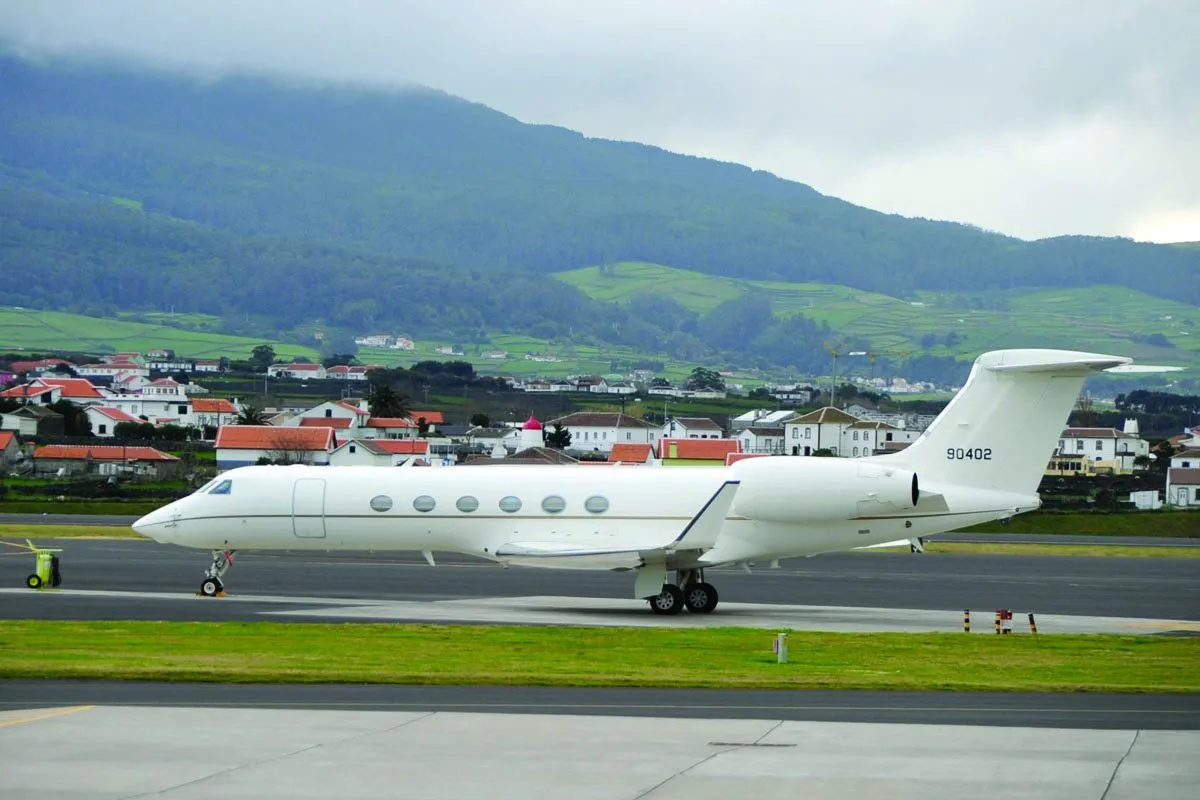 Photo: Chyrece Campbell, U.S. Air Force (public domain)
Part 119 also says that it “does not govern operations conducted under part 91, subpart K (when common carriage is not involved)” (119.1(d)). That is why a fractional program is not a charter certificate, even though its rules borrow heavily from Part 135.
Part 91 vs Part 135 vs Part 91K side by side
| Part 91 | Part 91K | Part 135 | |
|---|---|---|---|
| Who it’s for | Owners, companies and pilots flying for their own purposes, including corporate flight departments | Fractional owners and the program manager in a fractional ownership program (91.1001) | Operators selling on-demand or commuter air transportation |
| Certificate needed | None beyond pilot and aircraft certificates | Management specifications issued to the program manager (91.1015) | Air carrier or operating certificate plus operations specifications (119.5) |
| Compensation for transportation | Not allowed, except the limited charges in 91.501 for the aircraft it covers and private pilot cost sharing under 61.113(c) | Owners may not carry persons or property for compensation or hire on a program flight, except as provided in 91.321 or 91.501 (91.1005) | Allowed; it is what the certificate is for |
| Operational control | The operator of the aircraft, typically the owner or lessee; leases of large aircraft have to say who (91.23, AC 91-37B) | The owner on a program flight (91.1009), jointly responsible with the manager for tasks delegated to it (91.1011) | The certificate holder, which names the people authorized to exercise it (135.77) |
| Duty and rest | No regulatory flight, duty or rest limits for pilots; set by company policy | 91.1057 to 91.1059 | 135.267 for unscheduled one- and two-pilot crews |
| Pilot qualification | Part 61: certificate, ratings, type rating where required, recency, and a PIC proficiency check for multi-pilot or turbojet aircraft (61.58) | PIC 1,500 hours; ATP for multiengine turbine aircraft (91.1053); approved training program (91.1063 onward) | ATP for turbojets and 10+ passenger seats; 1,200 hours for IFR PIC otherwise (135.243); recurring tests and checks (135.293, 135.297, 135.299) |
| Maintenance program | 91.409: annual (and 100-hour if carrying people for hire); an inspection program the owner selects for large, turbojet and turboprop multiengine airplanes | Approved inspection program for each make and model (91.1109); a CAMP is optional (91.1411) | Up to 9 passenger seats: Parts 91 and 43 plus added 135 rules; 10 or more: a full maintenance program (135.411) |
| Weather, runway, fuel (high level) | Standard Part 91 fuel reserves (91.151, 91.167); landing distance from the flight manual | Higher minimums for new turbine PICs (91.1039); 60 percent landing rule for large transport category turbine airplanes (91.1037) | Weather reporting and destination minimums (135.219, 135.225); stricter alternate test (135.223); 60 percent rule (135.385) |
| Records | Maintenance records and pilot logbooks under the general rules | Pilot records, flight time, training and owner lists (91.1027) | Pilot records, flight time, checks and training; a load manifest for multiengine aircraft (135.63) |
Can a Part 91 operator charge for flights?
Mostly no. The default is that if someone pays for the transportation and you do not hold a certificate, the flight is illegal charter. There are a few narrow openings, and most of them live in Part 91 subpart F.
Subpart F applies only to “large airplanes of U.S. registry, turbojet-powered multiengine civil airplanes of U.S. registry, and fractional ownership program aircraft” operating under subpart K (91.501(a)). If your aircraft is a piston twin, a turboprop twin or a single-engine turboprop at or under 12,500 pounds maximum takeoff weight, the subpart F charges discussed below are not available to you under that section. Get advice before assuming otherwise.
What can a company charge under 91.501(b)(5)?
A company may carry its own officials, employees, guests and property on an airplane it (or its parent or subsidiary) operates, when the carriage is “within the scope of, and incidental to, the business of the company (other than transportation by air).” It may charge no more than “the cost of owning, operating, and maintaining the airplane.” There is one firm limit: “no charge of any kind may be made for the carriage of a guest of a company, when the carriage is not within the scope of, and incidental to, the business of that company” (91.501(b)(5)).
This is the paragraph behind intercompany chargebacks in a corporate flight department. It does not let the company sell seats to outsiders. If you charge back costs inside a corporate group, our post on flight department chargebacks goes deeper.
Time sharing, interchange and joint ownership
91.501(b)(6) allows carriage of company officials, employees and guests under three kinds of agreement, each defined in paragraph (c):
- Time sharing: “a person leases his airplane with flight crew to another person, and no charge is made for the flights conducted under that arrangement other than those specified in paragraph (d).” Paragraph (d) lists what may be charged per flight: fuel, oil, lubricants and additives; crew travel expenses; hangar and tie-down away from base; insurance for the specific flight; landing fees and airport taxes; customs and permit fees; in-flight food and beverages; passenger ground transportation; flight planning and weather services; and “an additional charge equal to 100 percent of the expenses listed in paragraph (d)(1),” which is the fuel line. No hourly rate or profit may be added.
- Interchange: a person leases an airplane to another “in exchange for equal time, when needed, on the other person’s airplane.” The only charge allowed is one “not to exceed the difference between the cost of owning, operating, and maintaining the two airplanes.”
- Joint ownership: “one of the registered joint owners of an airplane employs and furnishes the flight crew for that airplane and each of the registered joint owners pays a share of the charge specified in the agreement.”
Fractional owners can use some of these, with limits: under 91.501(b)(10) a fractional owner may not fly a joint ownership flight in a program aircraft, and interchange time has to be counted against the owner’s share of hours.
For leases of large civil aircraft, 91.23 also requires a written truth-in-leasing clause that identifies, among other things, the person responsible for operational control. The FAA’s guidance on leases and operational control is AC 91-37B, Truth in Leasing.
Cost sharing under 61.113(c)
61.113(c) is a private pilot rule, not an operator rule. It says a private pilot “may not pay less than the pro rata share of the operating expenses of a flight with passengers, provided the expenses involve only fuel, oil, airport expenditures, or rental fees.”
The FAA reads two more conditions into it. On its page for pilots, owners and operators, it says the pilot and passengers “must have a common purpose and the pilot cannot hold out as offering services to the public,” and that advertising “in any form (word of mouth, website, reputation, etc.) raises the question of ‘holding-out.’” Its guidance is AC 61-142.
What does “common carriage” mean, and why does it matter?
AC 120-12A, the FAA’s guidance on private versus common carriage, lists four elements: “(1) a holding out of a willingness to (2) transport persons or property (3) from place to place (4) for compensation.” Holding out does not require advertising; the AC says “a reputation to serve all is gained is sufficient.” Common carriage has to be conducted under Part 121 or 135.
Private carriage for hire (a few selected customers, usually on long-term contracts) is a separate category. Even then, for small airplanes, Part 119 still applies to “private carriage for compensation or hire” (119.1(a)(3)). The AC is old (1986) and refers to section numbers that have since moved, so read it for the concept and the current regulation for the rule.
How do duty and rest differ under each rule?
Part 91. Outside subpart K, Part 91 sets no flight time, duty or rest limits for pilots. The pilot in command is still responsible for the flight, and most corporate flight departments write their own duty policy into their operations manual. Our post on Part 91 duty time limits covers how departments build one.
Part 135. 135.267 applies to unscheduled one- and two-pilot crews:
- Flight time in all commercial flying may not exceed 500 hours in a calendar quarter, 800 in two consecutive quarters, or 1,400 in a calendar year (paragraph (a)).
- Paragraph (b): in any 24 consecutive hours, flight time “when added to any other commercial flying” may not exceed 8 hours for one pilot or 10 for two. Each assignment needs at least 10 consecutive hours of rest in the 24 hours before its planned completion (paragraph (d)).
- Paragraph (c) is the alternative: a regularly assigned duty period of no more than 14 hours, preceded and followed by at least 10 consecutive hours of rest, with the same 8 and 10 hour flight time caps, where duty and rest together equal 24 hours.
- If weather or other things outside anyone’s control push a crew past the daily limit, the next rest grows to 11, 12 or 16 hours depending on how far over (paragraph (e)).
- Each crewmember gets at least 13 rest periods of 24 consecutive hours each calendar quarter (paragraph (f)).
The details of tracks (b) and (c) are in our post on Part 135 duty time limits.
Part 91K. 91.1059 uses the same quarterly and annual caps and the same 8 and 10 hour limits, then adds a table: 10 hours minimum rest before duty, a duty period of up to 14 hours, flight time that may run to 9 hours (one pilot) or 12 (two pilots) only when extended by circumstances outside anyone’s control, and minimum rest after duty of 10 hours (12 if flight time was extended), or 14 hours (18 if extended) after a multi-time zone flight. 91.1057 defines duty, rest, standby and reserve, requires 10 consecutive hours of rest in the 24 hours before an assignment ends and 13 rest periods of 24 hours per quarter, and lets a program manager, “if authorized by the Administrator,” use the Part 121 or 135 limits instead. See Part 91K duty and rest.
What changes day to day for scheduling, crew tracking and records?
Scheduling. A Part 91 department schedules against its principal’s needs and its own policy. A Part 135 operator schedules against its operations specifications: the aircraft has to be listed, and the crew has to be inside 135.267 for the whole trip, including legs that may slip. A 91K program schedules program flights for owners and has to tell the owner whether a flight is a program flight or is being run under Part 121 or 135 (91.1007(c)). 135 and 91K trips also have to account for weather and runway rules that Part 91 leaves to the pilot’s judgment and the flight manual, such as the 60 percent landing distance rule for large transport category turbine airplanes (135.385, 91.1037) and higher minimums for a turbine PIC with under 100 hours as PIC in type (135.225, 91.1039).
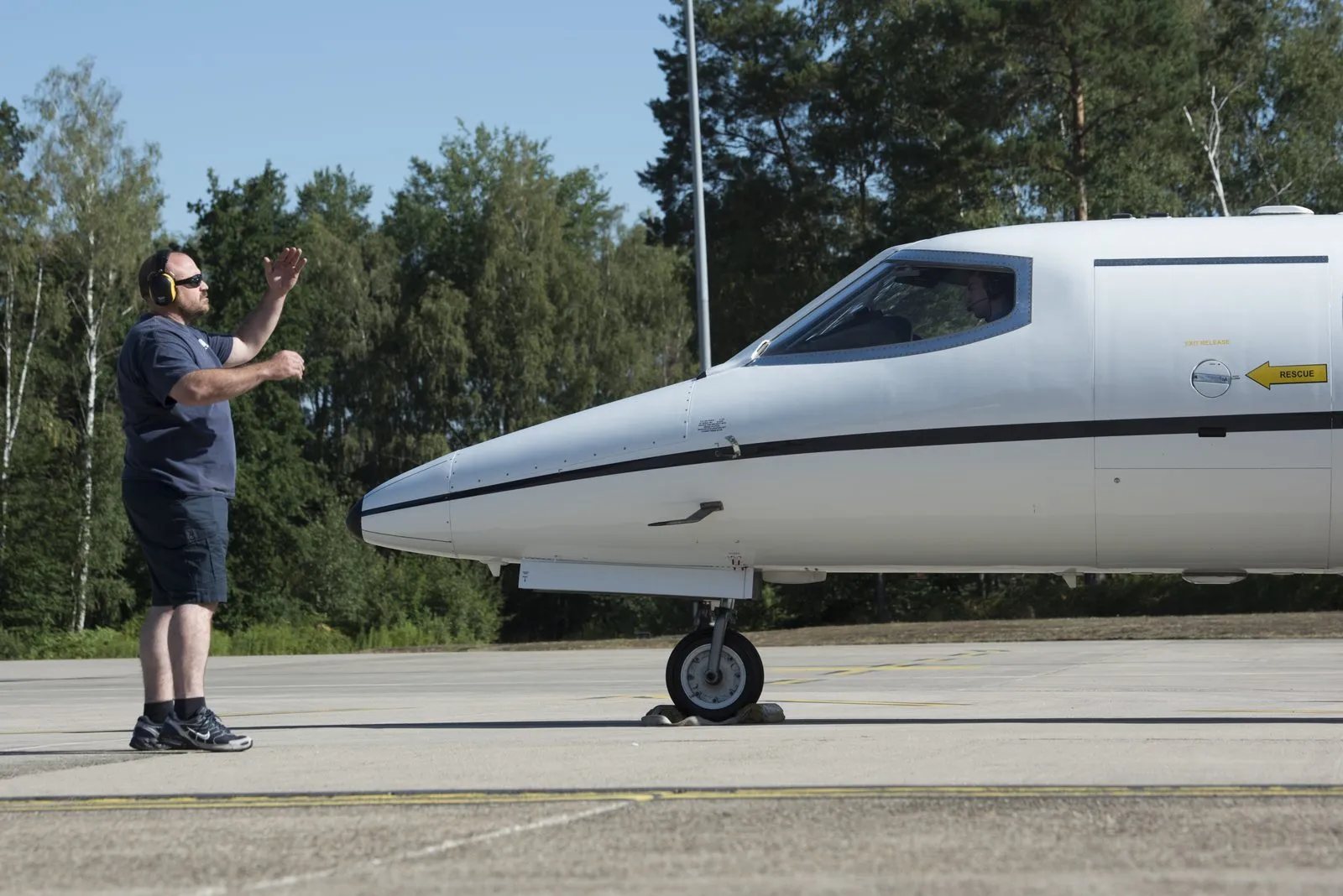 Photo: Airman 1st Class Taylor Slater, U.S. Air Force (public domain)
Crew tracking. Under Part 91 you track certificates, medicals, type ratings, recency and the proficiency checks Part 61 requires, plus whatever your own policy adds. Under 135 you add the operator’s own testing calendar: a knowledge test and competency check every 12 calendar months, an instrument proficiency check every 6 calendar months for IFR PICs, and a line check every 12 calendar months. You also need flight time “in sufficient detail to determine compliance with the flight time limitations” (135.63). Because 135.267 counts “any other commercial flying,” a pilot’s paid flying elsewhere counts too. 91K has an equivalent record list in 91.1027. Our post on pilot training and currency tracking covers the mechanics.
Records. Part 135 and 91K keep pilot records for at least 12 months and aircraft lists for at least 6 months, and a 135 operator prepares a load manifest before each takeoff in a multiengine aircraft (135.63). Part 91 operators keep maintenance records and logbooks under the general rules; anything beyond that is set by company policy.
Where are the gray areas, and what does illegal charter look like?
Sham dry leases. A dry lease is an aircraft leased with no crew, and the lessee takes operational control. The FAA warns about the “wet lease in disguise,” which happens “when one or more parties act in concert to provide an aircraft and at least one crewmember to a potential passenger,” for example two separate contracts, one for the aircraft and one for the pilot, or a lease conditioned on hiring specific pilots (FAA, Pilots, Owners, and Operators).
Time sharing priced like charter. If the invoice includes anything outside the 91.501(d) list, or the airplane isn’t one subpart F covers, it is not a time share.
Company aircraft carrying outsiders for money. 91.501(b)(5) covers the company’s own business. Selling a seat to a friend of the CEO is not within it.
The FAA’s warning signs. On its consumer page, the FAA lists red flags that a company may not be a legitimate operator:
- It provides the aircraft and at least one crewmember, “yet attempts to transfer operational control to a consumer via any document.”
- No Federal Excise Tax is charged; “legitimate operators have to charge this.”
- The price is too good to be true.
- No safety briefing or passenger briefing cards.
- Evasive answers to questions.
- Someone coaches passengers on what to say “if an FAA aviation inspector meets the aircraft at its destination.”
The FAA tells passengers to ask to see the operator’s certificate and confirm the aircraft is authorized for charter use.
Where to check and report. The FAA’s Safe Air Charter page links the current list of FAA-certificated charter operators, enforcement news, and the FAA Hotline at hotline.faa.gov for reporting suspected illegal charter. On its page for pilots, owners and operators, the FAA also points owners to the free General Aviation Dry Leasing Guide published by industry groups including NBAA and NATA.
Frequently asked questions
Is Part 91K the same as Part 135?
No. Part 91K is part of Part 91 and covers fractional ownership programs; Part 119, which governs Part 135 certificates, says it does not govern subpart K operations when common carriage is not involved. Many of the 91K crew, training and duty rules are close to Part 135, but the owner, not a certificate holder, has operational control of a program flight.
What is the minimum share for Part 91 subpart K?
A minimum fractional ownership interest is one-sixteenth of at least one subsonic fixed-wing or powered-lift program aircraft, or one-thirty-second of a rotorcraft (91.1001(b)(10)). Smaller interests can only be sold if those flights are operated under Part 121 or 135 by a certificated operator (91.1005(c)).
Can a Part 135 operator fly Part 91 legs?
Yes, some flights a certificate holder runs, such as ferry and training flights, are outside Part 119 (119.1(e)(3)) and are flown under Part 91. Paying passengers’ trips still fall under Part 135, and 135.267 counts other commercial flying toward a pilot’s limits.
Running Part 91, 135 and 91K in Avion Desk
In Avion Desk, duty and rest are checked whenever the schedule moves. Part 91 trips use a company duty policy you can edit. The plan for charter operators adds Part 135 duty and rest under §135.267 (track (b) or (c)) and Part 91K duty and rest under §91.1057 to §91.1059.
There are two plans: one for Part 91 operations, and one for charter operators that adds Part 135 and 91K, rate cards, quotes and the client portal. See crew, duty and rest and pricing. To try it, start a free trial and run your next trip through the duty check, or request a demo.
This article explains the rules in plain language and isn’t legal advice; the regulation text governs.