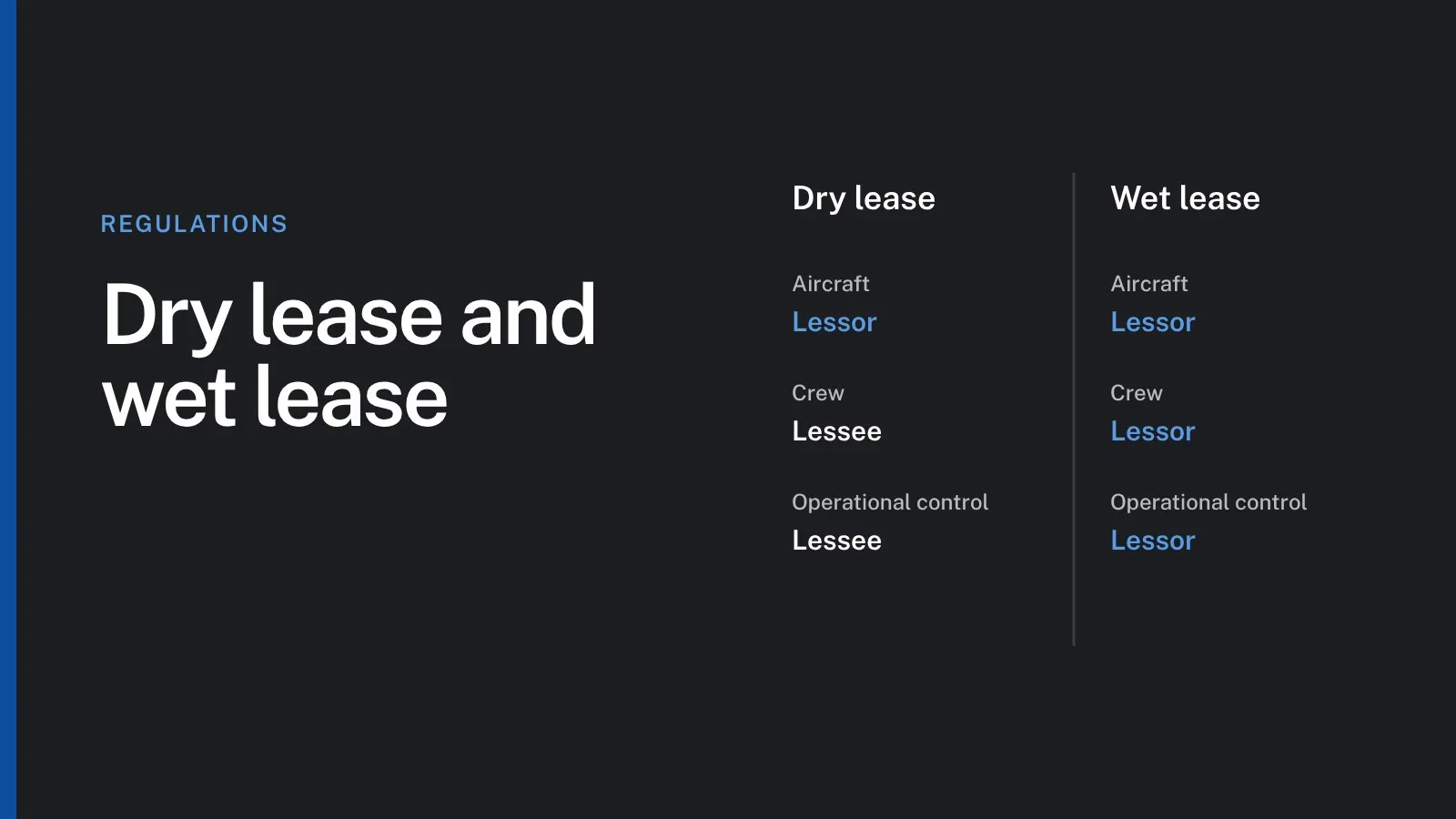
The difference between a dry lease and a wet lease is who supplies the crew, and with it who normally has operational control. In a wet lease the lessor provides “an entire aircraft and at least one crewmember” (14 CFR 110.2) and normally remains the operator. In a dry lease the aircraft comes without crew and the lessee normally becomes the operator. A flight becomes an illegal charter when the party that in fact supplies the aircraft and crew and runs the flight carries people or property for compensation without an air carrier or operating certificate, whatever the lease is called.
This article reads the regulations and the FAA’s Advisory Circular 91-37B, Truth in Leasing, in plain language. It is not legal advice. Whether a particular lease leaves operational control where the paper says is a question for aviation counsel.
Operational control under 14 CFR 1.1
The FAA’s definition is one sentence: “Operational control, with respect to a flight, means the exercise of authority over initiating, conducting or terminating a flight” (14 CFR 1.1). The same section defines “operate” as to “use, cause to use or authorize to use aircraft, for the purpose (except as provided in § 91.13 of this chapter) of air navigation including the piloting of aircraft, with or without the right of legal control (as owner, lessee, or otherwise).”
Operational control belongs to a flight, so it can sit with different parties on different days for the same airplane. And a person can be the operator without owning the aircraft, because “cause to use or authorize to use” is enough.
AC 91-37B says operational control “is not dependent on aircraft size or the number of aircraft operated” and is “a matter of legal responsibility,” and breaks it into three areas (paragraph 4.6):
| Area | What the party with operational control does, per AC 91-37B |
|---|---|
| Aircrew | Ensures crewmembers are trained and qualified and stay within flight, duty and rest requirements, “including designating a pilot in command (PIC) for each flight” |
| Aircraft | Ensures the aircraft “is Airworthy and is in compliance with applicable regulations” |
| Flight management | Sets the conditions under which a flight may be operated, such as weather minimums, loading, icing and fuel, and “handles the monetary and logistical issues associated with the aircrew and aircraft” |
Dry lease vs wet lease in the FAA’s words
Only the wet lease is defined in the regulations, in 110.2: “any leasing arrangement whereby a person agrees to provide an entire aircraft and at least one crewmember.” AC 91-37B supplies the other half: “Leasing of an aircraft without the crew is considered to be a dry lease” (paragraph 5).
| Dry lease | Wet lease | |
|---|---|---|
| What the lessor provides | The aircraft, without crew | “An entire aircraft and at least one crewmember” |
| Who normally has operational control | “The lessee exercises operational control of the aircraft” (AC 91-37B, 5.1) | “The lessor normally exercises operational control” (5.1) |
| Who normally is the operator | “When you dry lease an aircraft for your use, you normally become the aircraft operator” (6) | “The lessor is normally the aircraft operator” (6) |
| FAA certificate | The lessee doesn’t need one “as long as you do not carry persons or property for compensation or hire” (6.1) | A lessor that charges for aircraft and crew needs a certificate unless a Part 91 exception covers the flight |
The AC says “normally” for a reason: “The terms of the lease itself are important but since they may not reflect the true situation, the actual arrangements and responsibilities should be given very careful consideration” (5.1).
When a wet lease needs a Part 119 certificate
Part 119 applies to each person operating civil aircraft “as an air carrier or commercial operator, or both, in air commerce” (14 CFR 119.1(a)(1)). A commercial operator is “a person who, for compensation or hire, engages in the carriage by aircraft in air commerce of persons or property” (14 CFR 1.1).
The prohibition is in 14 CFR 119.5(g): “No person may operate as a direct air carrier or as a commercial operator without, or in violation of, an appropriate certificate and appropriate operations specifications.” Paragraph (k) extends it to anyone who would “advertise or otherwise offer to perform” such an operation without FAA authorization.
AC 91-37B connects this to leasing in paragraph 8.3:
“The FAA has taken the position that if a person leases an aircraft to another and also provides the flightcrew, fuel, and maintenance, the lessor of the aircraft is the operator. If the lessor makes a charge for the aircraft and services, other than as provided for in part 91 subpart F, the operation of the aircraft is subject to 14 CFR part 121, 125, 129, 135, or 137 depending upon the type or size of the aircraft as described in § 91.501.”
A wet lease for a charge is therefore the lessor’s operation, and unless a Part 91 exception covers the flight, the lessor needs a certificate.
Holding out is not required
A lessor that never advertises is still within Part 119. The FAA’s Advisory Circular 120-12A gives the four elements of common carriage: “(1) a holding out of a willingness to (2) transport persons or property (3) from place to place (4) for compensation.” Without the first element the operation is noncommon carriage, “an aircraft operation for compensation or hire that does not involve a holding out to others” (110.2), and Part 119 reaches that too (119.1(a)(2) and (a)(3)).
Wet leases Part 91 allows
Some leases with crew are lawful without a certificate, because 14 CFR 91.501 lists them. For large airplanes and turbojet-powered multiengine airplanes, a time sharing agreement is “an arrangement whereby a person leases his airplane with flight crew to another person, and no charge is made for the flights conducted under that arrangement other than those specified in paragraph (d)” (91.501(c)(1)). That is a wet lease by the 110.2 definition, permitted because the charge is capped at the listed expenses. Our post on flight department chargebacks covers time sharing, interchange and joint ownership charges, and the comparison of Part 91, Part 135 and Part 91K covers the operating rules on each side of the line.
Truth in leasing: what 14 CFR 91.23 requires
Section 91.23 applies to “a lease or contract of conditional sale involving a U.S.-registered large civil aircraft.” A large aircraft is one “of more than 12,500 pounds, maximum certificated takeoff weight” (14 CFR 1.1). For this section a lease is “any agreement by a person to furnish an aircraft to another person for compensation or hire, whether with or without flight crewmembers” (91.23(e)), so the rule covers dry leases and wet leases alike.
The truth-in-leasing clause
The parties must sign a written lease that includes “a written truth-in-leasing clause as a concluding paragraph in large print, immediately preceding the space for the signature of the parties” (91.23(a)). The clause has three parts:
- The regulations under which the aircraft “has been maintained and inspected during the 12 months preceding the execution of the lease,” and the parties’ certification of its maintenance and inspection status.
- “The name and address (printed or typed) and the signature of the person responsible for operational control of the aircraft under the lease,” with a certification “that each person understands that person’s responsibilities for compliance with applicable Federal Aviation Regulations.”
- A statement that an explanation of the factors bearing on operational control “can be obtained from the responsible Flight Standards office.”
AC 91-37B, Figure 1, is a sample.
The three steps before the first flight
Under 91.23(c), no person may operate a large civil aircraft subject to such a lease unless three things have been done:
| Step | Who | Deadline |
|---|---|---|
| Mail a copy of the lease to the FAA Aircraft Registration Branch in Oklahoma City | The lessee, “or the registered owner if the lessee is not a citizen of the United States” | “Within 24 hours of its execution” |
| Carry a copy of the lease in the aircraft | Whoever operates it | Every flight. It must be “made available for review upon request by the Administrator” |
| Notify the responsible Flight Standards office “by telephone or in person” of the departure airport, the departure time and the registration number | The lessee, or the registered owner as above | “At least 48 hours before takeoff in the case of the first flight of that aircraft under that lease,” unless the office authorizes otherwise |
For example, with illustrative dates: a lease signed on a Monday at 10:00 must be mailed by Tuesday at 10:00. If the first flight under it is planned for Friday at 14:00, the Flight Standards office must be notified by Wednesday at 14:00, which is 48 hours earlier.
Leases that 91.23 does not cover
The clause requirement does not apply when the party receiving the aircraft “is a foreign air carrier or certificate holder under part 121, 125, 135, or 141,” nor when certain certificated operators furnish it, including “a person operating under part 135 of this chapter having authority to engage in on-demand operations with large aircraft” (91.23(b)(1)).
Aircraft of 12,500 pounds or less are outside 91.23 as well. A light jet or turboprop under that weight needs no truth-in-leasing clause, but the operational control question and the Part 119 certificate rules apply to it in full.
Signs that a dry lease is really a charter
AC 91-37B describes the problem directly: “An example of this is a sham dry lease, in which you are provided with an aircraft on a lease basis, although it is actually serviced and flown by the leasing company” (6.2). Operational control “may remain with the lessor even though the lease is characterized as a dry lease,” so the FAA may “look at the actual manner in which the operations are conducted” (8.1).
The seven questions in AC 91-37B
Paragraph 6.3 lists questions that “can clarify who will maintain operational control,” regardless of how the lease is named. In summary:
- Who decides to assign crewmembers and aircraft, accept flight requests, and initiate, conduct and terminate flights?
- For whom do the pilots work as direct employees or agents?
- Who is maintaining the aircraft, and where?
- Before departure, who ensures the flight, aircraft and crew comply with the regulations?
- Who decides when and where maintenance is done, and who directly pays for it?
- Who determines weather and fuel requirements, and who directly pays for the fuel?
- Who directly pays for airport fees, parking and hangar costs, food service and rental cars?
The AC’s two notes give the consequences. If the lessee is responsible for any of these, it has “some operational control” and “will be held accountable for violations of 14 CFR for operation of the aircraft.” If the lessee is responsible for none of them, “then you do not have operational control and the aircraft is a wet lease requiring full compliance with the provisions of part 135 for air charter operations to carry passengers for hire.”
Red flags on the FAA’s Safe Air Charter pages
The FAA’s page for pilots, owners and operators describes the “wet lease in disguise,” which “occurs when one or more parties act in concert to provide an aircraft and at least one crewmember to a potential passenger.” It gives two forms: the passenger “enters into two independent contracts with the party that provides the aircraft and the pilot,” or the lessor conditions the lease, “whether directly or indirectly,” on a “professional services agreement with a specific pilot or group of pilots.”
The FAA’s dry lease red flags kneeboard card puts the questions to the pilot:
- “Am I the Lessor and the Pilot for the flight?”
- “Did the Lessor schedule me for this flight?”
- “Is the Lessor paying me directly for this flight?”
Its page for people chartering an aircraft adds signs a passenger can see, among them “a lack of Federal Excise Tax charged to the consumer.” The pilots and owners page also links a free General Aviation Dry Leasing Guide written by industry associations.
Worked example: the same money under two arrangements
Every figure below is illustrative. None is a market rate for any aircraft, pilot or fuel. A company uses a leased turboprop for 30 flight hours over 12 days in one month.
Arrangement A. The company signs a lease for the aircraft only, then arranges everything else itself.
| Payment | Arithmetic | Amount | Paid by the company to |
|---|---|---|---|
| Aircraft lease | 30 hr × $2,000 | $60,000 | The lessor |
| Maintenance | 30 hr × $400 | $12,000 | A shop the company selected |
| Pilots | 2 pilots × 12 days × $750 | $18,000 | Pilots the company chose and contracted |
| Fuel | 30 hr × $900 | $27,000 | Fuel vendors |
| Airport fees | one month’s total | $1,500 | Airports and FBOs |
| Total | 60,000 + 12,000 + 18,000 + 27,000 + 1,500 | $118,500 |
Arrangement B. The company signs a document titled “dry lease” and pays one invoice.
| Payment | Arithmetic | Amount | Paid by the company to |
|---|---|---|---|
| “Lease rate” | 30 hr × $3,950 | $118,500 | The lessor |
| Total | $118,500 |
Under B the lessor schedules and pays its own pilots, buys the fuel, arranges the maintenance and pays the airport fees out of the hourly rate. The company spends $118,500 either way, so the price doesn’t distinguish the two. The seven questions do:
| AC 91-37B question | Arrangement A | Arrangement B |
|---|---|---|
| 1. Assigns crew, accepts and initiates flights | Company | Lessor |
| 2. Pilots work for | Company, as its contractors | Lessor |
| 3. Maintains the aircraft | A shop the company selected | Lessor |
| 4. Checks compliance before departure | Company | Lessor |
| 5. Decides on and directly pays for maintenance | Company | Lessor |
| 6. Sets fuel and weather requirements, directly pays for fuel | Company | Lessor |
| 7. Directly pays airport and trip costs | Company | Lessor |
In B the company is responsible for none of the seven. By the AC’s second note it does not have operational control, and the arrangement is a wet lease that needs Part 135 compliance.
Arrangement A is not cleared by this table alone. If the lessor had required the company to use those two pilots as a condition of the lease, the FAA’s “wet lease in disguise” description would apply. Under A the company has also taken on the operator’s legal duties for crew qualification, airworthiness and every preflight decision.
Recording operational control for every flight
The record matters when the answer changes from flight to flight, as it does when an aircraft flies its owner under Part 91 on one day and flies charter under a Part 135 certificate on another.
Part 135 is explicit: “Each certificate holder is responsible for operational control and shall list, in the manual required by § 135.21, the name and title of each person authorized by it to exercise operational control” (14 CFR 135.77). Part 91 has no matching list, so the answer sits in the lease, in who employed the crew and in who made the decisions.
For each flight, the record that answers those questions is short:
- The rule the leg was flown under: Part 91, Part 91K or Part 135.
- The operator for that leg, by legal name, and the lease or agreement that makes it the operator.
- The pilot in command and who assigned the crew.
- Who accepted the trip request and who released the flight.
- Who was invoiced, by whom, and for what.
- For a large aircraft under lease: the dates the lease was mailed and the Flight Standards office notified.
The FAA says it will, on request, “determine whether the lessor or lessee has operational control,” based on “a careful review of the lease and any other circumstances regarding the actual operation” (AC 91-37B, 8.2). Records made at the time of each flight show the actual operation. The FAA is also pursuing these cases: its Safe Air Charter page reports “$18+ Million Levied Against Rogue Operators” as of this article’s date.
Frequently asked questions
Is a wet lease legal under Part 91?
Only in the forms Part 91 lists. A time sharing agreement under 14 CFR 91.501(c)(1) is a lease of an airplane with flight crew, allowed for the airplanes Subpart F covers when the charge stays within the expenses in 91.501(d). A wet lease for any other charge makes the flight subject to the certificated parts, per AC 91-37B paragraph 8.3.
What is a sham dry lease?
AC 91-37B describes it as an arrangement “in which you are provided with an aircraft on a lease basis, although it is actually serviced and flown by the leasing company.” The paper says dry lease and the operation is a wet lease.
Does truth in leasing apply to aircraft under 12,500 pounds?
No. 14 CFR 91.23 applies to U.S.-registered large civil aircraft, meaning more than 12,500 pounds maximum certificated takeoff weight. Operational control and the Part 119 certificate rules still apply to a lease of a smaller aircraft.
Can the aircraft owner supply the pilot under a dry lease?
A lease in which the lessor provides the aircraft and at least one crewmember is a wet lease by the 110.2 definition. The FAA’s Safe Air Charter guidance also flags a lessor that conditions the lease, “directly or indirectly,” on the lessee hiring a specific pilot or group of pilots. Have counsel review any link between the lessor and the pilots before the first flight.
Keeping the record of each flight in Avion Desk
Avion Desk does not decide who has operational control. It keeps the facts of each flight that the question turns on. In Company settings you check the rules you fly, Part 91, Part 91K or Part 135, and pick the one a new leg starts with. A trip can’t be released until it is confirmed, has its aircraft and its pilot in command, the aircraft is clear to fly and the risk assessment is answered. When a risk approval is needed, the approver’s name and written reason are kept. Every change to a trip is in its history, and each leg is logged as flown with corrections and voids kept. See the release features and trips. To try it, start a free trial and release one trip to see what is recorded, or request a demo.