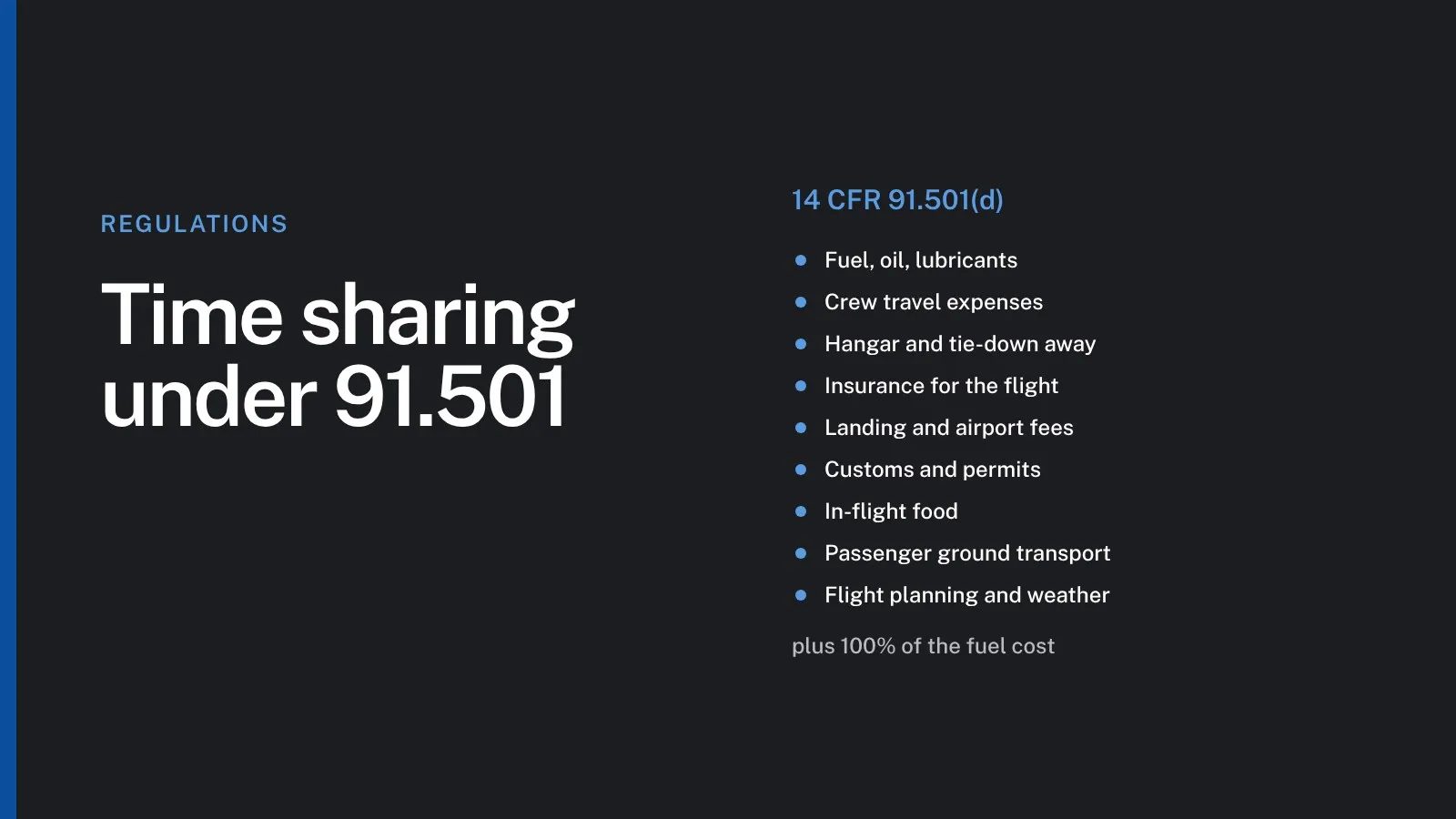
Under an aircraft time sharing agreement, the operator may charge only the ten expenses of the specific flight listed in 14 CFR 91.501(d): fuel, oil, lubricants and additives, crew travel, hangar and tie-down away from base, insurance bought for that flight, landing fees and airport taxes, customs and permit fees, in-flight food and beverages, passenger ground transportation, flight planning and weather services, and an additional charge equal to 100 percent of the fuel item. Crew salaries, maintenance, the home hangar, depreciation and profit are not on the list. The rule covers large airplanes, turbojet-powered multiengine airplanes and fractional program aircraft operated under Part 91, Subpart F.
This article explains the regulation for Part 91 flight departments and aircraft owners. It isn’t legal or tax advice, and every dollar figure in the worked example is illustrative.
Aircraft covered by Part 91 Subpart F
Time sharing exists only inside Subpart F of Part 91. Section 91.501(a) applies the subpart to “large airplanes of U.S. registry, turbojet-powered multiengine civil airplanes of U.S. registry, and fractional ownership program aircraft of U.S. registry that are operating under subpart K of this part in operations not involving common carriage.”
| Aircraft | In Subpart F? | Why |
|---|---|---|
| Airplane over 12,500 pounds maximum certificated takeoff weight | Yes | “Large aircraft” in 14 CFR 1.1 |
| Multiengine turbojet airplane of any weight | Yes | Named in 91.501(a) |
| Fractional program aircraft under Part 91K | Yes | Named in 91.501(a) |
| Turboprop or piston airplane of 12,500 pounds or less | No | Not large, not turbojet |
| Helicopter | No | 91.501(a) and (c)(1) speak of airplanes |
An operator outside the table’s first three rows can’t rely on 91.501 by itself. NBAA says aircraft “including piston airplanes, small airplanes, and all helicopters operated under the NBAA Small Aircraft Exemption can also make use of the cost reimbursement options allowed under Part 91, Subpart F” (NBAA, time sharing agreements). That exemption has its own conditions, so read it before using it. Our article on flight department chargebacks covers how Part 119 treats aircraft outside Subpart F.
Definition of a time sharing agreement in 91.501(c)(1)
Paragraph (b) of 91.501 lists operations that may be flown under Part 91 “instead of those in parts 121, 129, 135, and 137 of this chapter when common carriage is not involved.” Item (b)(6) is “the carriage of company officials, employees, and guests of the company on an airplane operated under a time sharing, interchange, or joint ownership agreement as defined in paragraph (c) of this section.” Paragraph (c)(1) then defines the term:
“A time sharing agreement means an arrangement whereby a person leases his airplane with flight crew to another person, and no charge is made for the flights conducted under that arrangement other than those specified in paragraph (d) of this section”
The definition has three parts, and each one does work:
- It is a lease. The owner or operator furnishes the airplane to another person, which brings in the truth-in-leasing rule for large aircraft described below.
- The airplane comes with flight crew. The party providing the airplane provides the pilots. The FAA’s advisory circular on leasing says “in a wet lease the lessor normally exercises operational control” (AC 91-37B), so the company providing the aircraft and crew remains the operator of the flight.
- The charge is capped by paragraph (d). A charge for anything else takes the arrangement outside the definition.
Two limits come from paragraph (b). Common carriage can’t be involved, so time sharing isn’t a way to hold the aircraft out to the public. And (b)(6) describes the carriage of “company officials, employees, and guests of the company.” If you plan to time share with an individual or for personal travel, confirm with aviation counsel that the flights fit.
Expenses a time sharing agreement may charge under 91.501(d)
Paragraph (d) says “the following may be charged, as expenses of a specific flight,” for time sharing under (c)(1), and also for demonstration flights under (b)(3) and carriage of property under (b)(7). The list, in the regulation’s own words:
(1) Fuel, oil, lubricants, and other additives. (2) Travel expenses of the crew, including food, lodging, and ground transportation. (3) Hangar and tie-down costs away from the aircraft’s base of operation. (4) Insurance obtained for the specific flight. (5) Landing fees, airport taxes, and similar assessments. (6) Customs, foreign permit, and similar fees directly related to the flight. (7) In flight food and beverages. (8) Passenger ground transportation. (9) Flight planning and weather contract services. (10) An additional charge equal to 100 percent of the expenses listed in paragraph (d)(1) of this section.
Expenses of a specific flight
Every item is tied to one flight. Items (1) through (9) are costs the flight itself caused, the kind that arrive as a fuel ticket, a hotel folio or an airport invoice.
“May be charged” sets a ceiling. The operator can charge less than the list allows, or nothing.
The fuel-times-two item in 91.501(d)(10)
Item (10) is the only item that isn’t an out-of-pocket cost. It allows “an additional charge equal to 100 percent of the expenses listed in paragraph (d)(1),” which are fuel, oil, lubricants and other additives. NBAA describes the result as “an amount equal to twice the cost of fuel used on the flight.”
Three things follow from the wording:
- The base is all of (d)(1), so oil and additives bought for the flight count along with fuel.
- The base is an expense “of a specific flight,” so it is the fuel that flight used at the price paid for it. A budget fuel rate per hour isn’t the flight’s expense.
- It is the only amount in a time sharing charge that can go toward maintenance, crew pay or ownership cost. None of those may be charged by name.
Costs that are not on the list
| Cost | On the 91.501(d) list? |
|---|---|
| Fuel, oil and additives used on the flight | Yes, (d)(1), and again under (d)(10) |
| Crew hotel, meals and ground transport on the trip | Yes, (d)(2) |
| Hangar or ramp parking at the destination | Yes, (d)(3) |
| Landing fees, airport taxes and similar assessments | Yes, (d)(5) |
| Catering | Yes, (d)(7) |
| Pilot salaries, benefits and contract pilot day rates | No |
| Maintenance reserves and engine or APU program charges | No |
| Hangar rent at the home base | No |
| Annual hull and liability insurance | No, only “insurance obtained for the specific flight” |
| Depreciation, interest or a margin | No |
The regulation doesn’t say how to treat a positioning leg flown to pick up the time sharing passengers. Settle that in the agreement with counsel before the first flight, and apply it the same way every time.
Worked example: a two-leg time sharing flight
All figures here are illustrative and round on purpose. They aren’t fuel prices, fees or costs for any aircraft type.
A company operates a midsize turbojet over 12,500 pounds. Under a time sharing agreement it flies three people from another company out and back, 1.8 hours each way, with one night at the destination.
| 91.501(d) item | Arithmetic | Charge |
|---|---|---|
| (1) Fuel | 3.6 hr × 220 gal per hr × $6.00 | $4,752 |
| (1) Oil | one purchase | $48 |
| (1) subtotal | 4,752 + 48 | $4,800 |
| (2) Crew travel | hotel 2 × $220, meals 2 pilots × 2 days × $60, ground transport $120 | $800 |
| (3) Hangar away from base | 1 night | $350 |
| (4) Insurance for the specific flight | none bought | $0 |
| (5) Landing fees and airport assessments | 2 landings × $150 | $300 |
| (6) Customs and permits | domestic flight | $0 |
| (7) In-flight food and beverages | 2 legs × $200 | $400 |
| (8) Passenger ground transportation | one charge | $250 |
| (9) Flight planning and weather services | one charge | $100 |
| (10) Additional charge | 100% × $4,800 | $4,800 |
| Most that may be charged | 4,800 + 800 + 350 + 300 + 400 + 250 + 100 + 4,800 | $11,800 |
If this operator’s fully allocated cost were $5,000 per flight hour, the same 3.6 hours would cost it $18,000. The time sharing charge recovers $11,800 of that. A time sharing agreement reimburses part of a flight’s cost and can’t be priced to cover the aircraft. Our guide to what a trip really costs shows how the fully allocated figure is built.
If federal excise tax applies to the payment (next section), the percentage tax is 7.5% × $11,800 = $885, and the 2026 domestic segment tax is 2 segments × 3 passengers × $5.30 = $31.80, for $916.80 of tax collected from the paying company.
Federal excise tax on time sharing payments
The FAA rule decides what may be charged. The Internal Revenue Code decides whether the amount charged is taxed. 26 U.S.C. 4261(a) imposes “on the amount paid for taxable transportation of any person a tax equal to 7.5 percent of the amount so paid,” plus a domestic segment tax that the IRS Instructions for Form 720 give as $5.30 per segment for calendar year 2026, multiplied by the number of passengers on a chartered aircraft.
In a time sharing flight one company provides the airplane and the crew and operates the flight, and another pays for it. The IRS looks at which party has possession, command and control of the aircraft to decide “whether a person is providing taxable transportation to another person” (T.D. 9948 preamble, Internal Revenue Bulletin 2021-6). A lessor that supplies aircraft and crew and keeps operational control fits that description, which is why time sharing payments are generally treated as taxable. NBAA puts it more cautiously: “Flights conducted under a timeshare agreement may be subject to a Federal Excise Tax.”
Four points to raise with your tax adviser before the first invoice:
- Who pays and who collects. The tax is “paid by the person making the payment subject to the tax” (4261(d)), and the Form 720 instructions say “the person receiving the payment for air transportation services must” collect it, submit it and file Form 720 for the quarter. The operator providing the time sharing flight is the one receiving the payment.
- Small aircraft. 26 U.S.C. 4281 exempts aircraft of 6,000 pounds or less maximum certificated takeoff weight not operated on an established line, but not “a jet aircraft.” Subpart F airplanes are large or turbojet, so this exemption won’t reach them.
- Affiliated groups. 26 U.S.C. 4282 exempts payments between members of an affiliated group for an aircraft not available for hire by nonmembers, judged “on a flight-by-flight basis.”
- Management fees are a different payment. The exemption for amounts an owner pays its management company doesn’t cover what a time sharing lessee pays the operator. See federal excise tax on aircraft management fees.
Truth-in-leasing requirements of 14 CFR 91.23
A time sharing agreement is a lease, and 14 CFR 91.23 defines a lease as “any agreement by a person to furnish an aircraft to another person for compensation or hire, whether with or without flight crewmembers.” The section applies to leases “involving a U.S.-registered large civil aircraft,” meaning over 12,500 pounds. For those aircraft the parties “shall execute a written lease” with a truth-in-leasing clause “as a concluding paragraph in large print, immediately preceding the space for the signature of the parties.”
The clause must contain three things (91.23(a)):
- The regulations under which the aircraft was maintained and inspected during the preceding 12 months, and the parties’ certification of its compliance with the maintenance and inspection requirements for the operation to be conducted.
- “The name and address (printed or typed) and the signature of the person responsible for operational control of the aircraft under the lease,” with a certification that each person understands that responsibility.
- A statement that an explanation of operational control and the pertinent regulations “can be obtained from the responsible Flight Standards office.”
Paragraph (c) then sets three conditions on operating the aircraft:
| Step | Who | When |
|---|---|---|
| Mail a copy of the lease to the Aircraft Registration Branch, Attn: Technical Section, P.O. Box 25724, Oklahoma City, OK 73125 | The lessee, or the registered owner if the lessee isn’t a U.S. citizen | “within 24 hours of its execution” |
| Carry a copy of the lease in the aircraft | The person operating the aircraft | Every flight under the lease |
| Notify the responsible Flight Standards office “by telephone or in person” of the departure airport, the departure time and the registration number | The lessee, or the registered owner if the lessee isn’t a U.S. citizen | “at least 48 hours before takeoff in the case of the first flight of that aircraft under that lease” |
The regulation puts the mailing and the notice on the lessee, which in a time sharing agreement is the company receiving the flights. But “no person may operate” the aircraft under the lease unless all three are done, so the flight department providing the airplane should confirm them itself. Paragraph (b) excepts certain leases to or from certificate holders. AC 91-37B says filing under 91.23 “does not constitute filing under 14 CFR part 47 or 49 to register the aircraft, or to record for public notice.”
A multiengine turbojet of 12,500 pounds or less is in Subpart F but isn’t a large aircraft, so 91.23 doesn’t apply to it by its terms. The FAA’s circular still urges “any person who is seeking to lease an aircraft” to understand operational control, and a written agreement is the place to record it.
Time sharing compared with interchange and joint ownership
Paragraph (c) defines two other agreements beside time sharing, and (b)(5) covers flights inside a corporate family. The definitions are quoted in full in our chargebacks article. The table shows how the four differ in practice.
| Time sharing (c)(1) | Interchange (c)(2) | Joint ownership (c)(3) | Company carriage (b)(5) | |
|---|---|---|---|---|
| Who provides the crew | The party providing the airplane | The regulation doesn’t say | One registered joint owner | The operating company |
| Second airplane needed | No | Yes, “equal time, when needed, on the other person’s airplane” | No | No |
| Other party’s tie to the airplane | None needed | Has its own airplane | Is a registered joint owner | Parent, subsidiary or subsidiary of the parent |
| Ceiling on the charge | The (d) list | “the difference between the cost of owning, operating, and maintaining the two airplanes” | “a share of the charge specified in the agreement” | “the cost of owning, operating, and maintaining the airplane” |
Time sharing is the only one of the four that works when the other party owns no airplane, holds no share of this one and sits outside the corporate family. It also recovers the least. For fractional owners, 91.501(b)(10) allows these operations in a program aircraft “except that a flight under a joint ownership arrangement under paragraph (b)(6) of this section may not be conducted.”
Charges above the 91.501(d) list
A charge beyond the list takes the flight out of the time sharing definition, and with it out of 91.501(b). AC 91-37B states the consequence: “If the lessor makes a charge for the aircraft and services, other than as provided for in part 91 subpart F, the operation of the aircraft is subject to 14 CFR part 121, 125, 129, 135, or 137 depending upon the type or size of the aircraft as described in § 91.501.”
Three patterns to keep off a time sharing invoice:
- A flat hourly rate with no tie to the flight’s actual (d) expenses.
- A line for crew, maintenance, hangar at base or an administration fee.
- Fuel billed at a budget figure higher than what the flight used and what was paid for it.
Build each invoice from the flight’s own receipts, one line per (d) item, with the fuel base and the additional charge shown separately. Our comparison of Part 91, Part 135 and Part 91K covers what changes when a flight is carriage for compensation under a certificate.
Frequently asked questions
Can I charge for pilot salaries under a time sharing agreement?
No. The 91.501(d) list allows “travel expenses of the crew, including food, lodging, and ground transportation,” and nothing for crew pay. The only amount beyond out-of-pocket costs is the additional charge equal to 100 percent of fuel, oil, lubricants and other additives under (d)(10).
Does twice the fuel mean fuel plus two more times fuel?
No. Item (d)(1) allows the fuel expense itself, and (d)(10) allows “an additional charge equal to 100 percent” of the (d)(1) expenses. Together that is two times the (d)(1) amount, not three.
Does a time sharing agreement have to be filed with the FAA?
For a U.S.-registered large civil aircraft, yes. 14 CFR 91.23 requires a copy of the written lease to be mailed to the Aircraft Registration Branch in Oklahoma City within 24 hours of execution, a copy carried in the aircraft, and notice to the responsible Flight Standards office at least 48 hours before the first flight.
Is federal excise tax due on time sharing flights?
Generally yes, unless an exemption such as the affiliated group rule in 26 U.S.C. 4282 applies. The 7.5% tax and the segment tax fall on amounts paid for taxable transportation, and the operator receiving the payment collects them. Confirm your own case with a tax adviser.
Can a turboprop or piston airplane be operated under a time sharing agreement?
Not under 91.501 alone unless it is a large airplane or a fractional program aircraft, because Subpart F covers large airplanes, turbojet-powered multiengine airplanes and fractional program aircraft. NBAA says operators under its Small Aircraft Exemption can use the Subpart F cost reimbursement options.
Time sharing flight records in Avion Desk
Avion Desk records the fuel uplift on each leg against your vendors and their prices, and keeps each trip’s expenses with their receipts and categories, counted only after they’re approved. Each trip shows what it cost, rolled up, and you can issue a printable invoice, a credit note for a correction, and record the payment. Which expenses belong on a time sharing invoice stays your decision under 91.501(d). See the accounting features. To try it, start a free trial and enter one recent trip with its fuel and receipts, or request a demo.