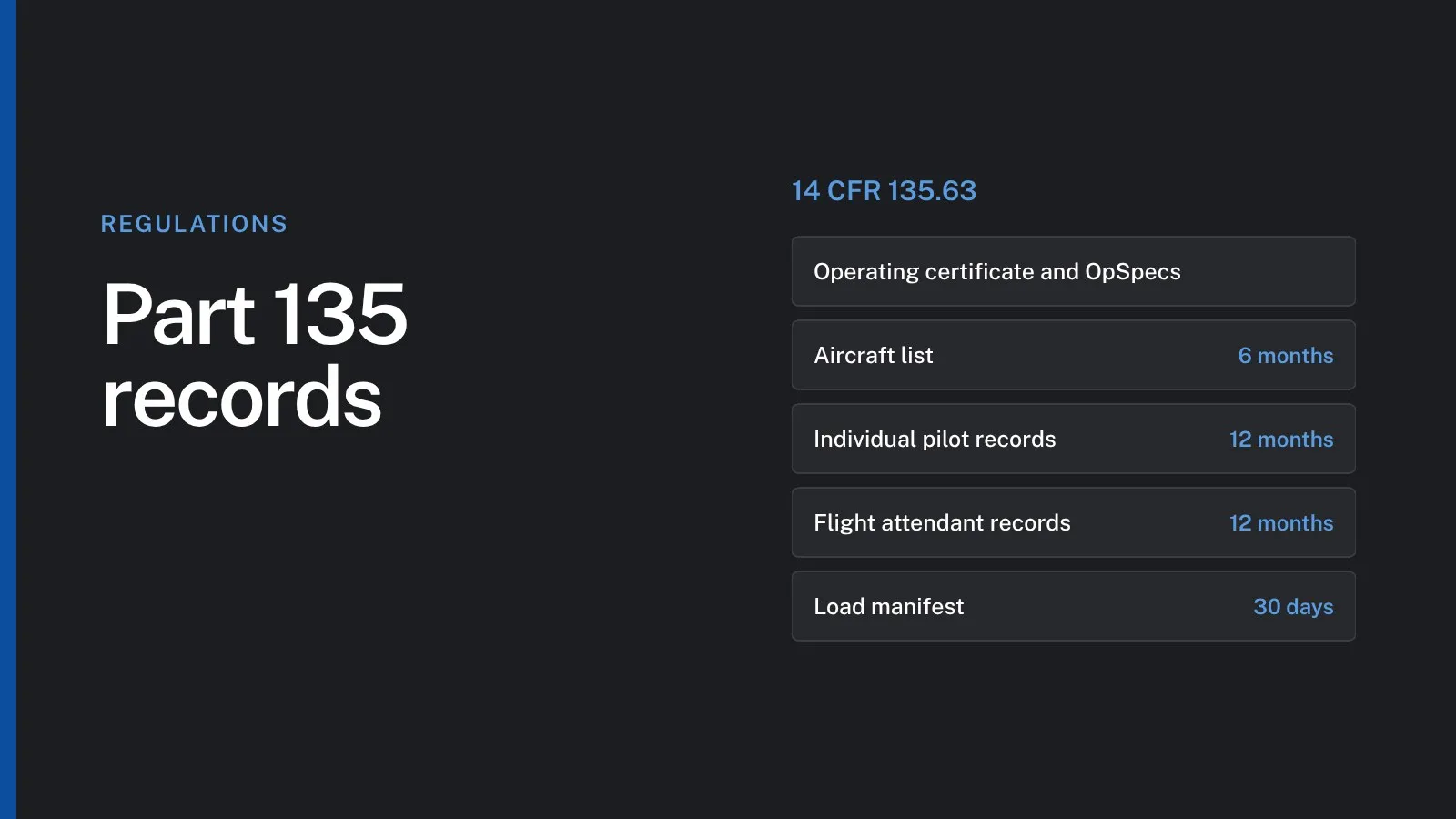
The core Part 135 recordkeeping requirements are in 14 CFR 135.63. A certificate holder must keep its operating certificate, its operations specifications, a current aircraft list (each kept at least 6 months), an individual record of each pilot (at least 12 months) and of each required flight attendant (at least 12 months), and, for multiengine aircraft, a load manifest for every takeoff (at least 30 days). Section 135.65 adds an aircraft maintenance log carried on board each aircraft, and other parts of 14 CFR add maintenance, pilot records database, drug and alcohol testing, hazardous materials training and safety management system records with their own periods.
This article explains the rules in plain language and isn’t legal advice. The regulation text governs, your operations specifications and manual can add to it, and your principal operations inspector (POI) decides what your certificate’s record system has to look like.
Part 135 records and retention at a glance
| Record | Contents | Minimum retention | Section |
|---|---|---|---|
| Operating certificate | The certificate itself | Kept and available for inspection. No period stated | 135.63(a)(1) |
| Operations specifications | The current operations specifications | Kept and available for inspection. No period stated | 135.63(a)(2) |
| Aircraft list | Aircraft “used or available for use” and “the operations for which each is equipped” | 6 months | 135.63(a)(3), (b) |
| Individual pilot record | The ten items in (a)(4)(i) to (x), listed below | 12 months | 135.63(a)(4), (b) |
| Flight attendant record | Enough detail to show compliance with 135.273 | 12 months | 135.63(a)(5), (b) |
| Load manifest, multiengine aircraft | The eight items in (c)(1) to (8), listed below | 30 days | 135.63(c), (d) |
| Aircraft maintenance log | Mechanical irregularities, their correction or deferral | No period in 135.65. Copies kept under the manual’s procedure | 135.65 |
| Maintenance records, 9 passenger seats or fewer | Work performed, total time, life-limited parts, inspection and AD status | Work records 1 year or until superseded. Status records go with the aircraft when sold | 91.417 through 135.411(a)(1) |
| Maintenance records, 10 passenger seats or more | Airworthiness release records and the same status records | Same pattern, plus the last complete overhaul until superseded | 135.439 |
| Hazardous materials training | Name, completion date, materials, provider, test certification | Training in the preceding 3 years, and 90 days after the person leaves the function | 135.507 |
| SMS records | Risk management and safety assurance outputs, training, communications | From 24 months to as long as a control remains relevant | 5.97 |
The periods are minimums. Nothing in 135.63 stops an operator from keeping records longer, and an operator’s manual may require it.
Operator records under 135.63(a)(1) to (a)(3)
Section 135.63(a) applies to each certificate holder operating under Part 135. It must keep the listed records “at its principal business office or at other places approved by the Administrator” and “make available for inspection by the Administrator” each of them. The first three describe the operation:
- “The certificate holder’s operating certificate”
- “The certificate holder’s operations specifications”
- “A current list of the aircraft used or available for use in operations under this part and the operations for which each is equipped”
The aircraft list is the one that changes. An aircraft added, one removed, or a change in what an aircraft is equipped for each makes a new list. Paragraph (b) says the operator “must keep each record required by paragraph (a)(3) of this section for at least 6 months.” The section does not say when the 6 months start. A practical reading is to date each version of the list and keep it for 6 months after a newer one replaces it, and to confirm that reading with your POI.
The individual pilot record under 135.63(a)(4)
The operator must keep “an individual record of each pilot used in operations under this part.” The words are “each pilot used,” so a part-time or contract pilot has a record too. Our article on contract pilots under Part 91 and Part 135 covers what that takes. The record includes “the following information,” quoted from 135.63(a)(4):
- “The full name of the pilot.”
- “The pilot certificate (by type and number) and ratings that the pilot holds.”
- “The pilot’s aeronautical experience in sufficient detail to determine the pilot’s qualifications to pilot aircraft in operations under this part.”
- “The pilot’s current duties and the date of the pilot’s assignment to those duties.”
- “The effective date and class of the medical certificate that the pilot holds.”
- “The date and result of each of the initial and recurrent competency tests and proficiency and route checks required by this part and the type of aircraft flown during that test or check.”
- “The pilot’s flight time in sufficient detail to determine compliance with the flight time limitations of this part.”
- “The pilot’s check pilot authorization, if any.”
- “Any action taken concerning the pilot’s release from employment for physical or professional disqualification.”
- “The date of the completion of the initial phase and each recurrent phase of the training required by this part”
The numbers 1 to 10 here stand for the regulation’s (i) to (x). Each record must be kept “for at least 12 months” (135.63(b)).
Tests, checks and training in the pilot record
Items 6 and 10 are the record of the pilot’s Part 135 qualification: the 135.293 knowledge test and competency check, the 135.297 instrument proficiency check, the 135.299 line check and the training phases of 135.343. Each entry needs three things: the date, the result and the aircraft type flown. A failed check is a result and belongs in the record.
Other sections say who writes the entry. The check pilot “certifies the competency of each pilot who passes the knowledge or flight check in the certificate holder’s pilot records” (135.293(f)). The line check is certified “in the pilot training record” (135.299(b)). For training, the instructor’s or check pilot’s certification “shall be made a part of the crewmember’s record,” and when it is made “by an entry in a computerized recordkeeping system, the certifying instructor, supervisor, or check pilot, must be identified with that entry” (135.323(c)). Our guide to pilot currency tracking covers the intervals and the grace month.
Flight time and duty records for 135.267
Item 7 does not prescribe a form. It sets a test: the flight time record must be detailed enough “to determine compliance with the flight time limitations of this part.” For an on-demand operator with one- or two-pilot crews, those limits are in 135.267, and reading that section shows what the record has to hold:
| Limit in 135.267 | What the record needs to show it |
|---|---|
| 500 hours in a calendar quarter, 800 in two consecutive quarters, 1,400 in a calendar year, in “all commercial flying” (a) | Flight time by date, with flying for other operators included |
| 8 hours (one pilot) or 10 hours (two pilots) in “any 24 consecutive hours” (b) | The start and end time of each flight, not only a daily total |
| A regularly assigned duty period of no more than 14 hours with 10 hours of rest before and after (c) | Duty on and duty off times |
| “At least 10 consecutive hours of rest during the 24-hour period that precedes the planned completion time” (d) | The time each rest period began and ended, and the planned completion time |
| Longer rest after an overrun beyond the operator’s control (e) | Planned and actual flight time, and the reason for the overrun |
| “At least 13 rest periods of at least 24 consecutive hours each in each calendar quarter” (f) | Each rest period of 24 hours or more, by date |
The rule’s wording asks for flight time. Duty and rest times are how an operator shows that paragraphs (c), (d) and (f) were met, so they belong in the same record. For how the limits work, see our article on Part 135 duty time limits.
Worked example: why daily totals are not enough
Every figure here is illustrative. A two-pilot crew flies under 135.267(b), where the limit is 10 hours of flight time in any 24 consecutive hours.
| Day | Leg | Block out | Block in | Flight time |
|---|---|---|---|---|
| Monday | 1 | 0800 | 1000 | 2.0 |
| Monday | 2 | 1500 | 1900 | 4.0 |
| Tuesday | 3 | 0700 | 1000 | 3.0 |
| Tuesday | 4 | 1100 | 1430 | 3.5 |
A record that holds only daily totals shows Monday at 2.0 + 4.0 = 6.0 hours and Tuesday at 3.0 + 3.5 = 6.5 hours. Both look well under 10.
The rule counts any 24 consecutive hours, not calendar days. Take the 24 hours from 1500 Monday to 1500 Tuesday: leg 2 (4.0) + leg 3 (3.0) + leg 4 (3.5) = 10.5 hours. That is 0.5 hours over the two-pilot limit, and only the record with the time of each flight shows it. The rest between the days passes in this example, at 1900 to 0700 with 30 minutes of duty at each end, which leaves 1930 to 0630 or 11.0 hours.
The load manifest for multiengine aircraft under 135.63(c)
Paragraph (c) applies “for multiengine aircraft.” The certificate holder “is responsible for the preparation and accuracy of a load manifest in duplicate containing information concerning the loading of the aircraft,” and the manifest “must be prepared before each takeoff.” It must include, quoted from 135.63(c):
- “The number of passengers”
- “The total weight of the loaded aircraft”
- “The maximum allowable takeoff weight for that flight”
- “The center of gravity limits”
- “The center of gravity of the loaded aircraft, except that the actual center of gravity need not be computed if the aircraft is loaded according to a loading schedule or other approved method that ensures that the center of gravity of the loaded aircraft is within approved limits. In those cases, an entry shall be made on the manifest indicating that the center of gravity is within limits according to a loading schedule or other approved method”
- “The registration number of the aircraft or flight number”
- “The origin and destination”
- “Identification of crew members and their crew position assignments”
Three points are easy to miss. The manifest is per takeoff, so a three-leg day has three manifests. Item 1 asks for the number of passengers, not their names, although an operator may have other reasons to list names. Item 3 is the maximum allowable takeoff weight “for that flight,” which can be lower than the certificated maximum when runway, climb or landing weight limits apply.
Carrying and keeping the load manifest
Paragraph (d) splits the two copies. “The pilot in command of an aircraft for which a load manifest must be prepared shall carry a copy of the completed load manifest in the aircraft to its destination.” The certificate holder “shall keep copies of completed load manifests for at least 30 days at its principal operations base, or at another location used by it and approved by the Administrator.”
As an illustration, a manifest for a takeoff on March 3 has to be on file through at least April 2. The copy has to reach the base, so the manual should say how. Paragraph (c) does not name single-engine aircraft, so a single-engine operator’s weight and balance records come from its own manual and operations specifications.
The aircraft maintenance log and mechanical irregularities under 135.65
Section 135.65 has four paragraphs, and each one puts a duty on a different person:
| Paragraph | Who | Duty, quoted from 135.65 |
|---|---|---|
| (a) | The certificate holder | “provide an aircraft maintenance log to be carried on board each aircraft for recording or deferring mechanical irregularities and their correction” |
| (b) | The pilot in command | “enter or have entered in the aircraft maintenance log each mechanical irregularity that comes to the pilot’s attention during flight time” |
| (b) | The pilot in command | “Before each flight,” if the pilot does not already know, “determine the status of each irregularity entered in the maintenance log at the end of the preceding flight” |
| (c) | Each person who corrects or defers | “record the action taken in the aircraft maintenance log under the applicable maintenance requirements of this chapter” |
| (d) | The certificate holder | “establish a procedure for keeping copies of the aircraft maintenance log required by this section in the aircraft for access by appropriate personnel” and put it in the manual required by 135.21 |
Section 135.65 states no retention period for the log. How many pages or days of the log stay in the aircraft, and where completed pages go, is set by the procedure in the operator’s manual under paragraph (d). For deferrals under Part 91, see our article on inoperative equipment under 91.213.
Maintenance records beyond the log
The log is the pilot-facing record. The maintenance records behind it depend on the aircraft’s seating, under 135.411(a):
- Nine passenger seats or fewer. The aircraft is “maintained under parts 91 and 43,” so the records are those of 91.417. Records of maintenance and inspections are kept “until the work is repeated or superseded by other work or for 1 year after the work is performed.” Total time in service, life-limited parts status, time since overhaul, inspection status and airworthiness directive status are “retained and transferred with the aircraft at the time the aircraft is sold.”
- Ten passenger seats or more. The aircraft is maintained under the maintenance program of 135.423 through 135.443, and 135.439 sets the records. The periods follow the same pattern, and records of the last complete overhaul are kept “until the work is superseded by work of equivalent scope and detail.” Such an aircraft may not be operated after maintenance without an airworthiness release or log entry under 135.443.
Records required outside 135.63
A Part 135 operator’s record system also has to hold records that other parts require.
- Pilot Records Database, 14 CFR part 111. The operator reports training, qualification and proficiency records that it maintains under 135.63(a)(4), “within 30 days of the effective date of the record” (111.225, 111.215(a)). Flight, duty and rest time records are not reported to the PRD (111.225(b)), and documentation of the National Driver Register search is kept 5 years (111.110(c)).
- Drug and alcohol testing, 14 CFR part 120. Alcohol program records are kept “in a secure location with controlled access,” some for 5 years and others for 2 (120.219(a)). Annual drug testing reports are kept 5 years (120.111(f)), and 49 CFR part 40 sets further periods that this article does not cover.
- Hazardous materials training, 135.507. Records cover direct employees “as well as independent contractors, subcontractors, and any other person” doing the listed job functions, and “may be maintained electronically” (135.507).
- Safety management system, 14 CFR part 5. A Part 135 operator authorized before May 28, 2024 must implement an SMS “no later than May 28, 2027” (5.9(a)). Safety assurance outputs are kept “a minimum of 5 years” and communications “a minimum of 24 consecutive calendar months” (5.97).
Where Part 135 records must be kept
Three places appear in the rules, and they are not always the same address:
| Record | Where | Source |
|---|---|---|
| The 135.63(a) records | “its principal business office or at other places approved by the Administrator” | 135.63(a) |
| Completed load manifests | “its principal operations base, or at another location used by it and approved by the Administrator” | 135.63(d) |
| The load manifest for the flight, and the maintenance log | In the aircraft | 135.63(d), 135.65(a) |
Part 119 adds an index. The certificate holder must make available at its principal base of operations “a current listing that will include the location and persons responsible for each record, document, and report required to be kept” (119.59(b)(1)(ii)). An inspection can come “at any time or place” (119.59(a)), and failure to make a required record available on request “is grounds for suspension of all or any part of the certificate holder’s certificate and operations specifications” (119.59(e)).
Sections 135.63 and 135.65 do not say whether a record is on paper or in software. Whether a given electronic system is acceptable for your certificate is a question for your POI before you move records into it.
Frequently asked questions
How long does a Part 135 operator have to keep pilot records?
At least 12 months for the individual pilot record required by 135.63(a)(4), under 135.63(b). That is a minimum, and an operator’s manual may set a longer period.
How long must a Part 135 load manifest be kept?
At least 30 days, at the principal operations base or another approved location, under 135.63(d). The pilot in command also carries a copy in the aircraft to the destination.
Does a single-engine Part 135 aircraft need a load manifest?
Section 135.63(c) requires the load manifest “for multiengine aircraft.” It does not name single-engine aircraft. A single-engine operator still has to load within weight and balance limits, and its manual or operations specifications may call for a record.
What has to be written in the aircraft maintenance log under 135.65?
Each mechanical irregularity that comes to the pilot in command’s attention during flight time, and the action taken by each person who corrects it or defers it (135.65(b), (c)). Before each flight the pilot in command determines the status of each irregularity entered at the end of the preceding flight.
Where do Part 135 records have to be kept?
The 135.63(a) records are kept “at its principal business office or at other places approved by the Administrator.” Completed load manifests are kept at the principal operations base or another approved location.
Part 135 records in Avion Desk
Avion Desk keeps certificates, training requirements and training records for each person. Each leg is logged as flown with block out and in, and corrections and voids are kept, not overwritten. The crew duty view shows each person’s duty with quarter, two-quarter and year totals, and a month downloads as CSV. Defects are logged, deferred and cleared against the aircraft. Each leg’s manifest line counts the people and totals their weight, but Avion Desk does not compute center of gravity, so it is not the 135.63(c) load manifest. The aircraft maintenance log carried on board, and your approved record system, stay yours to keep. See the crew, duty and rest page and the aircraft page. To try it, start a free trial and log last week’s legs to see each pilot’s totals, or request a demo.