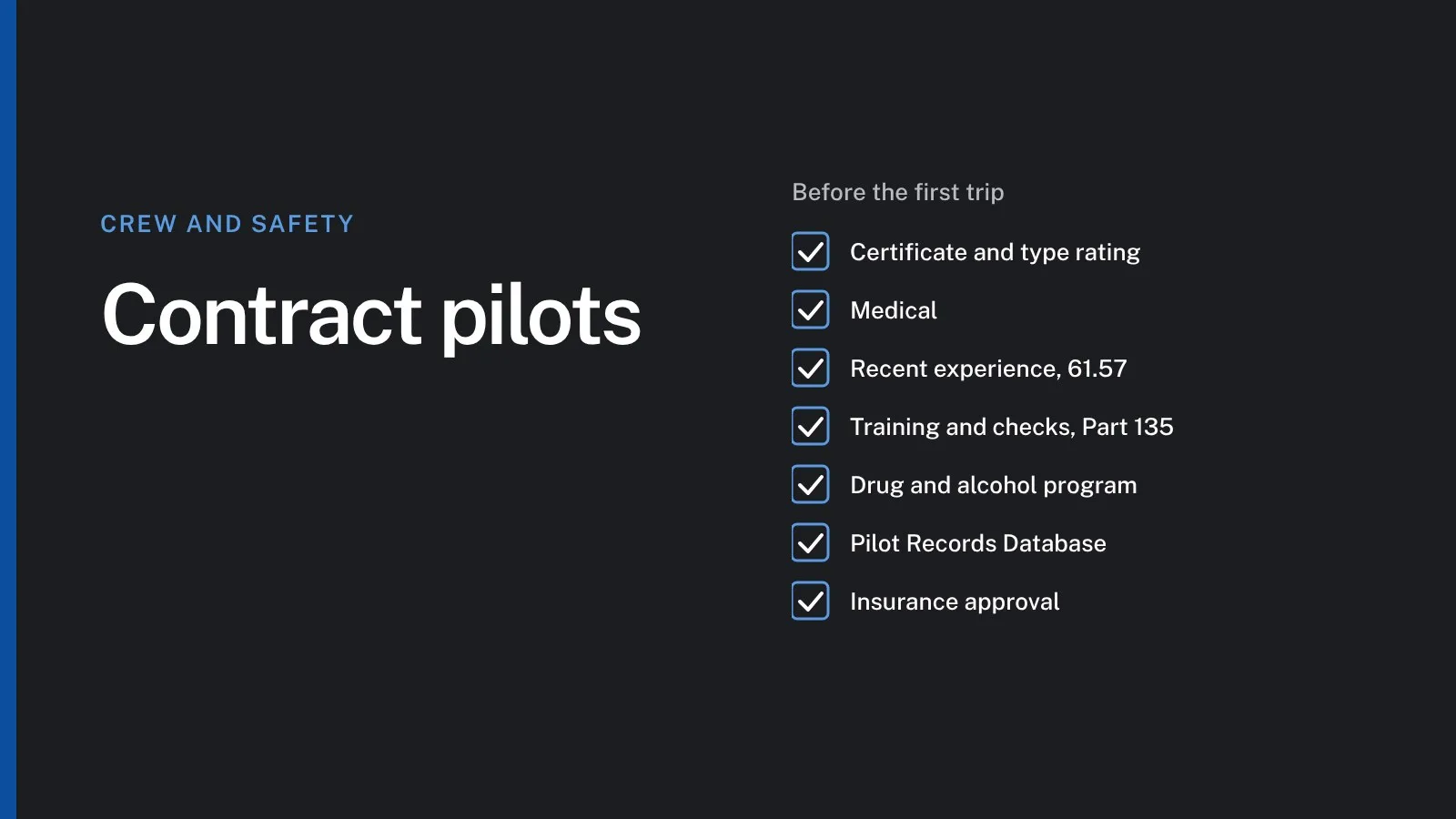
Both a Part 91 flight department and a Part 135 charter operator can use contract pilots, but the checks before the first leg are very different. Under Part 91 the operator confirms the pilot’s certificate, type rating, medical, recent experience and, where it applies, the 61.58 proficiency check, and gets the insurer’s approval of that pilot. Under Part 135 a contract pilot is treated like any other pilot the certificate holder uses: trained and checked under that certificate holder’s own program, covered by a drug and alcohol testing program under 14 CFR part 120, reviewed in the Pilot Records Database under 14 CFR part 111, and counted against the 135.267 flight time limits with all other commercial flying included.
This article explains the rules in plain language and isn’t legal advice. The regulation text governs, and a Part 135 operator’s principal operations inspector (POI) has the last word on how its program treats a pilot who is not on the payroll. Title 14 has no separate category for a contract pilot: its rules are written around the pilot who serves and the operator who uses that pilot, however the pilot is paid.
Contract pilot checks at a glance
| Item | Part 91 flight department | Part 135 certificate holder |
|---|---|---|
| Pilot certificate and ratings | 61.3, type rating under 61.31(a) | 135.95, 135.243 for the PIC, 135.245 for the SIC |
| Medical certificate | 61.3(c), class under 61.23(a) | Same, and its date and class go in the pilot record (135.63(a)(4)(v)) |
| Recent experience | 61.57 | 135.247 |
| Proficiency check | 61.58 for the PIC of a turbojet or an aircraft type certificated for more than one pilot | 135.293, 135.297 and 135.299, given under the certificate holder’s program |
| Training | SIC familiarization under 61.55(b) | The certificate holder’s approved training program (135.341, 135.343) |
| Drug and alcohol testing | Outside part 120 unless a 91.147 operator (120.1) | Required, including the pre-employment test (120.105, 120.109, 120.215) |
| Pilot Records Database | Reporting duties for some operators (111.1(b)(4)) | Review before the pilot begins service (111.105), then reporting (111.205) |
| Flight time limits | None in Part 91 outside Subpart K. Company policy applies | 135.267, counting all commercial flying |
| Insurance | The policy’s approval of the pilot | The same |
Using a contract pilot under Part 91
A Part 91 flight department that brings in a pilot for a trip is checking that the pilot may legally serve in that seat of that aircraft on that day. It has no approved training program to put the pilot through, so the paperwork is the pilot’s own.
Certificate, type rating and medical
A required pilot must carry a pilot certificate and photo identification (61.3(a)) and hold “the appropriate medical certificate” (61.3(c)). A pilot paid to fly is exercising commercial privileges, and 61.23(a)(2) requires at least a second-class medical for that.
The pilot in command of a large aircraft or a turbojet-powered airplane “must hold a type rating for that aircraft” (61.31(a)). Read the certificate’s limitations as well as its ratings.
The 61.58 proficiency check
Section 61.58 applies to the pilot in command of “an aircraft that is type certificated for more than one required pilot flight crewmember or is turbojet-powered.” That pilot must have completed a PIC proficiency check in such an aircraft “within the preceding 12 calendar months,” and one “in the particular type of aircraft in which that person will serve as pilot in command” within the preceding 24 calendar months (61.58(a)).
A contract pilot who flies several types can meet the 12-month test and miss the 24-month test in your type, so ask for the date and aircraft type of the last two checks. A check given under Part 135 or Part 91K “may be used to satisfy the requirements of this section” (61.58(c)).
Recent experience under 61.57
To carry passengers, the pilot in command needs “at least three takeoffs and three landings within the preceding 90 days” as sole manipulator of the controls, “in an aircraft of the same category, class, and type (if a class or type rating is required)” (61.57(a)). Night passenger flights need three full-stop night landings in the same 90 days (61.57(b)), and IFR needs six approaches, holding and course tracking “within the 6 calendar months preceding the month of the flight” (61.57(c)).
A contract pilot who flew all last month in a different type has no landings in yours. Our guide to pilot currency tracking lists each item and how its window is counted.
A contract second in command
A second in command of an aircraft type certificated for more than one pilot needs the category and class rating, an instrument rating for IFR, and a pilot type rating for the aircraft “unless the flight will be conducted as domestic flight operations within the United States airspace” (61.55(a)). The SIC must also have completed the familiarization and the three takeoffs and landings of 61.55(b) within the previous 12 calendar months.
The insurance policy
The insurance check is not in 14 CFR. An aircraft policy states which pilots it covers, by name or by minimum hours, ratings and recent training, and a pilot outside those terms can leave the flight uninsured. Send the pilot’s hours, ratings and last training date to your broker and get the approval in writing before the trip. Read your own policy, because the wording differs.
Pilot records for a Part 91 operator
Part 111 reaches a Part 91 operator of “two or more aircraft” that are standard airworthiness airplanes requiring a type rating, turbine-powered rotorcraft or large powered-lift, flown “in furtherance of or incidental to a business” (111.1(b)(4)). Such an operator may hold a pilot’s training, disciplinary and separation records and report them within 14 days when a reviewing operator asks, and must keep them “for five years from the date of creation” unless already reported (111.215(b)). A disciplinary removal from flying or a termination is reported without waiting for a request. Contract pilots are included, because the rule’s date of hire covers “employment that occurs on a contract basis for any form of compensation” (111.10).
Using a contract pilot under Part 135
Under Part 135 the pilot has to be qualified with your certificate. Being fully current at another certificate holder does not carry over by itself.
Certificates and experience
A certificate holder may not use an airman unless the person “holds an appropriate and current airman certificate” and “is qualified, under this chapter, for the operation for which the person is to be used” (135.95(a)). The pilot in command of a turbojet in passenger-carrying operations needs an airline transport pilot certificate with the type rating (135.243(a)), and exercising ATP pilot-in-command privileges takes a first-class medical (61.23(a)(1)). Other IFR pilots in command need the 1,200 hours in 135.243(c), and a second in command needs a commercial certificate and an instrument rating (135.245(a)).
Training and checking under your own program
A certificate holder that uses more than one pilot must “establish and maintain an approved pilot training program” (135.341(a)), and no person may serve as a crewmember unless that person “has completed the appropriate initial or recurrent training phase of the training program” since the beginning of the 12th calendar month before that service (135.343). The training program in that sentence is the certificate holder’s own.
The checks follow the same pattern.
- Knowledge test, 135.293(a). Every 12 calendar months, a written or oral test that covers Parts 61, 91 and 135 “and the operations specifications and the manual of the certificate holder” (135.293(a)(1)). No other operator’s test covers your operations specifications and manual.
- Competency check, 135.293(b). Every 12 calendar months, in the type for a multiengine or turbojet airplane.
- Instrument proficiency check, 135.297. For a pilot in command under IFR, “since the beginning of the 6th calendar month before that service” (135.297(a)).
- Line check, 135.299. For a pilot in command, every 12 calendar months, certified by the check pilot “in the pilot training record” (135.299(b)).
Whether your program can credit training the pilot completed elsewhere depends on your approved program and your POI, so ask before you plan around it.
Drug and alcohol testing under part 120
Flight crewmember duties are a safety-sensitive function, and a person who performs one “directly or by contract (including by subcontract at any tier)” for a Part 135 certificate holder must be subject to its drug testing and alcohol testing programs (120.105, 120.215). The pre-employment rule reads:
“No employer may hire any individual for a safety-sensitive function listed in § 120.105 unless the employer first conducts a pre-employment test and receives a verified negative drug test result for that individual.” (120.109(a)(1))
Being in another operator’s random pool does not put the pilot in yours. The one route the rule gives for a pilot outside your program is narrow: the contract employee must be “included under the contractor’s FAA-mandated drug and alcohol testing program” and “performing a safety-sensitive function on behalf of that contractor” (120.7(g)). A freelance pilot with no registered program of their own does not fit it. Have the negative result in hand before the first flight, and add the pilot to the random pool.
The Pilot Records Database under part 111
A Part 135 certificate holder is a reviewing entity (111.100(a)(1)), and “no reviewing entity may permit an individual to begin service as a pilot until the reviewing entity has evaluated all relevant information in the PRD” (111.105(a)). A contract pilot takes the same steps as a new hire:
- The pilot gives written consent and affirms the five-year employment history (111.120, 111.310).
- The operator reviews the FAA records, the records reported by earlier employers and the pilot’s employment history (111.105(b)).
- With separate consent, the operator requests a National Driver Register search (111.110) and documents it in the PRD within 45 days of the date of hire (111.240).
- The operator reports the date of hire and the records it then generates (111.205), each “within 30 days of the effective date of the record” (111.215(a)).
The date of hire is the earliest date the pilot “begins any form of required training” for the operator (111.10), so it is the first day of your indoc and not the first revenue leg. The employer and pilot logins are on the FAA’s Pilot Records Database page.
Other flying counts toward 135.267
Section 135.267 covers unscheduled one- and two-pilot crews, and its limits apply to the pilot’s total. A certificate holder may not assign, and a pilot may not accept, flight time if “that crewmember’s total flight time in all commercial flying” will exceed 500 hours in a calendar quarter, 800 hours in two consecutive calendar quarters or 1,400 hours in a calendar year (135.267(a)). During any 24 consecutive hours, the assigned flight time “when added to any other commercial flying by that flight crewmember” may not exceed 8 hours for one pilot or 10 hours for a two-pilot crew (135.267(b)).
Each assignment under paragraph (b) also “must provide for at least 10 consecutive hours of rest during the 24-hour period that precedes the planned completion time of the assignment” (135.267(d)). With a contract pilot, you know the rest only from what the pilot tells you about the days flown for others.
Section 135.267 doesn’t define “commercial flying.” Flight time for another Part 135 certificate holder plainly counts, and how the pilot’s paid Part 91 flying is treated is a question for your POI or aviation counsel. Our article on Part 135 duty time limits walks through the section paragraph by paragraph.
Worked example: a contract pilot who flew today for someone else
Every figure here is illustrative. A Part 135 operator wants a contract captain for a two-pilot trip tomorrow under 135.267(b). The crew reports at 0600, the trip is planned for 5.5 hours of flight time, and the last landing is planned for 1500.
The pilot reports this flying for another Part 135 certificate holder:
| Period | Flight time for the other operator |
|---|---|
| Today, two legs between 1630 and 2100 local, released from duty at 2130 | 4.0 hours |
| This calendar quarter to date | 212.0 hours |
| Previous calendar quarter | 301.5 hours |
| This calendar year to date | 705.3 hours |
The operator’s own records show 38.4 hours this quarter, 12.0 hours last quarter and 50.4 hours this year for the same pilot.
| Limit | Arithmetic | Result |
|---|---|---|
| 10 hours in any 24 consecutive hours, two pilots | 4.0 + 5.5 | 9.5 hours, within the limit |
| 10 consecutive hours of rest in the 24 hours before 1500 | 2130 to 0600 | 8.5 hours, 1.5 hours short |
| 500 hours in the calendar quarter | 212.0 + 38.4 + 5.5 | 255.9 hours |
| 800 hours in two consecutive quarters | 255.9 + 301.5 + 12.0 | 569.4 hours |
| 1,400 hours in the calendar year | 705.3 + 50.4 + 5.5 | 761.2 hours |
The 24 hours that end at 1500 tomorrow begin at 1500 today, so all of today’s flying falls inside them. The flight time passes and the cumulative totals are far from their limits, but the rest fails: the only long break runs from 2130 to 0600, which is 8.5 hours. A 0730 report gives 10.0 hours, and the trip is then planned again from the later departure. The operator’s own schedule shows the pilot as free today, so the short rest appears only if the pilot’s statement of today’s flying is on file.
Records for each contract pilot and each contract day
A Part 135 certificate holder must keep “an individual record of each pilot used in operations under this part” (135.63(a)(4)). The words are “each pilot used,” so a contract pilot has the same file as a staff pilot, down to “the pilot’s flight time in sufficient detail to determine compliance with the flight time limitations of this part.” Each record must be kept for at least 12 months (135.63(b)). Our article on Part 135 recordkeeping requirements covers the full list.
Before the first trip
- Copies of the pilot certificate, medical and photo identification, with total time and time in type.
- Part 91: the 61.58 check dates and types, the last three takeoffs and landings in type, instrument experience, and the insurer’s written approval.
- Part 135: your training phases, each test and check with its date and result, the verified negative pre-employment drug test, the PRD consent and review date, and the PRD date of hire.
For each contract day
| What to record | Why |
|---|---|
| Date, aircraft, trip and seat (PIC or SIC) | Ties the day to the flight log and the invoice |
| Duty on and duty off times | Shows the duty period and the rest that follows |
| Block out, block in and flight time for each leg | Feeds the 135.267 totals, or your Part 91 policy |
| Takeoffs, landings (day and night) and approaches flown by the pilot | Keeps 61.57 or 135.247 recent experience current in your type |
| The pilot’s dated, written statement of other commercial flying and rest since the last day with you | Adds the flying and duty the operator did not schedule |
| Day rate, expenses and the receipts | Belongs to the trip’s cost |
Frequently asked questions
Can a Part 135 operator use a contract pilot who is current with another operator?
Not on that basis alone. The 135.293(a) test covers “the operations specifications and the manual of the certificate holder,” 135.343 requires the certificate holder’s own training program, and the pilot must be in the operator’s drug and alcohol testing program and reviewed in the PRD first.
Does a contract pilot need a drug test before flying a Part 135 trip?
Yes. Under 14 CFR 120.109(a)(1) no employer may hire an individual for a safety-sensitive function without “a verified negative drug test result for that individual,” and 120.105 covers flight crewmember duties performed “directly or by contract.”
Does a Part 91 flight department have to check the Pilot Records Database for a contract pilot?
No. The review duty in 14 CFR part 111 applies to Part 119 certificate holders, Part 91K program managers and 91.147 air tour operators (111.100). A Part 91 operator of two or more type-rated airplanes has reporting and retention duties under 111.215(b) instead.
Does flying for another company count toward Part 135 flight time limits?
Yes for commercial flying. The quarterly and annual limits in 135.267(a) apply to “total flight time in all commercial flying,” and the daily limit in 135.267(b) adds “any other commercial flying by that flight crewmember.”
Contract pilots in Avion Desk
Avion Desk keeps certificates, training requirements and training records for each person, most urgent first, and a contract pilot is set up the same way as a staff pilot. At seating, the save is blocked when the pilot isn’t set up for that aircraft and seat, when the medical has expired on the leg’s date, or when a Part 135 check has expired past its grace month. On the plan for charter operators, duty and rest are checked against §135.267, including 500 hours a quarter, 800 hours in two quarters and 1,400 hours a year, from the flying recorded in Avion Desk. Crew events include a day type for flying elsewhere, so the office sees that the day is taken. The hours a contract pilot flew for someone else are still yours to collect from the pilot. See the crew, duty and rest page. To try it, start a free trial and set up one contract pilot with their checks and dates, or request a demo.