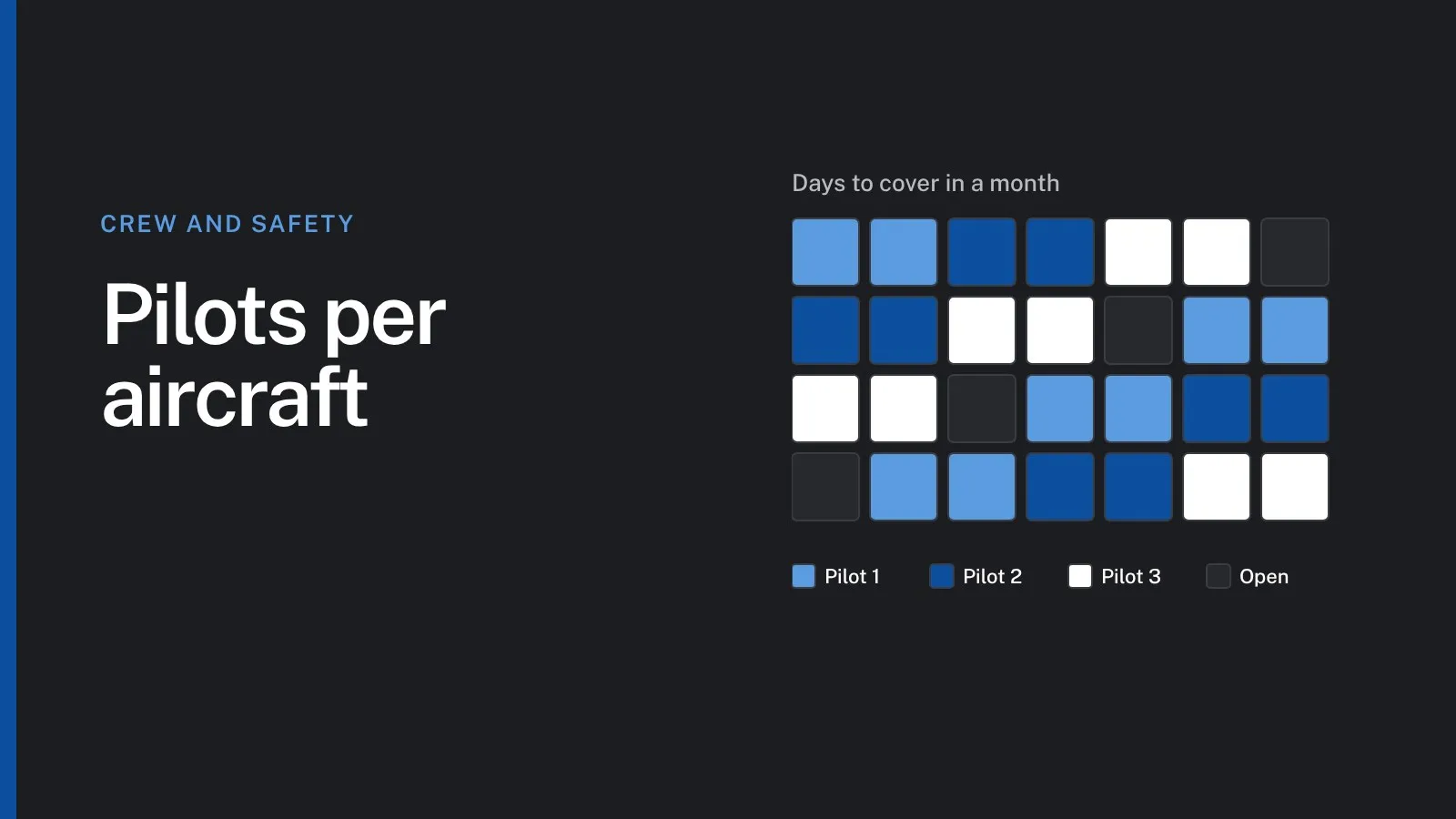
How many pilots per aircraft a flight department needs is a division: the pilot-days the schedule demands in a year, divided by the days one pilot is really available after days off, vacation, training and sick time. A two-pilot aircraft that needs a crew on 120 days a year can be covered by two full-time pilots and some contract days. The same aircraft needing a crew on 240 days needs three. Under Part 135, the rest rules in 14 CFR 135.267 reduce the days each pilot can give and can double the crews needed for each day of on-call coverage.
Every figure in the worked example is illustrative. None is a survey result, a pay figure or a recommendation, so put your own policy and your own trip history in their place.
What decides the number of pilots
NBAA’s guidance on staffing levels starts from the position that “each operation is unique” and lists the factors a company should review (NBAA, staffing levels). The table gives NBAA’s factors and where each one enters the arithmetic used below.
| Factor on NBAA’s list | Where it enters the count |
|---|---|
| Number of aircraft being utilized | Crew days are counted for each aircraft |
| Company flight time and rest considerations | Days off, and the gap needed between trips |
| The number of hours flown per year | A cross-check on trip days |
| The number of concurrent trips | Peak days, when two crews are out at once |
| Trips that require the pilot to fly for several consecutive days | Days off owed afterward |
| The number of overnight trips (RONs) required | Every night away is a crew day, flown or not |
| The number of night flights required | Rest the following day |
| Trips with augmented crew | Three pilots on those days |
| Trips requiring pre-positioning of a flightcrew | Extra crew days before the trip |
| The company’s vacation policy | Days a pilot is unavailable |
| The company’s training policy | Days a pilot is unavailable |
NBAA adds that its Management Guide “has sample formulas that companies can utilize to determine the number of pilots they might need,” and that “the first formula looks at the number of days a pilot is needed, while the second bases the calculation on estimated flight hours per year.” The Management Guide is a member publication and its formulas are not reproduced here. The method below takes the same starting point as the first, counting days, and the arithmetic and figures are ours.
Days describe a flight department’s demand better than hours do. A crew on a four-day trip with one leg out and one leg back has used four days for a few flight hours.
Required crew per flight
The count starts with how many pilots each flight needs, which comes from the aircraft and the rules the flight operates under.
- Part 91. 14 CFR 91.531 requires a second in command on “any airplane that is type certificated for more than one required pilot” and on “any large airplane,” with exceptions that include “any airplane certificated for operation with one pilot.”
- Part 135. 14 CFR 135.101 reads: “Except as provided in § 135.105, no person may operate an aircraft carrying passengers under IFR unless there is a second in command in the aircraft.” Section 135.105 allows an approved autopilot in place of the second in command when the operations specifications authorize it. Section 135.99(b) requires a second in command on an aircraft with “a passenger seating configuration, excluding any pilot seat, of ten seats or more.”
Company policy or the insurance policy may require two pilots where the regulations allow one. The examples below assume a crew of two on every flight.
Pilots needed, counted in days
The method has three steps.
- Count crew days. A crew day is any day the aircraft needs a crew assigned: flying, waiting away from base with the aircraft, positioning to meet it, or committed standby.
- Count available days per pilot. Start at 365 and subtract every day the pilot can’t be assigned.
- Divide, round up, then check the peaks. Pilot-days needed, divided by available days per pilot, gives the average. The busiest weeks decide whether the average holds.
Days one pilot is available
| Line | Illustrative days per year |
|---|---|
| Days in the year | 365 |
| Days off, two per week | −104 |
| Company holidays | −10 |
| Vacation | −20 |
| Training, including travel to and from the simulator | −14 |
| Sick days | −6 |
| Other duties: medical, ground school, office days | −6 |
| Days available for assignment | 205 |
On this illustrative policy a full-time pilot can be assigned on 205 of 365 days, which is 56 percent of the year. The 14 training days stand in for your own program. Under Part 91, a pilot in command of an aircraft that is “type certificated for more than one required pilot flight crewmember or is turbojet-powered” needs a proficiency check “within the preceding 12 calendar months” (14 CFR 61.58). Our post on pilot currency tracking lists the rest.
Worked example: one aircraft at two utilization levels
The aircraft is a two-pilot jet. Every figure is illustrative.
| Level 1 | Level 2 | |
|---|---|---|
| Flight hours per year | 250 | 500 |
| Trip days (flying, or away with the aircraft) | 100 | 200 |
| Committed standby days | 20 | 40 |
| Crew days | 100 + 20 = 120 | 200 + 40 = 240 |
| Pilot-days needed (crew days × 2) | 240 | 480 |
| Available days per pilot | 205 | 205 |
| Pilots by division | 240 ÷ 205 = 1.17 | 480 ÷ 205 = 2.34 |
| Full-time pilots, rounded up | 2 | 3 |
| Capacity (pilots × 205) | 410 | 615 |
| Share of capacity used | 240 ÷ 410 = 59% | 480 ÷ 615 = 78% |
Level 1. Two pilots are the minimum crew, and the division says two is enough on average. The average hides a weakness. With exactly two pilots, the aircraft has a crew only on days when both are available. Each pilot is away on 46 working days a year (20 vacation, 14 training, 6 sick, 6 other). There are 365 − 104 − 10 = 251 working days. If the two pilots take vacation and training together, the pair is broken on 34 shared days plus 12 separate days each, 58 days in all. If they never overlap, it is 92.
Vacation and training can be booked around trips that are known in advance. Sick days and short-notice trips can’t. With 120 crew days spread evenly over 251 working days, the 12 sick days alone would be expected to hit 12 × 120 ÷ 251, about 6 crew days. All 58 broken days would hit 58 × 120 ÷ 251, about 28. A two-pilot department at this level should budget somewhere between those figures in contract pilot days, or accept that some trips move.
Level 2. Two pilots can supply 410 days against 480 needed. Even with no vacation or sick day ever landing on a trip, the department is 480 − 410 = 70 pilot-days short. Three pilots supply 615, leaving 135 days of margin, and any one of the three can be away without grounding the aircraft. A contract pilot is needed only when two are out on the same day.
Peak weeks
The division works on a yearly average, and trips don’t arrive evenly. Check the busiest quarter by itself.
Suppose 30 percent of Level 2’s crew days fall in one quarter: 240 × 0.30 = 72 crew days in 92 calendar days. Two pilots would each work 72 of the 92 days and have 20 days for days off, vacation, training and illness together. Three pilots share 72 × 2 = 144 pilot-days, 48 each. For a Part 135 operator, the two-pilot version of that quarter also runs close to a legal limit, as the next section shows.
Then look at single days. Any day with two trips out at once needs two crews, and no yearly average will show it.
Part 135 rest rules and the pilot count
A flight department under Part 91 sets its own duty and rest policy, since Part 91 sets no duty limits for its pilots outside subpart K (see Part 91 duty time limits). A Part 135 on-demand operator with one- and two-pilot crews works under 14 CFR 135.267, and four of its provisions change the count. Our post on Part 135 duty time limits covers the section in full.
13 rest periods a quarter under 135.267(f)
Paragraph (f) reads: “The certificate holder must provide each flight crewmember at least 13 rest periods of at least 24 consecutive hours each in each calendar quarter.”
Thirteen rest periods in each of four quarters is 52 a year, so no Part 135 pilot can be assigned on more than 365 − 52 = 313 days, and no more than 92 − 13 = 79 in the longest quarter. The limit applies quarter by quarter, so extra days off in the next quarter don’t make up a short one. In the peak-quarter example above, 72 crew days for each of two pilots is under the ceiling of 79, but it leaves 7 days for vacation, training and illness together.
The rest period is 24 consecutive hours, which is different from a calendar day. A pilot released at 0200 on Tuesday completes a 24-hour rest period at 0200 on Wednesday, and has been unavailable for most of two calendar days.
The FAA has said the operator must be able to show that “each flight crewmember actually receives” at least 13 rest periods in every quarter, on-demand charter included (FAA legal interpretation to Schwarz, November 16, 2007). A day on which the pilot happened not to be called is a different thing from a rest period given in advance.
Standby counts as duty
The standby days in the example are counted as crew days for a reason. In a legal interpretation to Kalantari, the FAA wrote that it “has long-held that on-call standby is not rest, and if the flightcrew member has an obligation to report for a flight assignment if contacted, the on-call standby is considered duty.” Section 135.263(b) adds that “no certificate holder may assign any flight crewmember to any duty with the certificate holder during any required rest period.”
For the count, a standby day uses a pilot-day exactly as a flying day does, and it can’t be one of the 13 rest periods.
10 hours of rest and the length of a coverage day
Under 135.267(d), each assignment “must provide for at least 10 consecutive hours of rest during the 24-hour period that precedes the planned completion time of the assignment.” The alternative in paragraph (c) is “a regularly assigned duty period of no more than 14 hours” with at least 10 consecutive hours of rest before and after it.
Either way, one crew can be on duty for about 14 hours of a day. An operator that promises a response at any hour needs more than one crew per day. The FAA’s legal interpretation to Kleiner (2016) states: “A 24-hour on-call schedule cannot meet the rest requirements of 135.267(d) because, in such a situation, the rest period is not known in advance nor is it free from all restraint.”
The table applies that to a two-pilot aircraft, using the same illustrative 205 available days per pilot.
| Coverage promised | Crew days per year | Pilot-days | Pilots (÷ 205, rounded up) |
|---|---|---|---|
| One crew, weekdays except holidays | 251 | 251 × 2 = 502 | 2.45, so 3 |
| One crew, every day | 365 | 365 × 2 = 730 | 3.56, so 4 |
| Two crews a day for response at any hour | 365 × 2 = 730 | 730 × 2 = 1,460 | 7.12, so 8 |
The third row shows why around-the-clock availability for one aircraft takes far more pilots than its flight hours suggest.
The rest rule also separates trips. A crew that reports at 0900 and lands at 2300 can’t report for a 0600 departure, because 10 consecutive hours of rest don’t fit between them. If the schedule has that pattern, the morning trip is a second crew’s day.
Flight time caps and crew travel
Section 135.267(a) caps a pilot’s “total flight time in all commercial flying” at 500 hours in a calendar quarter, 800 in two consecutive quarters and 1,400 in a calendar year. In the Level 2 example, three pilots crewing 500 aircraft hours two at a time log 1,000 pilot-hours, about 333 each, so the caps aren’t close. They matter for a contract pilot who also flies for other operators, because that flying counts.
Section 135.263(c) says that transportation “not local in character” that the operator requires and provides, to get a crewmember to a flight or home from one, “is not considered part of a rest period.” Sending a fresh crew out by airline to take over a trip is not rest for that crew, so count the travel as a crew day.
Contract pilots as the swing
A contract pilot fills the gap between the two answers the division gives, the fraction and the whole number above it. At Level 1 the department is short on a handful of days a year, which is the case contract days suit. At Level 2 it is short at least 70 pilot-days, and the comparison is contract days against a third salary.
An illustrative break-even:
| Line | Illustrative figure |
|---|---|
| A third full-time pilot, per year: salary, benefits, recurrent training | $225,000 |
| A contract pilot, per day, including travel and hotel | $1,800 |
| Break-even | $225,000 ÷ $1,800 = 125 contract days a year |
Below about 125 days a year, contract days cost less in this example. Above it, the third pilot does. Neither figure is a market rate. Put in the day rate you are actually quoted and your own loaded cost.
Cost leaves out three things:
- Qualification under Part 135. A contract pilot can’t be put on a Part 135 leg on the strength of a type rating. Section 135.293(a) says “no certificate holder may use a pilot” who hasn’t passed, since the beginning of the 12th calendar month before, a test that covers “the operations specifications and the manual of the certificate holder.” A pilot in command under IFR also needs the instrument proficiency check in 135.297 since the beginning of the 6th calendar month before. The contract pilot has to be in your training and checking program before the day you need them.
- Their other flying. Because 135.267 counts “all commercial flying,” you need the contract pilot’s flight time and rest from their other work before you assign them.
- Availability. A contract pilot has other customers. Arrange two or three who are current in your aircraft, and trained on your certificate if you hold one, before the week you need them.
A Part 91 department has more room: the contract pilot needs the certificate, the type rating where one is required, the 61.58 check for a pilot in command, and whatever the insurance policy asks for. Ask the broker before the trip.
Checking the count against last year
Count last year’s records before trusting any plan.
- For each day of the year, mark whether the aircraft needed a crew. Total the crew days by quarter.
- For each pilot, total the days in each category: flying, standby, training, vacation, sick, off.
- Count the days the aircraft needed a crew and didn’t have two available pilots. That is your real contract-day demand, plus the trips that were moved or declined.
- Under Part 135, count each pilot’s 24-hour rest periods in each quarter against the 13 required.
- Redo the division with next year’s expected crew days.
Frequently asked questions
How many pilots do you need for one business jet?
At least the required crew, which is two for a jet type certificated for two pilots, and then as many as the days demand. In the illustrative example, a jet needing a crew on 120 days a year works with two full-time pilots and some contract days, and the same jet at 240 crew days needs three.
How many days a year can a Part 135 pilot work?
No more than 313, by arithmetic. Under 14 CFR 135.267(f), each flight crewmember must get “at least 13 rest periods of at least 24 consecutive hours each in each calendar quarter,” which is 52 a year, and the limit is applied quarter by quarter. Standby days count as duty, so they come out of the same total.
Can a contract pilot fly a Part 135 trip?
Yes, if the pilot has been trained and checked under that certificate holder’s program. Section 135.293 requires a test within the preceding 12 calendar months that covers the certificate holder’s operations specifications and manual, and a pilot in command under IFR needs the 135.297 check as well. The contract pilot’s other commercial flying counts toward the 135.267 limits.
How many pilots does a flight department need for two aircraft?
Count crew days for each aircraft and add them, then divide by available days per pilot as for one. Two aircraft of the same type share one pool of pilots, so the margin goes further. Two different types need pilots qualified on each, and the days on which both aircraft are out decide the peak.
Crew days and duty records in Avion Desk
Avion Desk keeps crew events by day type, including day off, vacation, standby, training, simulator and positioning, and shows the whole crew’s month on one board. The crew duty view lists each person by week or month, and a month downloads as CSV, so the days in the tables above can be counted from records. On the plan for charter operators, duty and rest are checked against §135.267 whenever the schedule moves.
See the crew features. To try it, start a free trial and enter last quarter’s trips and crew events to see each pilot’s days, or request a demo.