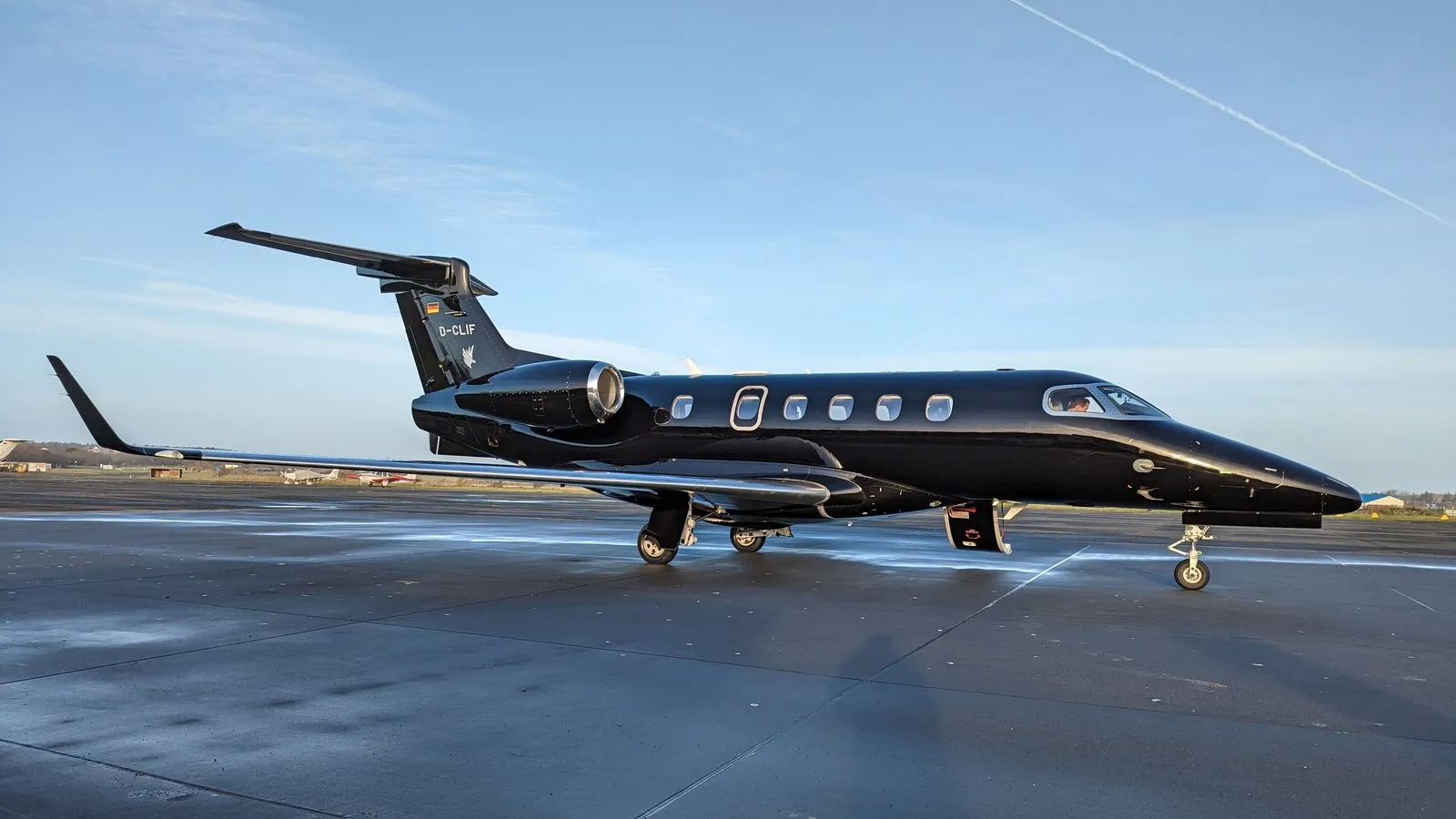
Every pilot in command of an Embraer Phenom 300 or 300E needs an EMB-505 type rating, because 61.31(a)(2) requires one for any “turbojet-powered airplane,” whatever it weighs. The airplane is also certificated for one pilot: the FAA data sheet sets the minimum crew as “one pilot (in the left pilot seat) plus additional equipment as specified in the Limitations Section of the FAA Approved Airplane Flight Manual (AFM),” or one pilot and one copilot (TCDS A60CE, Revision 14, September 17, 2025). Under Part 91, one pilot can fly it when that equipment works and the pilot’s rating carries no second-in-command limitation. Under Part 135, the operating rules decide whether a second pilot is needed, and the pilot in command needs an airline transport pilot certificate (135.243(a)(1)).
For a lot of operators the Phenom 300 is the first jet after a turboprop, and the chief pilot, the scheduler and the person who pays the bills each have something new to plan for: who can fly it, when a second pilot is required, how long days meet the duty limits, and what to record per trip.
What does the type certificate say about the Phenom 300?
The FAA data sheet is A60CE, for the Embraer model EMB-505. Note 6 says the airplane “is often referred to in Embraer marketing literature as the ‘PHENOM 300’ and ‘Phenom 300E’. These names are strictly marketing designations and are not part of the official model designation.” The figures below are from Revision 14, found under A60CE in the FAA Dynamic Regulatory System; check for a later revision before relying on them.
| Item | EMB-505 (FAA TCDS A60CE, Rev. 14) |
|---|---|
| Category | Commuter, under 14 CFR Part 23 |
| Engines | Two Pratt & Whitney Canada PW535E turbofans, or two PW535E1 |
| Maximum takeoff weight | 17,968 lb; 18,387 lb with the increased weights mod (Note 10); 18,551 lb with PW535E1 engines (Note 11) |
| Minimum crew | “One pilot (in the left pilot seat) plus additional equipment as specified in the Limitations Section of the FAA Approved Airplane Flight Manual (AFM),” or “one pilot and one copilot” |
| Seats | “Maximum of eleven occupants. Refer to the AFM, section 6 ‘Weight & Balance’ for seat configurations” |
| Maximum operating altitude | 45,000 ft |
Note 5 ties single-pilot approval to the cockpit as certificated: “No significant changes may be made to the installed cockpit equipment or arrangement (EFIS, autopilot, avionics, etc.), except as permitted by the approved MMEL, without prior approval from the responsible Aircraft Certification Office.” The RVSM paragraph says the airplanes carry RVSM-capable equipment as standard, but “each operator must obtain RVSM operating approval directly from the FAA.”
The data sheet caps occupants, not passenger seats, so count your airplane’s passenger seats from its weight and balance papers, leaving out both cockpit seats. Under Part 135, 10 or more passenger seats need a second in command whatever the autopilot can do (135.99(b), below).
Why does a Phenom 300 need a type rating?
61.31(a) requires a type rating to act as pilot in command of “large aircraft (except lighter-than-air)” and of “turbojet-powered airplanes.” The Phenom 300 meets both tests: it’s a turbofan, and at 17,968 lb or more it’s over the 12,500 lb line that makes an aircraft large (14 CFR 1.1). A turboprop under 12,500 lb needs endorsements under 61.31(e) to (g) but no type rating, so for many operators this is their pilots’ first one.
The FAA’s table of type designations has two entries for this model: “EMB-505 (Single Pilot)” and “EMB-505 (SIC Required; SIC limitation is required),” both with the type rating designation EMB-505 (FAA Order 8900.1, Figure 5-88, October 27, 2026). A pilot whose rating carries the SIC limitation can’t fly the airplane alone, so check every pilot’s certificate before planning single-pilot trips. The FAA’s draft Flight Standardization Board report adds that the flight manual “lists equipment that must be operative to operate the aircraft single-pilot” (FSBR EMB-505, Revision 5 draft).
Part 91 also adds a yearly check. 61.58 applies to “an aircraft that is type certificated for more than one required pilot flight crewmember or is turbojet-powered.” A Part 91 pilot in command needs a proficiency check within the preceding 12 calendar months in such an aircraft, and within 24 calendar months in the Phenom itself. A single-pilot turboprop falls outside the rule; a single-pilot jet is inside it because the test is turbojet power. Part 135 pilots meet it through their own checks (61.58(b) and (c)).
Can one pilot fly a Phenom 300 under Part 91?
Yes, as long as the pilot’s rating allows it. At 17,968 lb and in the commuter category, the EMB-505 falls under two of the three paragraphs of 91.531(a) that call for a second in command. What takes it out again is 91.531(b)(1), which exempts “any airplane certificated for operation with one pilot,” and A60CE’s one-pilot crew line is that certification.
When the captain’s rating carries the SIC limitation, the second pilot is required crew and must meet 61.55: at least a private pilot certificate, an instrument rating for IFR, and within the previous 12 calendar months, familiarization with the type plus three takeoffs and three full-stop landings, engine-out procedures and crew resource management training in the type or its simulator. An SIC type rating is needed only for flights outside domestic US operations. A second pilot the company adds by choice to a single-pilot captain isn’t required crew under Part 91.
Single-pilot saves the second pilot’s cost on each trip. Two pilots spread the workload on long days, give a backup if one pilot can’t continue, and build the next captain’s time in type. Whichever you choose, write it into the operations manual and schedule to it, so a trip isn’t booked one way and flown another.
When does a Phenom 300 need two pilots under Part 135?
135.99(a) bars flying with less than the minimum crew in the flight manual “and required by this part for the kind of operation being conducted.” The airplane’s minimum is one pilot. Three Part 135 rules can add a second:
- Ten passenger seats. “No certificate holder may operate an aircraft without a second in command if that aircraft has a passenger seating configuration, excluding any pilot seat, of ten seats or more” (135.99(b)).
- Passengers under IFR. “Except as provided in § 135.105, no person may operate an aircraft carrying passengers under IFR unless there is a second in command in the aircraft” (135.101).
- The autopilot exception. 135.105 allows flight without a second in command “if it is equipped with an operative approved autopilot system and the use of that system is authorized by appropriate operations specifications.” The FAA authorizes it if the autopilot “is capable of operating the aircraft controls to maintain flight and maneuver it about the three axes” and the operator shows the operation is safe. In commuter operations the PIC also needs “at least 100 hours pilot in command flight time in the make and model.”
So a single-pilot passenger IFR leg depends on three things: fewer than 10 passenger seats, the 135.105 authorization in your operations specifications, and an autopilot that works on the day. With the autopilot inoperative, the leg needs a qualified second pilot or it doesn’t go. The pilot also has to show, during the instrument proficiency check, the ability to fly “both with and without using the autopilot” and handle complex ATC instructions alone, once every 12 calendar months (135.297(g)).
What does a Part 135 Phenom 300 captain need?
135.243(a)(1) says no one may serve as pilot in command in passenger-carrying operations “of a turbojet airplane” unless they hold “an airline transport pilot certificate with appropriate category and class ratings and, if required, an appropriate type rating for that airplane.” A nine-seat single-engine turboprop captain can fly IFR with a commercial certificate and 1,200 hours under 135.243(c). The Phenom captain needs the ATP and the EMB-505 rating.
The recurring checks to track for each Phenom pilot on a certificate:
- Every 12 calendar months: a knowledge test and a competency check (135.293), which for a turbojet is in “that type of aircraft.” The PIC also needs a line check (135.299).
- Every 6 calendar months: an instrument proficiency check for a PIC flying IFR (135.297(a)).
How do Phenom 300 trips meet the duty limits?
Which limit applies depends on the kind of operation, not the airplane.
- Part 135 on-demand: this is where the single-pilot choice costs time. 135.267(b) allows 8 hours of flight time in any 24 consecutive hours, counting other commercial flying, for “a flight crew consisting of one pilot,” and 10 for “two pilots qualified under this part for the operation being conducted.” The rest rule looks back as well: the 24 hours before an assignment’s planned end must hold 10 consecutive hours of rest (135.267(d)). If weather or other circumstances outside anyone’s control push a pilot over, the next rest grows to 11, 12 or 16 hours for an overrun of up to 30 minutes, up to 60, or more (135.267(e)). See Part 135 duty time limits.
- Part 91K: 91.1059 has the same 8 and 10 hours plus a 14-hour duty period. See Part 91K duty and rest.
- Part 91: no FAA duty limits outside subpart K; the company’s own policy is the limit. See Part 91 duty time limits for a sample policy.
Worked example: one day, one pilot or two (illustrative)
The trip, times and numbers are made up and aren’t this type’s real performance. A Part 135 charter flies three passenger legs, all IFR, with 7 hours 20 minutes of planned flight time. The pilot had 12 hours of rest before reporting and no other commercial flying in the previous 24 hours. On the last leg, holding for weather that wasn’t forecast at departure adds 45 minutes, and the crew is released at 21:00 with 8 hours 5 minutes of flight time.
| Check | One pilot (135.105 authorization) | Two pilots qualified under Part 135 |
|---|---|---|
| Flight time limit in 24 hours, 135.267(b) | 8 hours | 10 hours |
| Flown, with the holding | 8 h 5 min: over by 5 minutes | 8 h 5 min: within |
| Rest before the next assignment | At least 11 consecutive hours (135.267(e)(1)) | 10 consecutive hours in the 24 before the next assignment ends (135.267(d)) |
| Tomorrow’s 07:00 departure | Moves to 08:00 at the earliest, or another pilot flies it | Can stand |
One hold used the plan’s 40 minutes of margin and moved the next morning.
How should you schedule and release a Phenom 300 trip?
These trip shapes are illustrative, not drawn from any operator’s records.
- A long day with a fuel stop. The binding limit is flight time in 24 hours, 8 hours single-pilot under Part 135, and the turn is where weather, a slot or a late passenger adds time.
- A short field at one end. A runway the old turboprop used every week has to be checked again for the jet, with distances for the weight, temperature and surface from the flight manual.
A turboprop operator’s existing risk form won’t ask the jet’s questions. Add these to your flight risk assessment tool:
- How many hours does each pilot have in type?
- For a single-pilot leg, are the flight manual’s single-pilot equipment and the autopilot working, and is the 135.105 authorization in the operations specifications if this is Part 135?
- Does the captain’s type rating carry an SIC limitation?
- Is the runway long enough per the flight manual for the weight, temperature and surface, and is it wet or contaminated?
- Will the day come within an hour of the flight time limit?
- Is the flight planned in RVSM airspace, and does the operator hold RVSM approval?
- Is any maintenance item coming due before the trip ends?
What maintenance does a Phenom 300 scheduler need to know about?
A first jet arrives with a maintenance program whose intervals nobody in the office knows by heart yet, the way they knew the turboprop’s. The shop or tracking service runs that program; the scheduler’s part is to see each item due by date, hours or cycles, and how soon it arrives at the jet’s current use, before booking a trip across it. An open defect can also stop a booking, and on a Phenom flown single-pilot that includes one that takes out equipment the flight manual requires for one pilot, even if two pilots could still fly it.
What should you record for each Phenom 300 trip’s cost?
Your turboprop’s cost history won’t predict the jet’s, and published Phenom hourly figures assume someone else’s airplane, programs and missions, so this guide quotes none. Start recording these on the first trip:
- Fuel uplifted at each stop, with the vendor and the price paid
- Flight time and cycles per leg, which drive any hourly or cycle-based reserves your programs bill
- Positioning legs, which cost fuel, crew time and reserves with no passengers aboard
- Crew: a second pilot’s day rate or salary share on two-pilot trips, hotels, meals and travel
- Landing, parking, handling and any international fees
- Catering and passenger supplies
The jet raises fixed costs as well: an EMB-505 type rating course for every pilot and the recurrent checks after it, plus insurance and hangar. Keep those out of the per-trip figure and spread them over the year’s hours. Aircraft operating cost per hour separates variable, fixed and per-trip costs, and how to price a charter trip covers rates, positioning, minimums and federal excise tax.
What changes when a Phenom 300 goes on a Part 135 certificate?
| Area | Part 91 | Part 135 |
|---|---|---|
| PIC certificate | EMB-505 type rating | ATP plus the EMB-505 type rating (135.243(a)(1)) |
| Single pilot | Allowed with the flight manual’s equipment and no SIC limitation on the rating (91.531(b)(1)) | Passenger IFR needs a 135.105 autopilot authorization; 10 or more passenger seats always need a second in command (135.99(b)) |
| Checks | 61.58 proficiency check every 12 months, in type every 24 | Knowledge test and competency check in type every 12 months, line check every 12, instrument proficiency check every 6 |
| Duty and rest | No FAA limits outside subpart K | 135.267: 8 hours flight time in 24 for one pilot, 10 for two |
Running a Phenom 300 in Avion Desk
When you save a Phenom trip, Avion Desk checks the aircraft, the crew and duty and names any problem it finds; an admin can override it, and the override is recorded with a note. On the plan for charter operators, one- and two-pilot crews are checked against 135.267, so a single-pilot day near 8 hours shows before it’s flown. Each pilot’s certificates, training requirements and training records are on their profile, most urgent first, and seating a pilot who isn’t qualified on the aircraft is flagged. A trip is released only after its checks, the aircraft’s state and a risk assessment with your own questions have passed. Fuel is recorded per leg, and approved expenses roll up into what each trip cost. See the crew features, release and risk and pricing. To try it, start a free trial and add your Phenom 300 with its crew, their type ratings and checks, and your first-jet risk questions, on the plan for charter operators if you fly it under Part 135, or request a demo.
Frequently asked questions
Do you need a type rating to fly a Phenom 300?
Yes. 61.31(a)(2) requires one for any turbojet-powered airplane, and at 17,968 lb or more the Phenom 300 is also a large aircraft under 61.31(a)(1). The FAA type rating designation is EMB-505 (Figure 5-88).
Is the Phenom 300 certified for single-pilot operation?
Yes. TCDS A60CE sets the minimum crew as one pilot in the left seat “plus additional equipment as specified in the Limitations Section” of the flight manual, or one pilot and one copilot. A pilot whose type rating carries an “SIC Required” limitation can’t fly it alone.
Is the Phenom 300E a different type rating from the Phenom 300?
No. The data sheet calls both names “strictly marketing designations.” Both are model EMB-505 under TCDS A60CE, with the EMB-505 type rating.
Can a Phenom 300 fly single-pilot charter under Part 135?
Yes, if the operations specifications authorize an autopilot in place of a second in command under 135.105, the autopilot works, and the airplane has fewer than 10 passenger seats (135.99(b)). The PIC needs an ATP, and flight time is limited to 8 hours in any 24 consecutive hours (135.267).
Does a Part 91 Phenom 300 pilot need a yearly proficiency check?
Yes. 61.58 covers turbojet-powered aircraft even when they’re certificated for one pilot: a check within 12 calendar months, and within 24 calendar months in the Phenom itself.
Sources
- FAA, Type Certificate Data Sheet A60CE, Embraer EMB-505, Revision 14, September 17, 2025
- FAA, Order 8900.1, Volume 5, Chapter 2, Section 19, Figure 5-88, Pilot Certificate Aircraft Type Designations, October 27, 2026
- FAA, Flight Standardization Board Report, EMB-505, Revision 5 draft
- 14 CFR 1.1, 61.31, 61.55, 61.58, 91.531, 91.1059, 135.99, 135.101, 135.105, 135.243, 135.267, 135.293, 135.297, 135.299
This article explains the rules in plain language and isn’t legal advice; the regulation text governs.