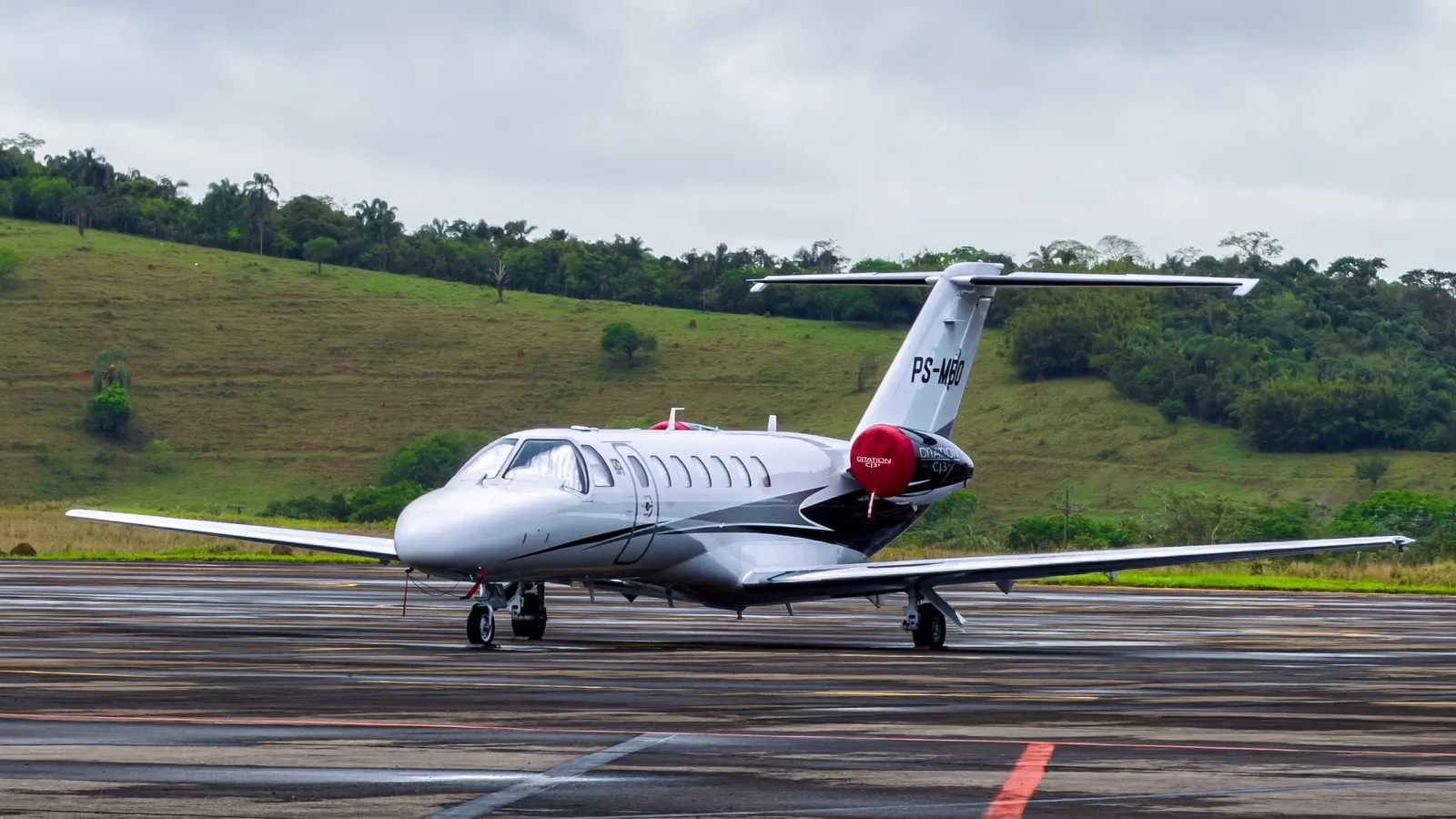
The CJ4 type rating and the CJ3+ type rating are the same rating. The FAA’s list of pilot certificate type designations puts the Models 525, 525A, 525B and 525C under one designation, issued two ways: CE-525 “(SIC Required)” and CE-525S “(Single Pilot)” (FAA Order 8900.1, Figure 5-88). The FAA’s Flight Standardization Board report lists the CJ3 and CJ3+ as the Model 525B and the CJ4 as the Model 525C, both on Type Certificate Data Sheet A1WI (TCDS A1WI, Revision 34). Both can be flown by one pilot, but only a CE-525S pilot in an airplane with the equipment the flight manual lists. That matters most to an owner who flies the airplane and also hires contract pilots, because each pilot’s rating decides who may fly alone, and the owner, not the pilot, is usually the operator.
What type rating does a Citation CJ3+ or CJ4 need?
Under 14 CFR 61.31(a), a pilot in command must hold a type rating for “(1) Large aircraft (except lighter-than-air)” and “(2) Turbojet-powered airplanes.” Both airplanes meet both tests. Section 1.1 defines a large aircraft as one “of more than 12,500 pounds, maximum certificated takeoff weight,” and the TCDS gives 13,870 lbs for the 525B and 17,110 lbs for the 525C.
The FAA’s draft Flight Standardization Board report for the series, posted for comment as Revision 10, says: “The Textron 525, 525A, 525B, and 525C type rating designation is CE-525 or CE-525S” (FSB report, draft Revision 10, 7.1). It lists the 525B as “CJ3, CJ3+, CJ3 Gen2” and the 525C as “CJ4.” The two forms differ by how the checkride was flown:
| Rating on the certificate | How it was earned | What it allows |
|---|---|---|
| CE-525S | Practical test “as a single pilot” (FSB 7.1.1) | Flying as the only pilot, in an airplane equipped per the AFM’s equipment list |
| CE-525, “Second in Command Required” | Practical test “while using a second in command (SIC) as a crewmember” (FSB 7.1.2) | Pilot in command only with a qualified SIC aboard |
| SIC privileges only | Familiarization under 61.55 | Second in command, not pilot in command |
The FAA’s Chief Counsel stated the limitation in a 2014 letter to Judd Cato: “A pilot holding a CE-525 type rating with the limitation of SIC required must always conduct a flight in this aircraft with an SIC.”
One rating doesn’t mean no extra training between models. The FSB report requires differences training and checking between the variations “as applicable to their operation” (9.8 and 10.7), and its draft table sets the move between the CJ3 and the CJ4 at level D both ways, which means a flight training device or simulator. A pilot with a CE-525S earned in a CJ3 still needs that differences course before flying your CJ4.
Can one pilot fly a CJ3+ or CJ4?
Yes, under the conditions the type certificate sets. The TCDS line for the 525B reads:
Minimum Crew for all Flights (see NOTE 5 for cockpit equipment/arrangement restrictions): One pilot (left seat) with CE-525S (Single Pilot) type rating plus additional equipment as specified in the Kinds of Operations Equipment List (KOEL) contained in the limitations section of the FAA Approved Airplane Flight Manual (AFM) OR Two pilots.
For the 525C it reads:
Minimum Crew for all Flights (see NOTE 5 for cockpit equipment/arrangement restrictions): One pilot (in the left pilot seat) with equipment as specified in the KOEL contained in the Limitations Section of the FAA Approved AFM OR One pilot and one copilot
Note 5 for both models adds that “Approval for operation with a minimum crew of one pilot is based upon the cockpit equipment installation and arrangement evaluated during FAA certification testing,” and that no significant changes may be made to it “except as permitted by the approved MMEL” without the certification office’s concurrence.
Part 91 then follows the certificate. Section 91.531(a) requires a designated second in command in “Any large airplane” and “Any commuter category airplane,” and the TCDS lists both models in the commuter category. Paragraph (b)(1) lifts that for “Any airplane certificated for operation with one pilot.” A CE-525S pilot can fly alone. A CE-525 pilot needs an SIC who meets 61.55: at least a private certificate, an instrument rating for IFR, an SIC type rating unless the flight stays within the United States, and within the previous 12 calendar months the familiarization and the three takeoffs and landings that 61.55(b) lists.
Equipment can change the answer on the day. The 2014 Cato letter says that if the autopilot is inoperative, “the aircraft type certification would require a pilot and co-pilot for safe operation.” It also says the reverse: when the PIC holds a CE-525S and nothing requires a second pilot, a second pilot the owner adds by policy “is not a required flight crewmember, and cannot log the time as SIC.”
The 61.58 proficiency check applies to single pilots too
A 2008 Chief Counsel letter to Dennis Ortiz said a CE-525S pilot flying alone didn’t need the 61.58 pilot-in-command check. That letter predates the current rule. In 2011 the FAA amended 61.58, and the final rule “extends the requirement for recurrent proficiency checks to pilots operating single-piloted turbojet-powered aircraft.” Today’s 61.58(a) covers an aircraft that “is type certificated for more than one required pilot flight crewmember or is turbojet-powered,” and a 2012 FAA notice to inspectors (since expired) said “the terms ‘turbojet’ and ‘turbofan’ are considered synonymous in the context of § 61.58.” Plan on a check every 12 calendar months in a qualifying aircraft and every 24 in the type, for every pilot who flies your airplane as PIC under Part 91.
Who is the operator when an owner flies with a contract pilot?
Under Part 91, usually the owner. Section 1.1 defines operate as to “use, cause to use or authorize to use aircraft, for the purpose … of air navigation including the piloting of aircraft, with or without the right of legal control (as owner, lessee, or otherwise),” and operational control as “the exercise of authority over initiating, conducting or terminating a flight.” An owner who decides the trip goes, picks the pilot and pays for the fuel holds operational control, and with it responsibility for the pilot being qualified and the airplane being airworthy.
The pilot in command has a separate duty. Section 91.3(a) makes the PIC “directly responsible for, and is the final authority as to, the operation of that aircraft.” A contract captain can refuse a flight or end one. That doesn’t hand the owner’s operational control to the pilot.
Advisory Circular 91-37B splits operational control into aircrew, aircraft and flight management. The aircrew part “Ensures that crewmembers are trained and qualified in accordance with the applicable regulations and remain in compliance with all applicable flight, duty, and rest requirements including designating a pilot in command (PIC) for each flight.” For an owner with two contract pilots, that sentence is the job description of whoever keeps the records.
The AC’s questions for who has operational control, shortened:
- Who assigns the crew and the aircraft, accepts flight requests, and starts, conducts and ends flights?
- Whose employees or agents are the pilots?
- Who maintains the aircraft, and who decides when and where?
- Before departure, who makes sure the flight, aircraft and crew comply?
- Who decides weather and fuel requirements and pays for fuel?
- Who pays airport fees, hangar and crew expenses?
When the owner answers all of them, the owner is the operator. When a company that also supplies the pilot answers them, the AC’s warning applies: “if a person leases an aircraft to another and also provides the flightcrew, fuel, and maintenance, the lessor of the aircraft is the operator,” and if that person charges outside what Part 91 subpart F allows, the flight falls under Part 135.
Leases and the truth-in-leasing clause
Both models are large civil aircraft, so 91.23 applies to most leases of them, including a dry lease from the owner’s LLC to the owner’s operating company. The lease must be written and must end, in large print, with a clause that names “the person responsible for operational control of the aircraft.” Under 91.23(c), a copy goes to the FAA Aircraft Registration Branch within 24 hours of signing, a copy rides in the airplane, and the responsible Flight Standards office hears about the first flight at least 48 hours before takeoff.
Under 91.501, which covers large airplanes and turbojet multiengine airplanes, an owner can also lend the airplane with crew under a time sharing agreement, charging no more than the items in 91.501(d): fuel, oil and additives, crew travel expenses, hangar and tie-down away from base, insurance for the flight, landing and similar fees, customs and permits, catering, passenger ground transportation, flight planning and weather, and an additional charge of up to 100 percent of the fuel cost.
Keeping each pilot qualified and current
An owner-pilot with one or two contract pilots has three or four people whose records decide whether a trip is legal. Track at least these for each one:
| Item | Source |
|---|---|
| Rating form: CE-525S, CE-525 SIC required, or SIC privileges only | Pilot certificate |
| Differences training for each model flown (CJ3 to CJ4 and back) | FSB report 9.8 |
| 61.58 check: 12 calendar months in a qualifying aircraft, 24 in type | 61.58(a) |
| SIC familiarization and landings, 12 calendar months, if flying SIC | 61.55(b) |
| Flight review, 90-day landings, instrument currency, medical | Part 61; see our pilot currency tracking guide |
The FSB report adds no currency rules of its own: “There are no additional currency requirements for the CE-525 series other than those already specified in 14 CFR parts 61 and 135” (11).
Duty and rest are a company decision under Part 91, since Part 91 sets no duty limits outside subpart K. Write a policy that covers the contract pilot as much as the owner, especially for a single pilot on a long day. Our post on Part 91 duty time limits has a sample.
Trips, risk and what the scheduler checks
The trip shapes below are illustrative, not data about any operator:
- An owner flies a morning leg alone and a contract pilot takes the evening return. Each leg needs its own crew check: the owner’s CE-525S and 61.58 date for the first, the contract pilot’s for the second.
- The owner flies left seat with a contract pilot along. If the owner holds a CE-525 with SIC required, the second pilot is required crew and must meet 61.55. If the owner holds a CE-525S, the second pilot is extra.
- A two-day trip with an overnight. Whatever the duty policy says about rest applies to both pilots.
Turn the questions that change the crew into risk questions on the trip form: is anything on the equipment list for single-pilot flight inoperative, does the planned PIC hold a CE-525S, is the pilot current in this model, is the runway short, wet or contaminated, is icing or convection forecast, how long is the duty day for a single pilot. Our flight risk assessment tool post shows how to score them.
What to record per trip
Record what each trip costs so the owner sees the airplane’s real cost and, under a time sharing agreement, can show that the charge stayed within 91.501(d). Categories that matter for this setup: fuel by leg, contract pilot fees and travel, airport and handling fees, hangar away from base, catering, and a share of fixed costs such as insurance and recurrent training. We won’t quote a cost per hour for these models; your own fuel receipts and invoices are the only reliable source. See what a trip really costs and, for charter, how to price a charter trip.
Maintenance: what the scheduler needs to know
The shop or a maintenance tracking service plans the work. The scheduler needs two things: what’s coming due by date, hours or cycles before a trip runs past it, and whether an open defect touches something on the single-pilot equipment list. A defect that leaves the airplane airworthy for two pilots may still ground a single-pilot trip.
Moving to Part 135 or a management company
When the airplane carries other people for pay, it goes on a Part 135 certificate, the owner’s or a management company’s. The certificate holder then has operational control and the crew rules change:
| Rule | What it means for a CJ3+ or CJ4 |
|---|---|
| 135.243(a)(1) | A PIC carrying passengers in “a turbojet airplane” must hold an airline transport pilot certificate |
| 135.99(a) | At least the minimum crew in the operating limitations or AFM |
| 135.99(b) | An SIC with ten or more passenger seats; the TCDS lists eight passenger seats for the 525B and up to nine for the 525C |
| 135.101 | An SIC when carrying passengers under IFR |
| 135.105 | Except with an operative approved autopilot whose use the operations specifications authorize |
| 135.293, 135.297, 135.299 | Annual competency check in type, 6-month instrument check, annual line check |
| 135.267 | Flight time and rest limits replace the company policy |
Under 61.58(b), the 61.58 check no longer applies to Part 135 flying, and 61.58(c) lets the Part 135 check satisfy it for the pilot’s Part 91 flying. The draft FSB report adds that proving tests under 135.145 “are appropriate when the CE-525 series is new to an operator” (13.4). For duty, see Part 135 duty time limits, and for fractional programs, Part 91K duty and rest.
Running a CJ3+ or CJ4 in Avion Desk
Avion Desk keeps each pilot’s certificates, training requirements and training records, sorted with the most urgent first. When a trip seats a pilot who isn’t qualified on the aircraft, the trip is flagged. Duty and rest are checked against your Part 91 company policy whenever the schedule moves, and the plan for charter operators adds Part 135 and Part 91K duty and rest. A trip is released only after its checks, the aircraft’s state and a risk assessment pass, and you write your own risk questions. Maintenance items due by date or counter show their status, and a logged defect can ground the aircraft. Each trip’s costs roll up so the owner sees what it cost. The free trial runs on the plan you pick at sign-up, so a charter operator can try the Part 135 checks. See pricing. To try it, start a free trial and add your CJ3+ or CJ4 with its crew and each pilot’s type rating, or request a demo.
Frequently asked questions
Does one type rating cover both the CJ3+ and the CJ4?
Yes. The FAA lists the Models 525, 525A, 525B and 525C under one designation, CE-525 for a pilot who needs an SIC and CE-525S for a single pilot (FAA Order 8900.1, Figure 5-88). Differences training between the models is still required.
What is the difference between CE-525 and CE-525S?
A CE-525S pilot passed the checkride alone and may fly as the only pilot. A CE-525 pilot passed it with an SIC and carries the limitation “Second in Command Required,” so must always fly with an SIC (FAA letter to Cato, 2014).
Is the CJ4 certified for single-pilot operation?
Yes. TCDS A1WI lists the 525C minimum crew as one pilot in the left seat with the equipment in the AFM’s Kinds of Operations Equipment List, or a pilot and copilot (TCDS A1WI).
Does a single-pilot CJ pilot need a 61.58 check?
Under Part 91, yes. Since the 2011 amendment, 61.58(a) covers aircraft that are “turbojet-powered,” not only those certificated for two pilots (61.58). It doesn’t apply to Part 135 or 91K flying.
If I own the CJ and hire a contract pilot, who has operational control?
Usually you, as the owner who decides the flight goes and supplies the airplane. The contract pilot is PIC and the final authority on the flight under 91.3, but if the same company supplies both the airplane and the pilot for pay, it becomes the operator and Part 135 applies (AC 91-37B).
This article explains the rules in plain language and isn’t legal advice; the regulation text governs.