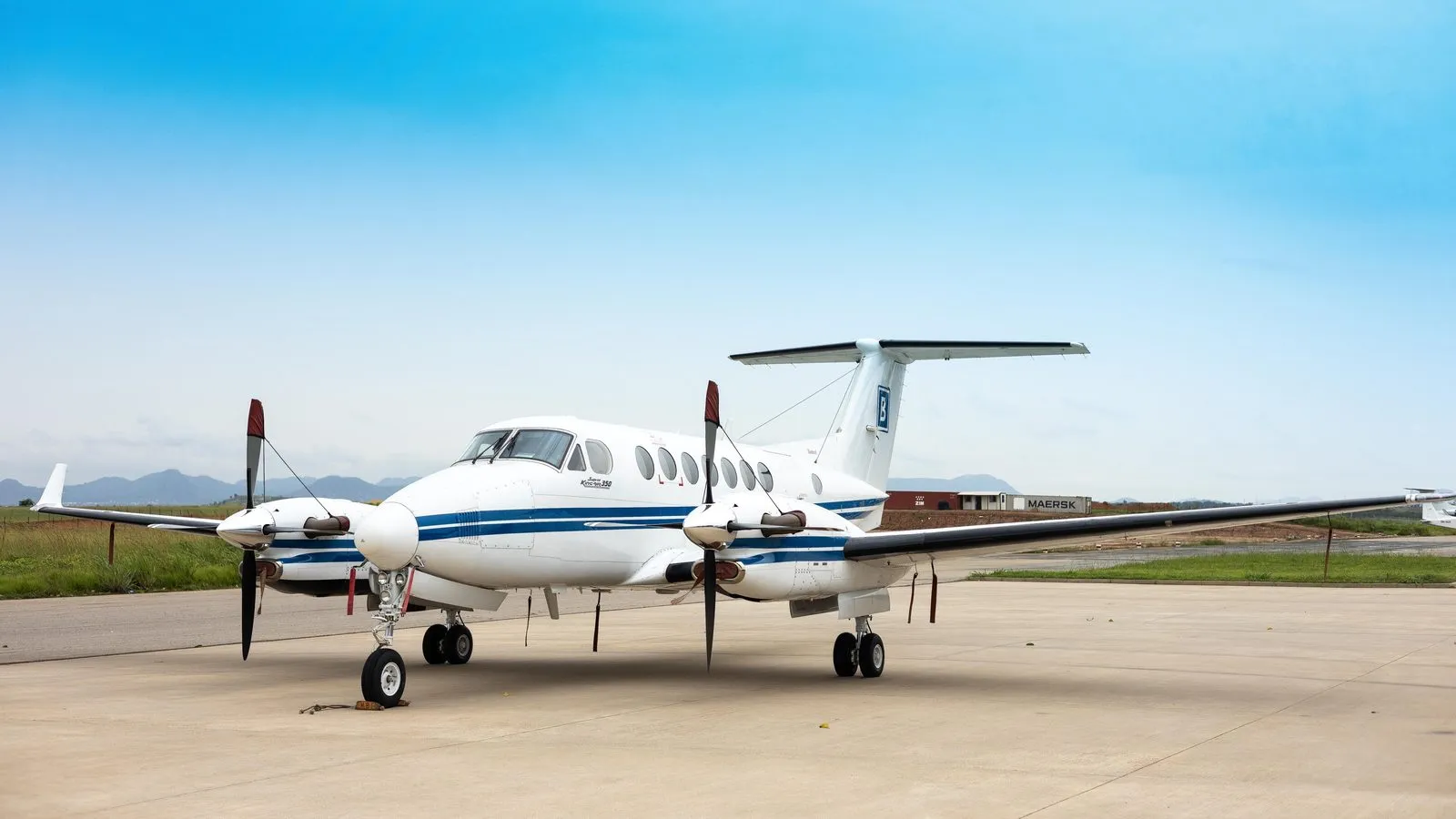
Yes, a King Air 350 can be flown single pilot. The airplane is the Beechcraft Model B300 (and the closely related B300C), and its FAA type certificate data sheet gives the minimum crew as “One pilot.” Under Part 91, a flight department can fly it with one pilot. Under Part 135, a second pilot is required when the cabin has ten or more passenger seats, and on IFR passenger flights unless the operations specifications authorize the autopilot in place of a second in command. Either way, the pilot in command needs a type rating, the FAA’s BE-300, because the airplane weighs more than 12,500 lb.
What the type certificate says about the King Air 350
The B300 is on FAA Type Certificate Data Sheet A24CE, the same data sheet as the King Air 200 series and the 1900. The figures below are quoted from Revision 132 of that data sheet, dated August 21, 2026. Check the revision that applies to your serial number.
| Item | TCDS A24CE, Model B300 and B300C |
|---|---|
| Category | Commuter Category (B300 approved December 12, 1989; B300C September 7, 1990) |
| Engines | Two Pratt & Whitney Canada PT6A-60A turboprops |
| Maximum takeoff weight | 15,000 lb (ramp 15,100 lb, landing 15,000 lb, zero fuel 12,500 lb) |
| Minimum crew | “One pilot” |
| Seats | “Maximum 17 (including two crew at +129)” |
| Maximum operating altitude | 35,000 ft |
Some airplanes have been modified to higher weights. Notes 15 and 16 of the FAA data sheet list a 16,500 lb maximum takeoff weight (ramp 16,600 lb, landing 15,675 lb) for B300 and B300C airplanes modified for increased weights, and Note 17 covers airplanes built or modified with PT6A-67A engines. Your airplane’s flight manual and airworthiness certificate decide which numbers are yours.
Does the King Air 350 need a type rating?
Yes. 14 CFR 61.31(a) says a person who acts as pilot in command of a “large aircraft” must hold a type rating for it, and 14 CFR 1.1 defines a large aircraft as one “of more than 12,500 pounds, maximum certificated takeoff weight.” At 15,000 lb, the B300 is over the line. It is a turboprop, so the weight alone brings in the rating.
The FAA’s table of pilot type designations in Order 8900.1, Volume 5, Chapter 2, Section 19 (Figure 5-88) lists models “300, 300LW, B300, B300C” under the type rating designation BE-300. The table tells you to compare the model in Block 2 of the airworthiness certificate with its model column, and a note beside the entry says the serial number decides whether BE-200 or BE-300 applies, so check the certificate rather than the marketing name. One rating covers the whole 300 series, so a pilot rated in an older 300 can fly a newer B300 on the same rating.
Because the B300 is certified for one pilot and isn’t turbojet-powered, the pilot-in-command proficiency check in 61.58 doesn’t apply to it under Part 91. That rule covers aircraft “type certificated for more than one required pilot flight crewmember or … turbojet-powered.” Your insurer or training policy may still require recurrent training, and Part 135 has its own checks.
Can a King Air 350 be flown single-pilot under Part 91?
Yes. 14 CFR 91.531(a) requires a second in command in “any large airplane” and “any commuter category airplane,” and the B300 is both. But 91.531(b)(1) lets you operate “any airplane certificated for operation with one pilot” without one. The TCDS line “Minimum Crew: One pilot” is that certification.
When does Part 135 require a second pilot?
Four rules decide it:
| Rule | What it says | What it means for a B300 |
|---|---|---|
| 135.99(a) | No less than the minimum crew in the operating limitations or flight manual | One pilot is the floor |
| 135.99(b) | A second in command if the aircraft “has a passenger seating configuration, excluding any pilot seat, of ten seats or more” | A cabin with 10 or more passenger seats always needs two pilots |
| 135.101 | No passengers under IFR without a second in command, “except as provided in § 135.105” | IFR passenger flights need two pilots unless 135.105 applies |
| 135.105 | No second in command needed if the aircraft has “an operative approved autopilot system” and its use is authorized by operations specifications | Single-pilot IFR is possible with the autopilot authorization, but not when 135.99 requires two pilots |
135.105 opens with “Except as provided in §§ 135.99 and 135.111,” so the autopilot authorization never removes the ten-seat requirement or the second pilot needed for Category II operations under 135.111. The autopilot also has to work. An inoperative autopilot on a single-pilot IFR passenger trip turns it into a two-pilot trip.
How do you decide: one pilot or two?
Ask these in order for each airplane and each kind of trip.
- How many passenger seats are in the cabin? The TCDS allows up to 17 seats including two crew seats. Its Note 7 mentions an eight-seat “double club cabin arrangement” and “optional passenger seating of 10 or more.” Under Part 135, ten or more passenger seats means two pilots on every flight (135.99(b)) and an airline transport pilot certificate for the captain (135.243(a)(1)). Confirm how your configuration is listed with your principal operations inspector.
- Is it a Part 135 passenger flight under IFR? Then two pilots, unless your operations specifications authorize the autopilot under 135.105 and the autopilot works.
- Does the trip involve Category II? Two pilots under 135.111.
- What does the flight department or insurer require? Under Part 91 the rules allow one pilot. A department can set its own policy by trip type: passengers aboard, night, weather, a new airport, or a pilot with low time in type. Write the policy down so the scheduler can apply it without a phone call.
- Does the flight time fit one pilot? Under Part 135, unscheduled one-pilot crews are limited to 8 hours of flight time in 24 consecutive hours, and two-pilot crews to 10 (135.267(b)). A long day can require two pilots even when nothing else does.
When a second pilot flies on a Part 135 trip that requires one, that pilot needs the second-in-command qualifications in 61.55 and Part 135’s own training and checks (135.245 and subparts G and H). A second pilot who rides along where no rule requires one doesn’t fill a required seat. A Part 135 operator can let that pilot log the time only through an approved second-in-command professional development program under 135.99(c).
Pilot qualifications for King Air 350 charter
For the pilot in command on a Part 135 flight in a B300, 135.243 sets the minimum:
| Operation | Pilot in command needs | Rule |
|---|---|---|
| 10 or more passenger seats, or a commuter operation (scheduled flying) in this multiengine airplane | An airline transport pilot certificate with the type rating | 135.243(a)(1) |
| IFR, fewer than 10 passenger seats | At least a commercial certificate with the type rating, an instrument rating, and 1,200 hours including 500 cross-country, 100 night and 75 instrument, at least 50 of them in actual flight | 135.243(c) |
| VFR only | At least a commercial certificate with the type rating, 500 hours including 100 cross-country and 25 at night, and an instrument rating or an ATP certificate | 135.243(b) |
135.105 adds one requirement for commuter operations as defined in Part 119: a pilot in command flying under the autopilot authorization needs at least 100 hours as pilot in command in the make and model. On-demand charter isn’t a commuter operation, so this applies only if you fly the airplane on a published schedule.
Duty and rest on typical King Air trips
Part 91 sets no duty or rest limits for a flight department, so your company policy is the rule; Part 91 duty time limits covers how departments set one. Under Part 135, 135.267 applies, and our Part 135 duty time limits guide walks through tracks (b) and (c). Fractional programs use Part 91K’s duty and rest rules.
Short legs can mean little flight time inside a long duty day. Three illustrative trip shapes, made up for this guide:
| Shape | Example day | What to watch |
|---|---|---|
| Out and back with a wait | Depart 0700, one leg of about 1.5 hours, wait 7 hours, return | About 3 hours of flight time, but a duty day of 11 hours or more once preflight and post-flight are added |
| Regional multi-stop | Four legs of 40 to 90 minutes to smaller fields, crew overnights at the last stop | Four approaches, possibly single-pilot; the overnight rest starts after the last post-flight duties |
| Charter with positioning | Position empty to pick up passengers, fly two passenger legs, position home | Positioning legs add flight time and duty; the 135.267 caps count all commercial flying, so confirm how your operator counts them |
On the single-pilot charter shape, plan around the 8-hour flight time cap. If the day can’t fit in 8 hours, staff the second pilot before the trip is sold.
Short fields, weather and the release
If your King Air trips include shorter runways and smaller airports, put runway performance at the top of the risk list.
Under Part 135, the B300 is a commuter category airplane, and 135.398 applies to it. That rule requires compliance with the flight manual’s takeoff weight limits and a net takeoff flight path that clears obstacles. Paragraph (c) also says the landing limits in 135.385 and 135.387 “are applicable to all commuter category airplanes notwithstanding their stated applicability to turbine-engine-powered large transport category airplanes.” Those limits work out as follows:
| Airport | Full stop within | Rule |
|---|---|---|
| Destination | 60 percent of the effective runway length, at the expected arrival weight | 135.385(b) |
| Destination, turboprop that can’t meet 60 percent on the runway the expected wind favors | Allowed if an alternate is selected that meets the section with a 70 percent factor | 135.385(c) |
| Alternate | 70 percent of the runway for a turboprop | 135.387(a) |
| Eligible on-demand operators with an approved destination airport analysis and operations specifications | 80 percent | 135.385(f), 135.387(b) |
A Part 91 department flies to the flight manual’s numbers and its own policy, which can add its own runway margins. Under either part, write these into your risk assessment as questions with clear answers. Some examples to adapt (a flight risk assessment tool explains how to score them):
- Does the landing distance at the expected arrival weight fit within the required runway factor, on the runway the wind will give you?
- Is the runway forecast wet or contaminated at arrival?
- Is the field uncontrolled, unlit, or without an instrument approach?
- Is this a single-pilot IFR trip into weather near minimums?
- Has the pilot flown into this airport before?
- Is icing forecast on the route? The TCDS gives ice protection compliance only “when ice protection equipment is installed in accordance with the Equipment List.”
What to record per trip for costs
Record your own costs rather than planning with someone else’s per-hour figure. For each King Air trip, capture these categories (what a trip really costs goes deeper):
- Fuel per leg: gallons and price, by the vendor at each stop.
- Fees: landing, handling, ramp and parking at each airport, plus any hangar for an overnight.
- Crew: hotel, meals and per diem, and if you add a second pilot, that pilot’s day rate or salary share and travel.
- Positioning legs: the empty legs before and after the passengers, which a charter quote has to cover.
- Reserves: your own per-hour allowance for maintenance and engines, set with your shop.
Choosing one pilot or two also sets part of the cost. A second pilot adds a day rate, a hotel room and meals on every overnight, so a trip that legally needs two pilots costs more than one that doesn’t, and the quote should show it. See how to price a charter trip for building quotes that include crew and positioning.
Maintenance: what the schedule needs to know
Your shop or a maintenance tracking service does the maintenance work. The scheduler needs to keep the airplane off trips it can’t fly. That means knowing what comes due by date, by hours and by cycles, and short regional legs add cycles faster than hours. It also means knowing about any open defect that grounds the airplane or limits the trip, such as an inoperative autopilot before a single-pilot IFR charter.
What changes when a King Air 350 goes on a Part 135 certificate
If a department’s B300 starts flying charter, the same airplane picks up different rules:
| Topic | Part 91 department | Part 135 charter |
|---|---|---|
| Second pilot | Not required (91.531(b)(1)); company policy | Required at 10+ passenger seats, under IFR unless 135.105 applies, and in Category II |
| Captain’s certificate | A pilot certificate with the BE-300 type rating, as the operation allows | ATP at 10+ seats or in commuter operations; otherwise commercial with the 135.243 hours |
| Duty and rest | Company policy | 135.267 limits, including 8 hours of flight time for one pilot and 10 for two |
| Runway | Flight manual and policy | 135.398, with the 135.385 and 135.387 landing factors |
| Inoperative equipment | 91.213 with an MEL (91.213(d) excludes turbine-powered airplanes) | 135.179 with an MEL in the operations specifications |
Running a King Air 350 in Avion Desk
In Avion Desk, each pilot’s certificates and training are kept per person, most urgent first. Every save of a trip is checked, and seating a pilot who isn’t qualified on the airplane is flagged. Duty and rest are checked whenever the schedule moves, against your Part 91 policy, or against 135.267 on the plan for charter operators. A trip is released only after its checks, the aircraft’s state and a risk assessment pass, and you write the risk questions yourself, so your runway and single-pilot questions go into every release. Fuel per leg and each trip’s expenses roll up into what the trip cost. Your free trial runs on the plan you pick, so a charter operator can try the Part 135 checks from the first day. To try it, start a free trial and add your King Air 350 with its crew and next week’s trips, or request a demo.
Frequently asked questions
Is the King Air 350 a single-pilot airplane?
Yes. FAA TCDS A24CE lists the B300’s minimum crew as “One pilot,” and 91.531(b)(1) lets you fly it without a second in command under Part 91. Under Part 135, 135.99, 135.101 and 135.105 can still require two pilots.
What type rating does a King Air 350 need?
BE-300. FAA Order 8900.1’s type designation table lists models 300, 300LW, B300 and B300C under it. The rating is required because the airplane weighs more than 12,500 lb (61.31(a)).
Can a King Air 350 fly Part 135 IFR with one pilot?
Yes, if it has fewer than 10 passenger seats, an operative approved autopilot, and operations specifications that authorize its use in place of a second in command (135.105). Ten or more passenger seats, or a Category II operation, always need two pilots.
How many passengers can a King Air 350 carry?
The TCDS allows a maximum of 17 seats including two crew seats, so up to 15 passenger seats. Your airplane’s installed configuration and its flight manual’s loading instructions decide the real number.
Does the King Air 350 count as a large aircraft?
Yes. Its 15,000 lb maximum takeoff weight is over the 12,500 lb line in 14 CFR 1.1, which brings in the type rating. It is also a commuter category airplane, which brings in the Part 135 runway rules in 135.398.
This article explains the rules in plain language and isn’t legal advice; the regulation text governs.