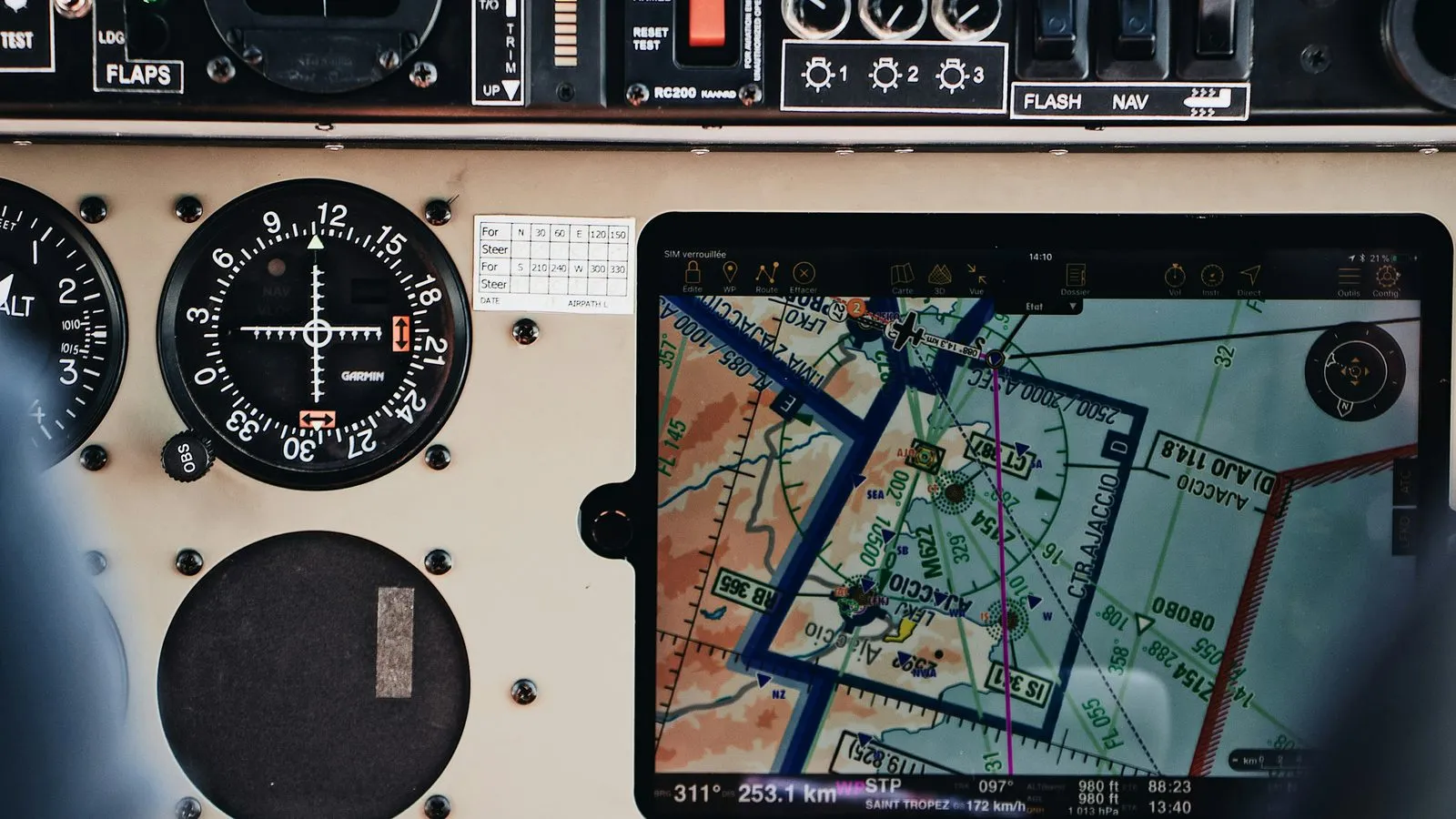
To fly IFR using VOR navigation, your aircraft’s VOR equipment must have been operationally checked within the preceding 30 days and found within limits, unless it is maintained, checked and inspected under an approved procedure (14 CFR 91.171(a)). The allowed error is ±4° for a VOT, a repair station test signal or a ground checkpoint, ±6° for an airborne checkpoint or an airway check, and 4° between the two receivers on a dual VOR check. The person who does the check logs the date, place and bearing error and signs the aircraft log or other record (91.171(d)).
You can download a free CSV log template to print or open in a spreadsheet.
What does 14 CFR 91.171 require?
The rule starts with a condition. Section 91.171(a) says no person may operate a civil aircraft under IFR “using the VOR system of radio navigation” unless the VOR equipment either:
 Photo: MKFI (public domain), via Wikimedia Commons
- “Is maintained, checked, and inspected under an approved procedure,” or
- “Has been operationally checked within the preceding 30 days, and was found to be within the limits of the permissible indicated bearing error” set out in paragraphs (b) or (c).
The second path is the 30-day operational check that the crew does and logs. If your operation has an approved procedure that covers the VOR equipment, that procedure governs, and your director of maintenance or your operations manual will say so. If you’re not sure which applies to you, assume the 30-day check does.
The rule applies to civil aircraft under IFR regardless of operating part, so the 30-day check matters to a charter operator’s crews as much as to a corporate department’s.
What are the VOR check methods and tolerances?
Section 91.171(b) lists four methods in order, and 91.171(c) adds the dual VOR check.
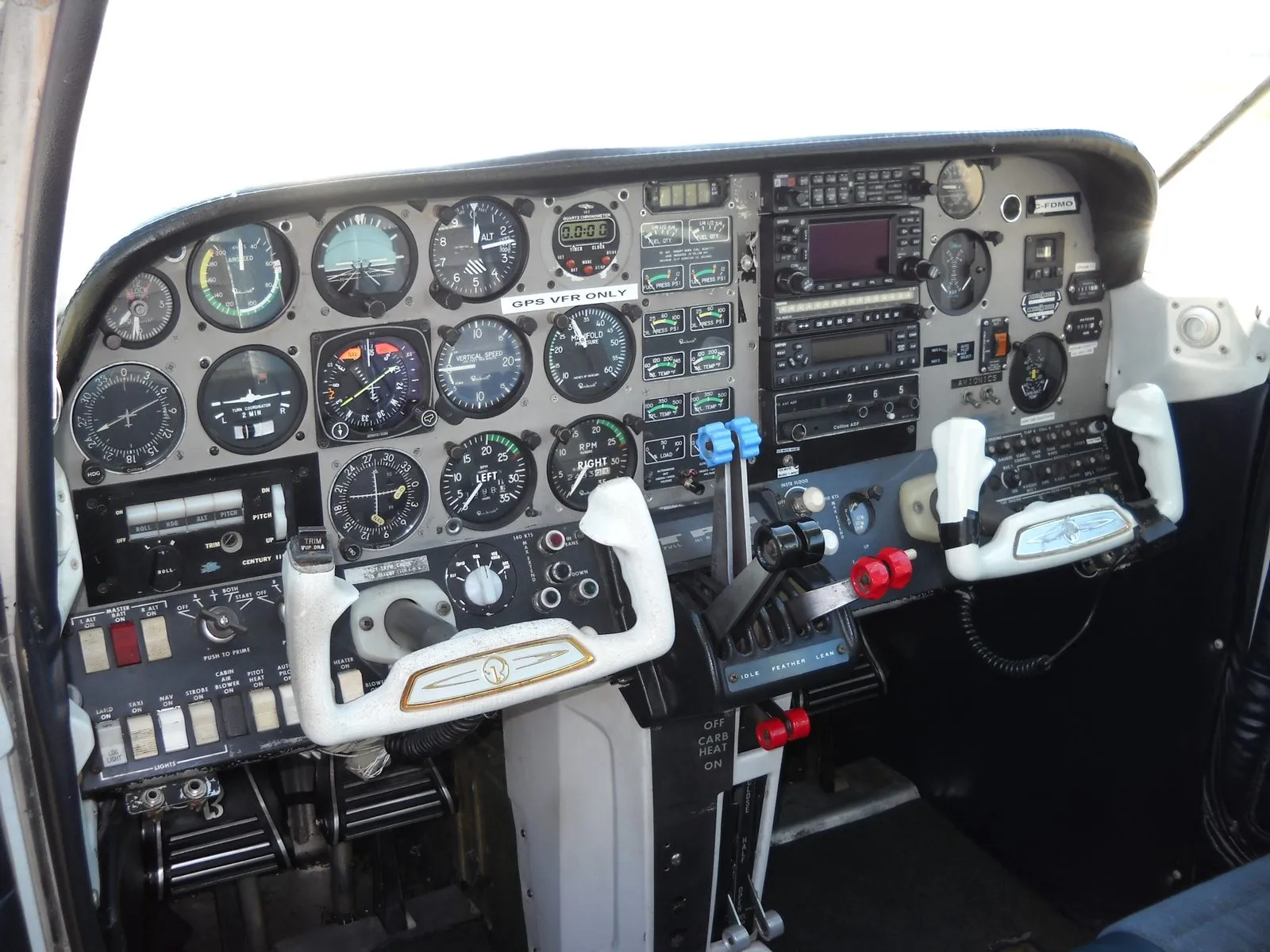 Photo: Ahunt (public domain), via Wikimedia Commons
| Method | Where it’s done | Maximum error | Rule | When you may use it |
|---|---|---|---|---|
| VOT (FAA-operated or approved test signal) | At the airport of intended departure | ±4° | 91.171(b)(1) | Any time one is available |
| Repair station test signal | At the airport of intended departure | ±4° | 91.171(b)(1) | Any time; the repair station must also make a log entry |
| Designated ground checkpoint | A point on the airport surface at the airport of intended departure | ±4° | 91.171(b)(2) | Any time one is available |
| Designated airborne checkpoint | In flight, over the designated point | ±6° | 91.171(b)(3) | Only if neither a test signal nor a surface checkpoint is available |
| Airway check (self-selected point) | In flight, over a prominent ground point on a VOR airway radial | 6° | 91.171(b)(4) | Only if no check signal or checkpoint is available |
| Dual VOR check | Anywhere both receivers can tune the same VOR | 4° between the two systems | 91.171(c) | Only with two systems independent of each other except for the antenna |
Outside the United States, the regulation accepts test signals and checkpoints “operated or approved by an appropriate authority” in place of FAA ones.
How to do a VOT check
A VOT transmits a test signal for checking a receiver on the ground at the airport where the VOT is located. The Aeronautical Information Manual, 1-1-4 gives the procedure:
- Tune the VOT frequency on the VOR receiver and identify it. The AIM says the VOT identifier is either a series of dots or a continuous tone.
- Center the course deviation indicator (CDI) with the omni-bearing selector (OBS).
- The OBS should read 0° with a FROM indication, or 180° with a TO indication. An RMI driven by that receiver should point to 180° whatever the OBS setting.
- Note the difference between what you read and 0° (or 180°). That difference is the bearing error. It must be within ±4°.
The AIM also says airborne use of a VOT is permitted only in the areas and altitudes the Chart Supplement specifically authorizes.
How to check against a repair station test signal
Some radio repair stations can radiate a test signal, normally on 108.0 MHz according to the AIM. They don’t transmit it continuously, so you have to arrange it with the station, and not every station offers the service. Confirm which radial is being transmitted and whether you should see TO or FROM before you read the needle.
This method carries an extra logging duty. Under 91.171(d), the repair station certificate holder or its representative must make an entry in the aircraft log or other record certifying the bearing transmitted and the date of transmission. Your own entry for the check is still required too.
How to use a ground checkpoint
A ground checkpoint is a designated spot on the airport surface where the aircraft should receive a published radial from a nearby VOR. Taxi to the spot, tune and identify the VOR, center the CDI and compare your reading with the published radial. The error must be within ±4°. Checkpoint locations, like VOTs and airborne checkpoints, are listed in the Chart Supplement (AIM 1-1-4).
How to use an airborne checkpoint
An airborne checkpoint is a published radial over a specific landmark near the airport. Fly over the landmark, center the CDI and compare. The limit is ±6°. The regulation only allows this method “if neither a test signal nor a designated checkpoint on the surface is available.”
How to do an airway check
When nothing published is available, 91.171(b)(4) lets you make your own check in flight:
- Select a VOR radial that lies along the centerline of an established VOR airway.
- Select a prominent ground point along that radial, preferably more than 20 nautical miles from the VOR.
- Fly directly over the point at a reasonably low altitude.
- Note the bearing the receiver indicates over the point. The maximum variation from the published radial is 6°.
This is the last-resort method. It takes planning and some flight time, so it rarely makes sense when a VOT or a checkpoint is at your departure airport.
How to do a dual VOR check
If the aircraft has two VOR systems that are independent of each other except for the antenna, you may check one against the other instead of using any of the methods in paragraph (b). Tune both systems to the same VOR ground facility, note the indicated bearing to the station on each, and compare. The two readings may differ by no more than 4° (91.171(c)).
It’s convenient because it can be done anywhere both receivers can tune the same station. It proves only that the two systems agree with each other. It doesn’t compare either one against a known signal.
What must a VOR check log entry include?
Section 91.171(d) says each person making the check “shall enter the date, place, bearing error, and sign the aircraft log or other record.” That is four items:
| Required item | What to write |
|---|---|
| Date | The day the check was made |
| Place | The airport, checkpoint or ground point where it was made |
| Bearing error | The error you found (for a dual check, the variation between the two systems) |
| Signature | The signature of the person who made the check |
Add the repair station’s entry when you use its test signal: the certified bearing transmitted and the date of transmission, made by the certificate holder or its representative.
The rule says “aircraft log or other record,” so it doesn’t require a particular book or form. A page in the aircraft’s flight log, a dedicated VOR check log or an electronic record can all serve, as long as the four items are there and the entry is signed by the person who made the check.
Useful extras beyond the rule
The regulation sets the minimum. A log that is easier to audit usually also records:
- The aircraft, if one log covers more than one airframe
- The check method (VOT, ground checkpoint, dual, and so on)
- The facility or checkpoint used and its frequency
- The published or test bearing and what each system read
- The tolerance that applied, so a reviewer can see the result passed without looking it up
- The printed name of the person who signed
- The date the next check is due
Download the VOR check log template
The VOR check log template (CSV) has a column for each item 91.171(d) requires plus the extras above, including the repair station fields. Open it in any spreadsheet, delete the two example rows (both fictional), and print it or keep it as a file. Keep a signature column on any paper copy, since the rule requires the entry to be signed. The example rows set the recheck date a couple of days inside the 30 so that a check doesn’t expire between when you plan a trip and when it departs.
How often is a VOR check required?
Within the preceding 30 days of the IFR operation that uses VOR navigation (91.171(a)(2)). You meet it at the time of the flight, and the 30 days don’t round to the end of a calendar month. A check done 31 days before departure doesn’t cover that flight.
The AIM adds a separate recommendation: have the receiver calibrated by an authorized repair facility to the manufacturer’s specifications at yearly intervals. Its reasoning is that a deteriorating receiver can read accurately close to a VOR or VOT and drift out of tolerance farther out where the signal is weaker. That yearly calibration is guidance, not part of 91.171, and it doesn’t replace the 30-day check.
What if the VOR check is out of tolerance?
Then the aircraft may not be operated under IFR using VOR navigation until the problem is fixed. The AIM says that if the error is more than ±4° on a ground check or ±6° on an airborne check, “IFR flight must not be attempted without first correcting the source of the error.”
Before you write the receiver up, rule out the easy causes. The AIM notes that certain propeller RPM settings or helicopter rotor speeds can make the CDI fluctuate as much as ±6°, and that slight RPM changes usually smooth it out. Also make sure you identified the right station or test signal. A VOR under maintenance may transmit a T-E-S-T identifier or none at all.
If the receiver really is out of limits, treat it like any other inoperative or out-of-tolerance equipment. Our guide to inoperative equipment under 91.213 covers how that decision usually goes.
Common VOR check mistakes
Each of these comes straight from the wording of the rule or the AIM.
- Leaving out the place. Date, bearing error and signature are there, but not where the check was made. The rule requires all four.
- No signature. A typed line in a shared spreadsheet with no signature, or initials that can’t be tied to a person, is a weak record. The rule says the person making the check signs.
- Counting from the wrong date. The 30 days run from the check, not from the last IFR flight or the end of the month.
- Using an airborne check when a ground check was available. The regulation sets an order: the ±6° airborne methods are only allowed when the ±4° methods aren’t available. A dual check is allowed in place of all of them.
- Using a VOT or ground checkpoint at another airport. Paragraphs (b)(1) and (b)(2) say “at the airport of intended departure.”
- Using a VOT in the air where it isn’t authorized. Airborne VOT use is limited to the areas and altitudes the Chart Supplement authorizes.
- Applying your own correction. The AIM says no correction other than the manufacturer’s correction card figures should be applied.
- A dual check on systems that aren’t independent. Paragraph (c) requires units independent of each other except for the antenna. If yours share more than that, use another method.
- Forgetting the repair station’s entry. When you use a repair station’s test signal, its certificate holder or representative must certify the bearing transmitted and the date in the record.
- Logging the bearing instead of the error. “358” alone doesn’t say whether the test bearing was 360 or 180. Log the error (“−2°”) and, if you like, the reading next to it.
Does a GPS-equipped aircraft need a VOR check?
Read the condition in 91.171(a): the requirement applies when you operate under IFR “using the VOR system of radio navigation.” If a flight won’t use the VOR system, the 30-day check isn’t required for that flight. But many crews keep the check current anyway, because a GPS outage or an ILS or VOR approach at the destination can put the VOR back into use at short notice. The AIM’s section on the VOR Minimum Operational Network describes the VOR as the reversionary service the FAA keeps for exactly that case.
For departments that track this alongside the rest of the aircraft’s records, see our aircraft maintenance tracking guide and the broader aircraft management software checklist.
Keeping these records in Avion Desk
Avion Desk records each aircraft’s VOR checks against 14 CFR 91.171. See how it works on the aircraft features page. To try it, start a free trial and log your next VOR check in it, or book a demo.
Frequently asked questions
How often do you need a VOR check?
Within the preceding 30 days of an IFR flight that uses VOR navigation, unless the equipment is maintained, checked and inspected under an approved procedure (91.171(a)).
What is the tolerance for a VOT check?
Plus or minus 4°. With the CDI centered, the OBS should read 0° FROM or 180° TO; the difference is your bearing error (91.171(b)(1), AIM 1-1-4).
What do you write in the VOR check log?
The date, the place, the bearing error and the signature of the person who made the check, in the aircraft log or other record. If you used a repair station’s test signal, the station also enters the bearing it transmitted and the date (91.171(d)).
Can you check one VOR against the other?
Yes, if the two systems are independent of each other except for the antenna. Tune both to the same VOR, compare the indicated bearings to the station, and they may differ by no more than 4° (91.171(c)).
Where do you find VOT frequencies and VOR checkpoints?
In the Chart Supplement, which lists VOTs, ground checkpoints and airborne checkpoints (AIM 1-1-4).
This article explains the rules in plain language and isn’t legal advice; the regulation text governs.